

Close Menu

    Subscribe to Updates

    Get the latest news information from worldwide businesses.

    What's Hot

    Why Ankur Warikoo Has Stuck to a Routine He ‘Nearly Hates’ for the Last 4 Years

    July 8, 2026

    Ancient DNA reveals the mysterious collapse of Europe’s megalith builders

    July 8, 2026

    Assam records highest cancer survival rate, Assembly told

    July 8, 2026
    Facebook Instagram YouTube LinkedIn X (Twitter)
    Trending
    • Why Ankur Warikoo Has Stuck to a Routine He ‘Nearly Hates’ for the Last 4 Years
    • Ancient DNA reveals the mysterious collapse of Europe’s megalith builders
    • Assam records highest cancer survival rate, Assembly told
    • Forensic medicine HoD at SMS Medical College found hanging, investigation launched
    • The robotaxi law that could ban Tesla
    • India’s auto parts exports to US remain strong despite tariff tensions
    • India silver import curbs create shortages, push premiums to six-month high
    • As a once-hot stock market tumbles into bear territory, this Wall Street bull says it’s time to buy the dip
    Newspublicly
    • About Us
    • Advertise & Partner with us
    • Pitch Your Story
    • Contact Us
    Facebook Instagram LinkedIn X (Twitter)
    Subscribe
    • Home
    • World News
      • Asia
      • India
      • USA
      • UK & Europe
      • Middle East
    • Economy & Business
      • Global Economy
      • Corporate & Industry
      • Finance & Markets
      • Policy & Trade
    • Technology
      • Gadgets & Devices
      • Software & Apps
      • AI & Machine Learning
      • Robotics & Automation
    • Health & Medicine
      • Fitness & Nutrition
      • Research & Innovation
      • Disease & Treatment
      • Doctors, Clinics & Patient Care
    • Travel & Tourism
    • Automobile
      • Electric & Hybrid Vehicles
      • Auto Industry Insights
    • Sports
    • More
      • Education
      • Real Estate
      • Environment & Climate
      • Space & Astronomy
      • War & Conflicts
    Newspublicly
    Home»More»Space & Astronomy»Earth may survive the sun’s death after all, new study suggests
    Space & Astronomy

    Earth may survive the sun’s death after all, new study suggests

    AdminBy AdminJuly 8, 2026No Comments5 Mins Read0 Views
    Share
    Facebook Twitter LinkedIn Copy Link WhatsApp


    For decades, astronomers have debated whether Earth’s fate was tied to the sun’s. When the star exhausts the hydrogen fuel that powers it about 5 billion years, it will swell into a red giant large enough to engulf Mercury and Venus — and, several studies have suggested, Earth as well.

    New research, however, suggests our planet has a better chance of escaping that fiery end than previously thought. Using updated models of how aging stars interact with their planets, researchers found that the gravitational forces drawing Earth toward the expanding sun are weaker than older models predicted. That would give the planet more time to drift outward as the dying sun sheds its outer layers into space, potentially avoiding engulfment altogether.

    The finding does not guarantee Earth’s survival. Instead, researchers say it shifts the biggest uncertainty from how strongly the expanding sun tugs on planets to the poorly understood variable of how much mass the star will lose during its final stages of evolution.

    “The largest uncertainty no longer comes from the tidal calculations, but from how much mass the future sun will lose,” study lead author Mats Esseldeurs of the KU Leuven’s Institute of Astronomy in Belgium said in a statement. “Observations of sun-like giant stars currently point towards Earth’s survival, but we need better observations before we can be certain.”

    When stars like the sun exhaust their core hydrogen and balloon into massive red giants, they trigger a cosmic tug-of-war between expanding tidal forces pulling planets inward and shedding stellar weight pushing them outward, which ultimately decides whether nearby worlds are engulfed or saved.


    You may like

    This planetary push-and-pull unfolds in two stages. As the sun expands, gravitational tides act like a subtle brake, slowly draining Earth’s orbital energy and pulling the planet inward. At the same time, the dying star sheds vast amounts of gas through powerful stellar winds, eventually losing about half its mass. As the sun grows lighter, its gravitational grip weakens, pushing the surviving planets outward into a wider orbit that could double their distance from the star, according to NASA.

    “The fate of Earth depends on a delicate balance between these two effects,” Esseldeurs said in the statement. “If tidal interactions dominate, Earth is engulfed. If mass loss dominates, Earth escapes to a wider orbit.”

    Space

    Previous studies reached different conclusions mostly because they treated those competing processes differently, Esseldeurs and his team argue. A few of those studies neglected tidal interactions altogether, while others relied on simplified prescriptions developed decades ago that predicted a much stronger inward pull, according to the study.

    Instead of relying on those older formulas, the new study uses updated calculations of tidal forces based on the shifting internal structure and dynamics of aging stars — which the team says allowed it to precisely account for both tidal friction and shifting stellar winds — before testing the results against a range of possible mass-loss rates for the sun’s final giant phase.

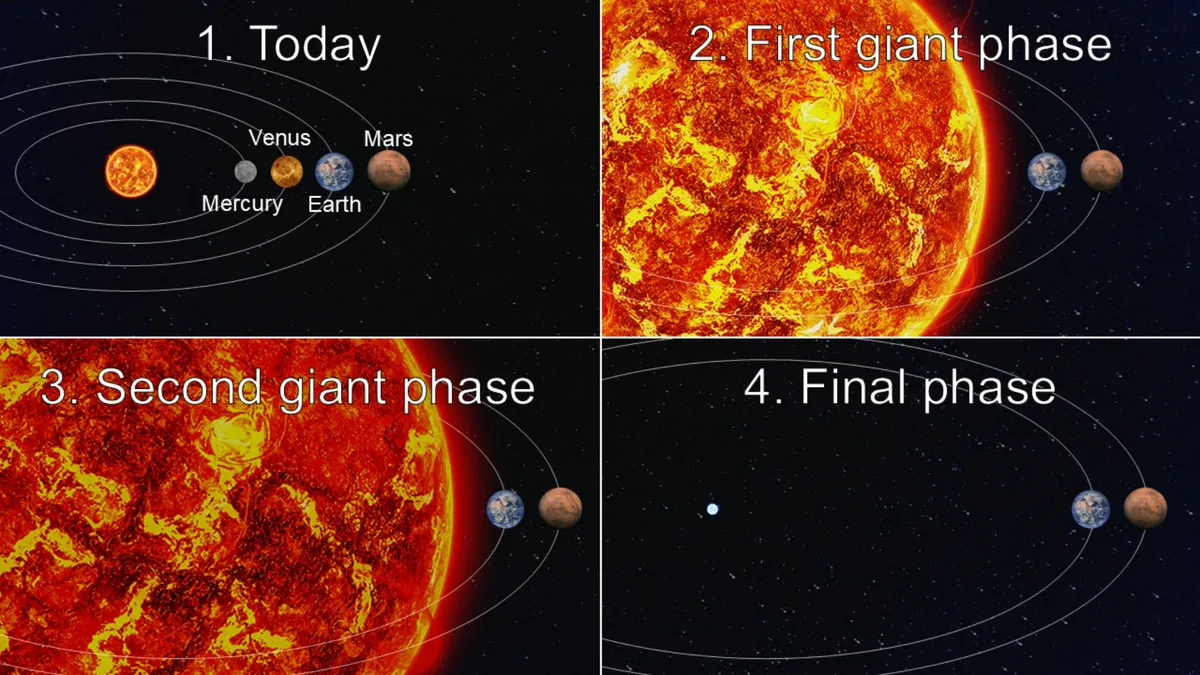
    The results suggest that even with the weaker inward gravitational pull, Mercury and Venus are unable to outpace the expanding sun and are inevitably engulfed, while Earth and Mars migrate safely through both giant phases, leaving our planet to eventually settle into a broader orbit around the white dwarf remnant the sun will leave behind, the study found.

    What to read next

    A diagram showing what the phases of the sun dying are.

    A schematic evolution of the sun as it goes through its giant phases. The image showed the sun as it is today, going through its two giant phases, before ending its life as a white dwarf. The study showed that Mercury and Venus will be engulfed by the expanding sun, but Earth and Mars survive, ending up in a wider orbit. Sizes and distances are not to scale. (Image credit: Institute of Astronomy of KU Leuven)

    The picture is far from settled, however. Because astronomers still cannot precisely observe how rapidly sun-like stars lose mass late in life, “the ultimate fate of the Earth remains uncertain,” the researchers write in the new paper.

    By factoring in real-world mass-loss rates from L2 Pup — a red giant star roughly 183 light-years away that was used as a proxy for our future sun due to its similar mass — the researchers confirmed that Earth will drift outward just quickly enough to avoid being swallowed, tipping the scales toward survival over destruction, the study notes.

    For us humans, the finding offers academic comfort rather than practical salvation. Most scientists agree that as the sun ages, it will steadily grow hotter, boiling Earth’s oceans and rendering the planet completely uninhabitable in about 1 billion years, long before the sun begins to expand.

    Yet even if humans aren’t around to witness it, tracking Earth’s ultimate survival provides important context for how planetary systems evolve as their stars age, a framework that researchers say will be further refined by future observations of dying, sun-like stars.

    “This will enable us to conduct population studies of the planetary orbital evolution around evolved stars,” the researchers wrote in the paper, “and help us to constrain the future evolution of the Earth-sun system.”

    The study was published in June in the journal Astronomy & Astrophysics.


    Source link

    Author

    • Admin

      NewsPublicly.com is News & Articles Platform that creating SEO-focused articles on travel, lifestyle, and digital trends.

    Admin
    • Website

    NewsPublicly.com is News & Articles Platform that creating SEO-focused articles on travel, lifestyle, and digital trends.

    Related Posts

    Our Milky Way galaxy might be larger than we thought  

    July 7, 2026

    James Webb Space Telescope celebrates its 4th birthday with stunning image of a galaxy crash site

    July 7, 2026

    ‘Project Hail Mary’ is finally streaming Amazon Prime Video, and we can’t wait to watch it again

    July 7, 2026
    Leave A Reply Cancel Reply

    Demo
    Top Posts

    The Blue Moon rises on May 30— Where and when to see the second full moon of the month

    May 30, 202640 Views

    New SOCOM rifle allows barrel swapping and cartridge changes

    June 1, 202633 Views

    “Inside Gemini Robotics 1.5: How Robots Learn to Reason & Act

    November 22, 202525 Views

    525 pounds of cocaine seized after Nebraska K9 alerts troopers on I-80

    May 28, 202624 Views
    Don't Miss

    Why Ankur Warikoo Has Stuck to a Routine He ‘Nearly Hates’ for the Last 4 Years

    July 8, 20263 Mins Read0 Views

    3 min readNew DelhiJul 8, 2026 05:00 PM IST Entrepreneur Ankur Warikoo, 45, recently shared…

    Ancient DNA reveals the mysterious collapse of Europe’s megalith builders

    July 8, 2026

    Assam records highest cancer survival rate, Assembly told

    July 8, 2026

    Forensic medicine HoD at SMS Medical College found hanging, investigation launched

    July 8, 2026
    Stay In Touch
    • Facebook
    • Twitter
    • Instagram
    • YouTube
    • LinkedIn
    • WhatsApp

    Subscribe to Updates

    Get the latest creative news from SmartMag about art & design.

    Demo
    NEWSPUBLICLY
    Facebook X (Twitter) Instagram LinkedIn

    Home

    • About Us
    • Leadership
    • Advertise & Partner With Us
    • Pitch Your Story
    • Media Kit & Pricing
    • Career
    • FAQs

    Guidelines

    • Editorial & Submission
    • Partnership
    • Advertising & Sponsor
    • Intellectual Property Policy
    • Community & Comment
    • Security & Data Protection
    • Send Your Opinion

    Quick Links

    • Cookie Policy
    • Payment & Billing Terms
    • Refund & Cancellation
    • Copyright Policy
    • Complaint & Support
    • Sitemap
    • Contact Us

    Subscribe Us

    Get the latest news and updates!

    Copyright © 2026 Newspublicly (DIGITALIX COMMUNICATION). All Rights Reserved.
    • Privacy Policy
    • Terms of Use
    • Disclaimer