

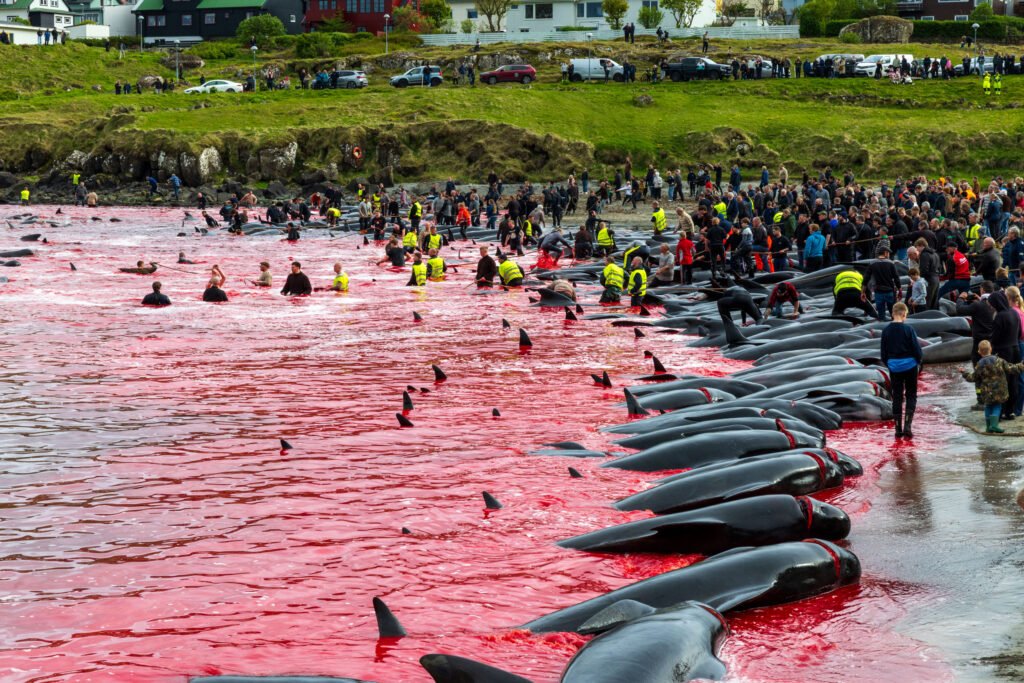
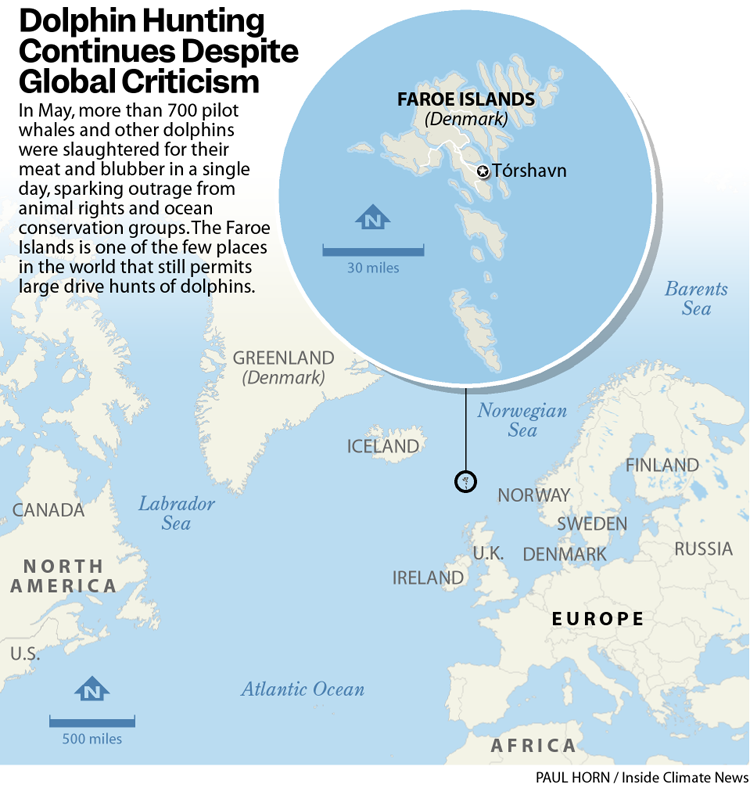
On May 27, a massive pod of more than 400 long-finned pilot whales was spotted off the coast of Tórshavn, the capital of the Faroe Islands—a remote archipelago located about 200 miles north of Scotland. By early evening, dozens of motorboats converged on the animals, forming a wide arc around them to block their escape as crews revved their engines and pounded on the hulls of their vessels, using the noise to drive the pod into a shallow bay.
Soon the animals became trapped, thrashing in just inches of water as several hundred people on shore, who had been waiting for this moment, rushed into the bay to kill them.
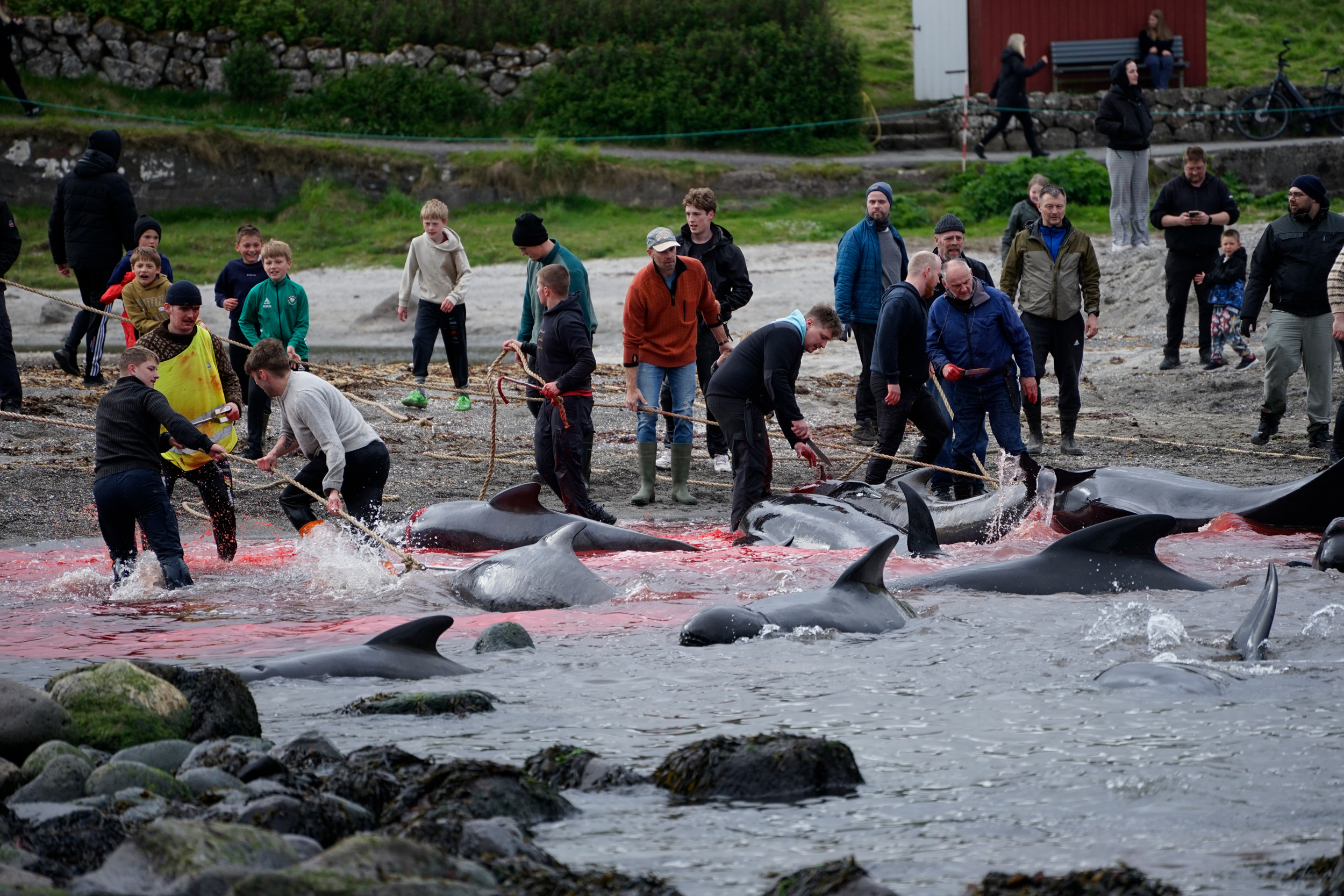
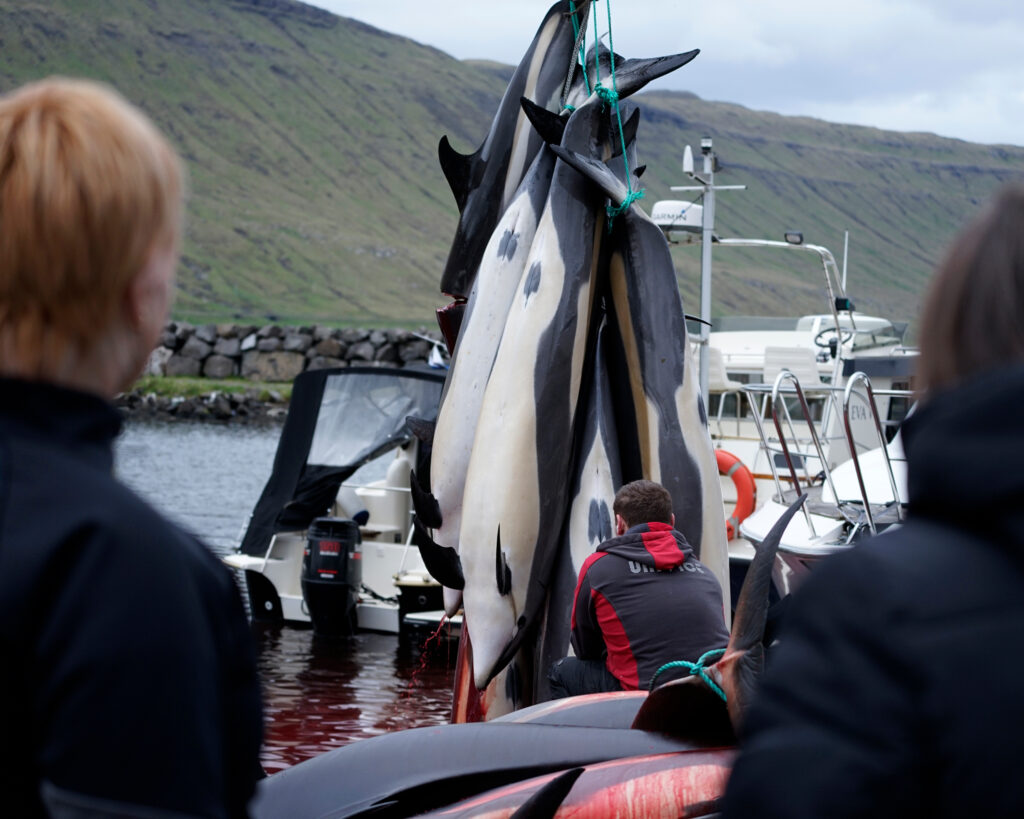
Some used spear-like instruments called spinal lances, specifically designed by a Faroese veterinarian to sever a pilot whale’s spinal cord and make for a quicker death. But not enough of the specialized tools were available to kill so many animals at once, said Karsten Michels, a volunteer photographer from Germany who documented the hunt for the international marine conservation organization Sea Shepherd and later recounted what he witnessed to Inside Climate News. Many of the pilot whales he saw killed were slaughtered with knives alone, he said.
As deep cuts were carved into their flesh, blood spilled into the bay. “The water was completely red,” Michels said. In just over an hour, the entire pod was dead. “The whole beach was full of whales.”
That same evening, two other large pods of Atlantic white-sided dolphins were killed in separate but similar hunts, bringing the day’s death toll to more than 700 animals—one of the deadliest days for pilot whales and dolphins in the Faroe Islands in recent years.
Two Sea Shepherd volunteers—not including Michels—were arrested by Faroese police and fined for disturbing one of the hunts while filming it.
For centuries, communities across the Faroe Islands have gathered to kill pilot whales—which, despite their name, are actually large dolphins—and other smaller cetaceans in public hunts known as the grindadráp, commonly referred to as “the grind.”
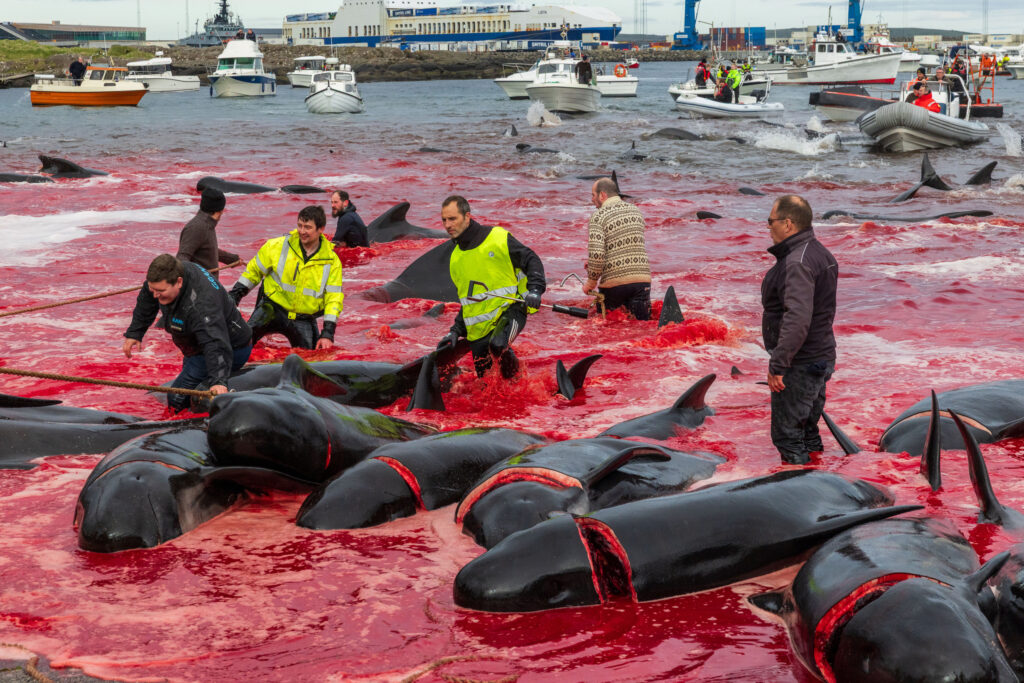
The opportunistic hunts take place whenever a pod is spotted close enough to shore to be driven into one of the island nation’s 23 bays designated for these events, though most occur during the summer months. After the kills, the dolphins are butchered for their meat and blubber, which is distributed to local residents.
Numerous animal rights and ocean conservation groups have criticized the hunts for decades, including Sea Shepherd, which has protested the grind since the 1980s.
“Our documentation shows hunts that are prolonged, chaotic and violent, where large family groups are driven into shallow water and killed under conditions that would be unacceptable for any other animal,” said Valentina Crast, who leads Sea Shepherd’s campaign against the grind, Operation Living Fjords.
Local Faroese health authorities have issued warnings for decades about the health risks associated with consuming pilot whale meat and blubber, which is known to contain high levels of mercury. Mercury has been linked to neurological disorders, cardiovascular disease, compromised immunity and increased risk of Parkinson’s disease. It can also affect fetal brain development and children’s immune systems, making it especially risky for pregnant women and children to eat pilot whale meat. Yet, despite these longstanding concerns, the grind is still fiercely defended by the Faroese government and many of its people as a practice deeply rooted in the islands’ history and culture that continues to sustain them.
“Pilot whale meat and blubber is a healthy and nourishing local source of food that has been a staple in the diet of Faroe Islanders for more than a millennium,” a spokesperson from the Faroe Islands’ Ministry of Foreign Affairs and Fisheries said in a statement provided to Inside Climate News.
Early records show dolphin hunts date back to at least 1584 in the Faroe Islands, though some historians believe they originated even earlier, during the Viking Age, when Norse settlers relied on eating the marine mammals on the remote North Atlantic islands.
But critics say what once served as a lifeline for isolated island communities has long outlived its original purpose.
“It’s just unnecessary,” said Jakub Pingley Mortensen, a Faroese resident who grew up participating in the grind with his family, but has since stopped. “There’s no good argument for killing whales,” he said.
The recent mass killing has become a rallying point for a growing international campaign to end the hunts called Stop the Grind. The coalition, led in part by Sea Shepherd, brings together dozens of animal protection and marine conservation groups, scientists, public figures and lawmakers working to end the hunts through public education, political advocacy and putting international pressure on the Faroese government to ban dolphin hunts permanently.
In most parts of the world, hunting small cetaceans is strictly prohibited, including across much of Europe. Denmark, for example, is a signatory state to the Bern Convention, a legally binding treaty aimed at protecting Europe’s wildlife, which prohibits the deliberate capture and killing of cetaceans. But as a self-governing territory within the Kingdom of Denmark, the Faroe Islands are not party to that agreement. Consequently, the same dolphins protected throughout the rest of Europe can be legally hunted once they enter Faroese waters.
“The Faroese grind is the last European dolphin slaughter,” said Crast.
The grindadráp ranks as one of the world’s largest remaining dolphin hunts, along with those carried out in Japan. There, in the coastal town of Taiji, pods of dolphins are herded into a shallow cove where some are selected to be sold to marine entertainment parks and aquariums in China, Thailand and the Middle East. The rest are slaughtered for their meat, which is sold in local markets and restaurants.
In both the Faroe Islands and Japan, every stage of these hunts raises serious animal welfare concerns, according to a peer-reviewed scientific paper published last year in Biology Letters—from chasing the dolphins into shallow waters and forcing them to strand to killing or capturing them near shore. Throughout the ordeals, animals are likely to experience pain, fear and panic, researchers say.
Even measures introduced over the years in the Faroe Islands to reduce suffering, such as requiring hunters to use a spinal lance, are not foolproof. The study found that that tool may not always render animals immediately unconscious, meaning the dolphins may still be aware of what’s happening as they bleed to death. Sometimes the required tools aren’t used at all to kill the animals, as in the case of the recent hunt that took place in Tórshavn.
Researchers say the very nature of the grind makes it impossible to carry out humanely.
For years, the hunts were subject to the Faroese Animal Welfare Act, which prohibits animal abuse and cruelty. While no hunters were ever charged under the law, Crast said, the inclusion of the grind still offered a potential measure of legal accountability if participants breached animal welfare protocols.
That’s no longer the case.
Just before more than 700 dolphins were killed in late May, the Faroese parliament voted unanimously to eliminate all hunting-related activities from the law’s scope, including the grind.
Crast said she believes it is no coincidence that the law changed after Sea Shepherd filed a complaint alleging that participants in a 2024 grind had violated Faroese animal welfare regulations.
According to Ocean Care—an international marine conservation organization based in Switzerland that has long opposed the grind—the Faroese Whalers’ Association, which represents hunters involved in the grind, welcomed the amendment, saying the change would ensure participants could not be prosecuted under the Animal Welfare Act.
The Faroese government says the hunts will still be regulated under separate laws that specifically govern grind activities. These include the Parliamentary Act on Pilot Whales and Other Small Whales and the Executive Order on the Pilot Whale Drive, which set requirements for hunting methods, equipment and qualifications for hunters. But Crast said these restrictions are minimal. Anyone over the age of 16 can be certified to hunt by attending a short presentation that includes a demonstration how to use a spinal lance, she said.
“With the latest changes to the Faroese animal welfare law, it is now clear that the government is not focused on protecting animals,” she said. “It is focused on removing legal obstacles to the continuation of a hunt that wipes out entire families, including pregnant animals and juveniles.”
Those findings have taken on added significance as scientists have learned more about pilot whales. These are deeply social and highly communicative animals that form close-knit matriarchal pods. Some include several generations of offspring that may stay together for decades, according to Frants Havmand Jensen, a senior researcher at Aarhus University in Denmark, who studies pilot whale behavior.
This story is funded by readers like you.
Our nonprofit newsroom provides award-winning climate coverage free of charge and advertising. We rely on donations from readers like you to keep going. Please donate now to support our work.
Their strong social bonds are the reason entire groups become vulnerable during hunts or other mass stranding events, he said. When one member of the pod is driven toward shore or becomes stranded, others often follow rather than abandon them. And when one animal is suffering, others likely suffer too.
Pilot whales are known to emit high-pitched vocalizations during the hunts, which some witnesses like Michels describe as “screams.” The sounds, Jensen said, are likely attempts to maintain contact with other members of their pod during the hunts.
“I’m sure they’re crying out. They rely on these social calls to stay together, to reach their group members,” he said. “When they’re in these periods of stress or excitement, they will call out very loudly.”
Beyond animal welfare concerns, some scientists, including Jensen, also question the long-term ecological consequences of killing hundreds of dolphins each year.
The Faroese government has long defended the grind as a sustainable practice, arguing that the populations targeted by the hunts remain abundant. And while it’s true that long-finned pilot whales are not considered endangered, Jensen said the impact of hunting them could become increasingly significant as the ocean changes. “We don’t know what the future is going to hold.”
Both climate change and overfishing are already altering the availability of their primary food source, deep sea squid. As temperatures warm, squid populations are moving, forcing their predators to search harder for food. At the same time, Jensen said, “we’re starting to fish the prey that these animals depend on.”
To stop the grind, Sea Shepherd and other advocacy groups are demanding that European lawmakers and the international community hold the Faroese government accountable.
“We call on governments across Europe to stand up to see these hunts banned once and for all,” Crast said in a press release.
The Faroe Islands are among the world’s wealthiest economies per capita, primarily due to their fishing and aquaculture industries. More than 90 percent of the Danish territory’s exports are seafood, including Faroese farm-raised Atlantic salmon.
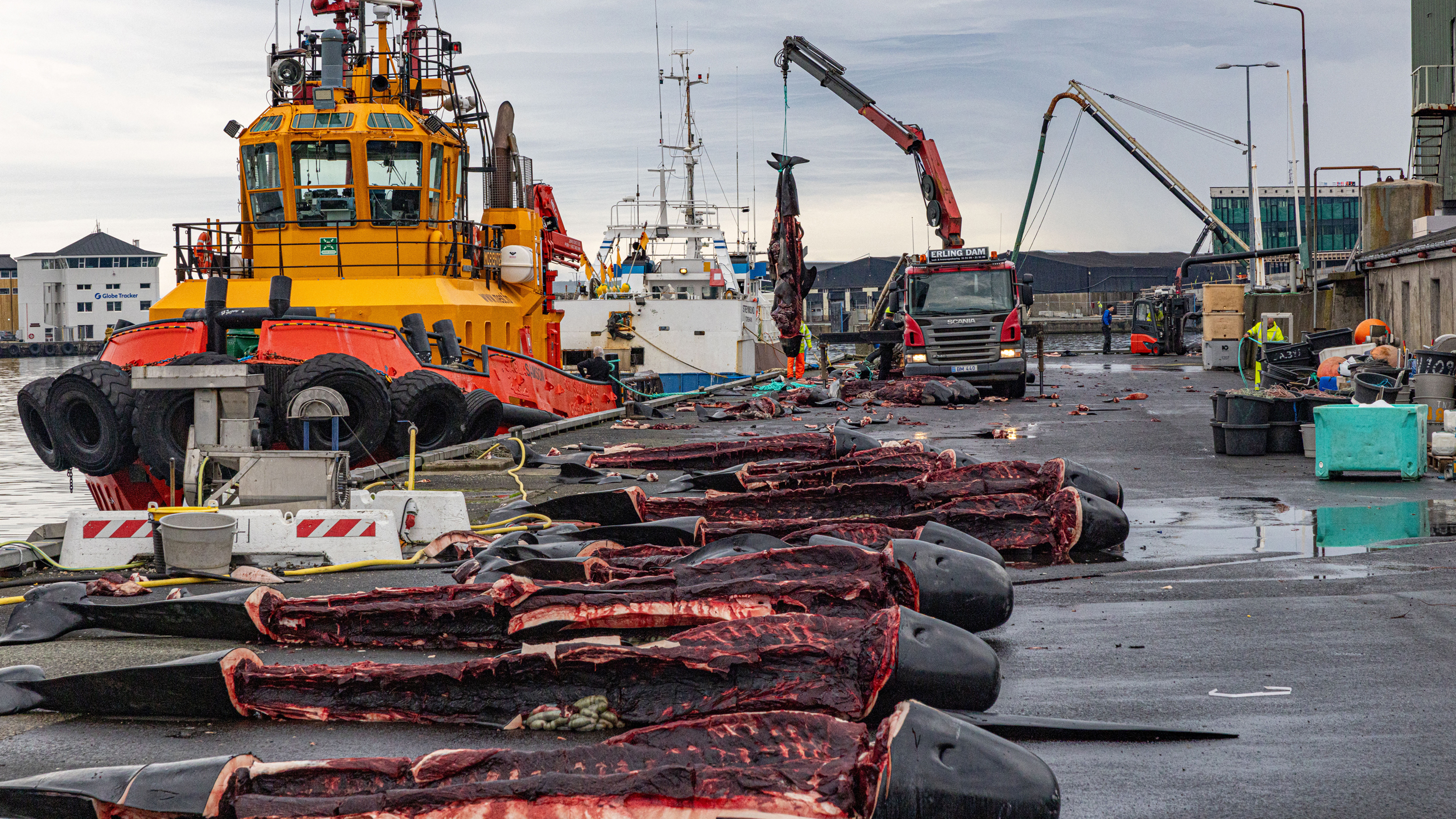
Crast is now urging governments that trade with the Faroe Islands to require clearer country-of-origin labeling on Faroese seafood as part of future trade negotiations. Transparent labeling would allow consumers to make informed purchasing decisions, she said, including choosing not to buy Faroese fish in protest of the grind.
At the same time, she said, Sea Shepherd crews and other activists continue to document the hunts on the ground, sharing images and video footage of the events to raise awareness about the killings.
“The hope is that more people realize what cruelty they are doing by watching these pictures,” said Michels, the photographer who documented the recent mass killing in Tórshavn. “Hopefully, in some time, even here on the Faroe Islands, the people will stand up and say, ‘No, that’s enough.’”
But getting to that point will be a process.
Speaking against the grind in the Faroe Islands comes with consequences. Many Faroese worry they will be bullied or ostracized within their communities if they voice their opposition, Crast said. One Faroese man told her he worried his kids would be harassed at school if he spoke out against the longstanding practice.
Others, however, like Mortensen, who grew up hunting whales, said he is eager to have more open conversations about the hunts. He stopped participating in the grind about 10 years ago, when he was in his thirties, after getting a glimpse of the slaughter from a distance.
“That was the first time I’ve noticed from a distance all the sounds that the whale makes,” he said. “It just broke my heart.”
Now, Mortensen and his wife, Jane Pingley Mortensen, want to encourage other Faroese to come together to discuss the grind and a path forward without fear of being judged or attacked. “We need to sit down and talk to each other,” he said.
The couple agreed that this is the only way the grind is likely to end, regardless of how much the world condemns it.
About This Story
Perhaps you noticed: This story, like all the news we publish, is free to read. That’s because Inside Climate News is a 501c3 nonprofit organization. We do not charge a subscription fee, lock our news behind a paywall, or clutter our website with ads. We make our news on climate and the environment freely available to you and anyone who wants it.
That’s not all. We also share our news for free with scores of other media organizations around the country. Many of them can’t afford to do environmental journalism of their own. We’ve built bureaus from coast to coast to report local stories, collaborate with local newsrooms and co-publish articles so that this vital work is shared as widely as possible.
Two of us launched ICN in 2007. Six years later we earned a Pulitzer Prize for National Reporting, and now we run the oldest and largest dedicated climate newsroom in the nation. We tell the story in all its complexity. We hold polluters accountable. We expose environmental injustice. We debunk misinformation. We scrutinize solutions and inspire action.
Donations from readers like you fund every aspect of what we do. If you don’t already, will you support our ongoing work, our reporting on the biggest crisis facing our planet, and help us reach even more readers in more places?
Please take a moment to make a tax-deductible donation. Every one of them makes a difference.
Thank you,

Oceans Correspondent
Teresa Tomassoni is an environmental journalist covering the intersections between oceans, climate change, coastal communities and wildlife for Inside Climate News. Her previous work has appeared in The Washington Post, NPR, NBC Latino and the Smithsonian American Indian Magazine. Teresa holds a master’s degree in Journalism from the Craig Newmark Graduate School of Journalism. She is also a recipient of the Stone & Holt Weeks Social Justice Reporting Fellowship. She has taught journalism for Long Island University and the School of the New York Times. She is an avid scuba diver and spends much of her free time underwater.