

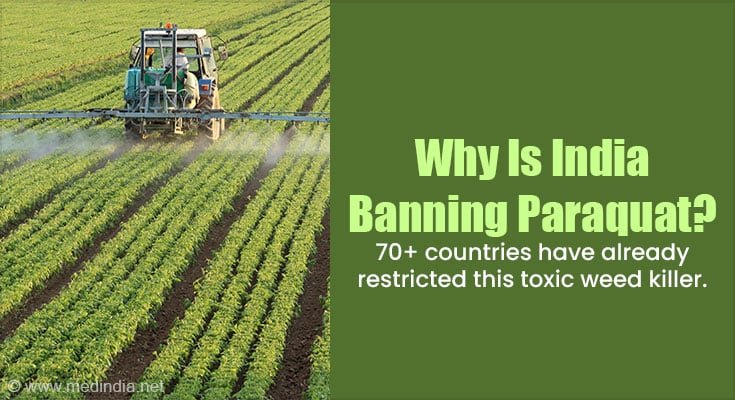
India proposes a nationwide ban on paraquat dichloride, citing health risks, toxicity, and concerns over pesticide-related poisoning.

- India has proposed banning paraquat, one of the world’s most toxic weed killers
- Paraquat poisoning can damage the lungs, kidneys, and liver and has no specific antidote
- The draft notification covers the manufacture, import, sale, transport, and use of paraquat across India
More than 70 countries have banned or restricted paraquat, a highly toxic weed killer associated with severe poisoning and significant public health concerns.
India may soon join that list. On July 13, 2026, the Ministry of Agriculture and Farmers Welfare issued a draft notification proposing a nationwide ban on paraquat dichloride, covering its manufacture, import, transport, distribution, sale, and use. (1✔ ✔Trusted Source
The WHO Recommended Classification of Pesticides by Hazard and Guidelines to Classification 2019.
), (2✔ ✔Trusted Source
Ministry of Agriculture and Farmers Welfare. (2026). Draft Banning of Paraquat Dichloride Order, 2026. Gazette of India.
)
The proposal is currently open for public comments for 30 days before a final decision is made. For the public, this means that paraquat has not yet been banned in India, but its future use is under review.
Advertisement
What Is Paraquat, the Weed Killer India Wants to Ban?
Paraquat dichloride is an herbicide, commonly known as a weed killer, used to eliminate unwanted plants in crops such as tea, cotton, rice, and rubber plantations.
The chemical acts rapidly by damaging plant cells. Unfortunately, it can also cause severe harm to humans if swallowed, inhaled, or absorbed through broken skin. Unlike many poisons, paraquat has no known antidote, making prevention extremely important. (3✔ ✔Trusted Source
A Case for Banning Paraquat in India: A Public Health Concern. National Medical Journal of India.
Advertisement
Why Has India Proposed a Ban on Paraquat?
The proposed ban follows recommendations from expert committees constituted under the Insecticides Act, 1968. According to the draft notification, the government cited risks to human and animal health as the primary reason for considering a complete prohibition. (2✔ ✔Trusted Source
Ministry of Agriculture and Farmers Welfare. (2026). Draft Banning of Paraquat Dichloride Order, 2026. Gazette of India.
)
Several Indian states had already raised concerns before the draft notification. Telangana and Andhra Pradesh have introduced restrictions or taken steps to reduce access to paraquat following reports of poisoning and self-harm incidents. (3✔ ✔Trusted Source
A Case for Banning Paraquat in India: A Public Health Concern. National Medical Journal of India.
It is important to note that the proposed ban is still under consultation and has not yet become law.
Advertisement
How Dangerous Is Paraquat Poisoning?
Paraquat poisoning is a medical emergency. Even a small amount can result in severe illness.
It may cause severe lung injury, kidney failure, liver damage, and multi-organ failure. Researchers have reported high fatality rates because treatment is largely supportive and there is currently no specific antidote. (3✔ ✔Trusted Source
A Case for Banning Paraquat in India: A Public Health Concern. National Medical Journal of India.
Several studies have also explored an association between long-term paraquat exposure and an increased risk of Parkinson’s disease. However, researchers continue to investigate this relationship, and paraquat has not been proven to directly cause Parkinson’s disease. (3✔ ✔Trusted Source
A Case for Banning Paraquat in India: A Public Health Concern. National Medical Journal of India.
Who Is Most at Risk of Paraquat Poisoning?
People who work closely with pesticides are at the greatest risk of exposure. These include farmers, agricultural workers, pesticide handlers, and individuals living near spraying sites.
Children may also be at risk if pesticides are improperly stored at home. Public health experts recommend keeping all agricultural chemicals in their original containers and away from food storage areas and living spaces. (1✔ ✔Trusted Source
The WHO Recommended Classification of Pesticides by Hazard and Guidelines to Classification 2019.
India’s Proposed Paraquat Ban Reflects a Global Shift in Pesticide Safety
India’s proposal reflects a broader global movement toward reducing exposure to hazardous pesticides and strengthening public health protections. The draft notification also highlights the growing emphasis on safer agricultural practices in India.
Paraquat Poisoning: Key Facts at a Glance
|
Fact |
Evidence |
|
Paraquat is classified by WHO as a hazardous pesticide. |
WHO Guidelines (1✔ ✔Trusted Source The WHO Recommended Classification of Pesticides by Hazard and Guidelines to Classification 2019. ) |
|
More than 70 countries have banned or restricted paraquat. |
WHO and international regulatory records (1✔ ✔Trusted Source The WHO Recommended Classification of Pesticides by Hazard and Guidelines to Classification 2019. ) |
|
There is no specific antidote for paraquat poisoning. |
NMJI review article (3✔ ✔Trusted Source A Case for Banning Paraquat in India: A Public Health Concern. National Medical Journal of India. ) |
|
India issued a draft nationwide ban on July 13, 2026. |
Gazette of India (2✔ ✔Trusted Source Ministry of Agriculture and Farmers Welfare. (2026). Draft Banning of Paraquat Dichloride Order, 2026. Gazette of India. ) |
|
The proposed ban is currently open for public comments. |
Gazette of India (2✔ ✔Trusted Source Ministry of Agriculture and Farmers Welfare. (2026). Draft Banning of Paraquat Dichloride Order, 2026. Gazette of India. ) |
What Does India’s Proposed Paraquat Ban Mean for Public Health?
India’s proposed ban is more than a regulatory decision—it is part of an ongoing effort to reduce preventable poisoning and promote safer agricultural practices. While the consultation process is still underway, the move underscores growing awareness of the risks associated with highly toxic pesticides.
For farmers and the general public, the message is clear: paraquat should be handled with extreme caution until a final decision is made. The draft notification also serves as a reminder that pesticide safety remains an important public health issue, particularly in countries where agricultural chemicals are widely used.
If finalized, the ban could place India among the many nations that have chosen to prioritize human health and safety over the continued use of one of the world’s most controversial weed killers.
Frequently Asked Questions
Q: Why is India banning paraquat?
A: India has proposed banning paraquat because it is highly toxic and poses significant risks to human and animal health.
Q: What is paraquat used for?
A: Paraquat is used as a weed killer in crops such as tea, cotton, rice, and rubber.
Q: Is paraquat poisoning deadly?
A: Yes. Paraquat poisoning can be fatal and currently has no specific antidote.
Q: Has paraquat already been banned in India?
A: No. India has issued a draft notification proposing a nationwide ban. The final decision is pending public consultation.
Q: Can paraquat cause Parkinson’s disease?
A: Researchers have reported an association between long-term paraquat exposure and Parkinson’s disease, but a direct cause-and-effect relationship has not been established.
References:
- The WHO Recommended Classification of Pesticides by Hazard and Guidelines to Classification 2019. – (https://iris.who.int/items/a435789c-7862-4d68-ac32-ef82b38d2067)
- Ministry of Agriculture and Farmers Welfare. (2026). Draft Banning of Paraquat Dichloride Order, 2026. Gazette of India. – (https://egazette.gov.in/(S(wuocqois1zyl3c55sikxporr))/Default.aspx)
- A Case for Banning Paraquat in India: A Public Health Concern. National Medical Journal of India. – (https://nmji.in/a-case-for-banning-paraquat-in-india-a-public-health-concern/)
Source-Medindia