

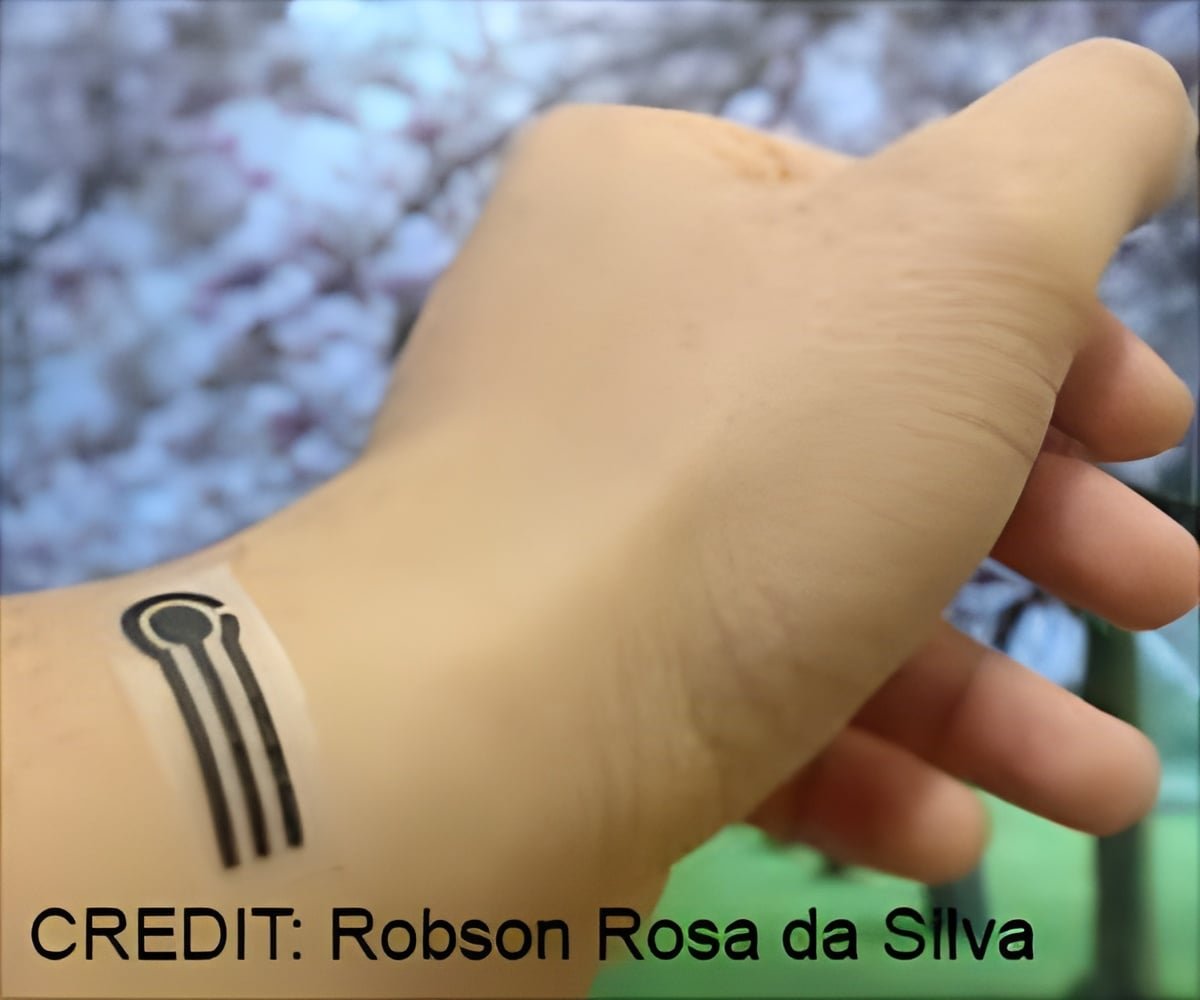
Ultrathin on-skin electrodes developed by University of Tokyo researchers could make health tracking more natural by reducing the visibility and discomfort of wearable sensors.
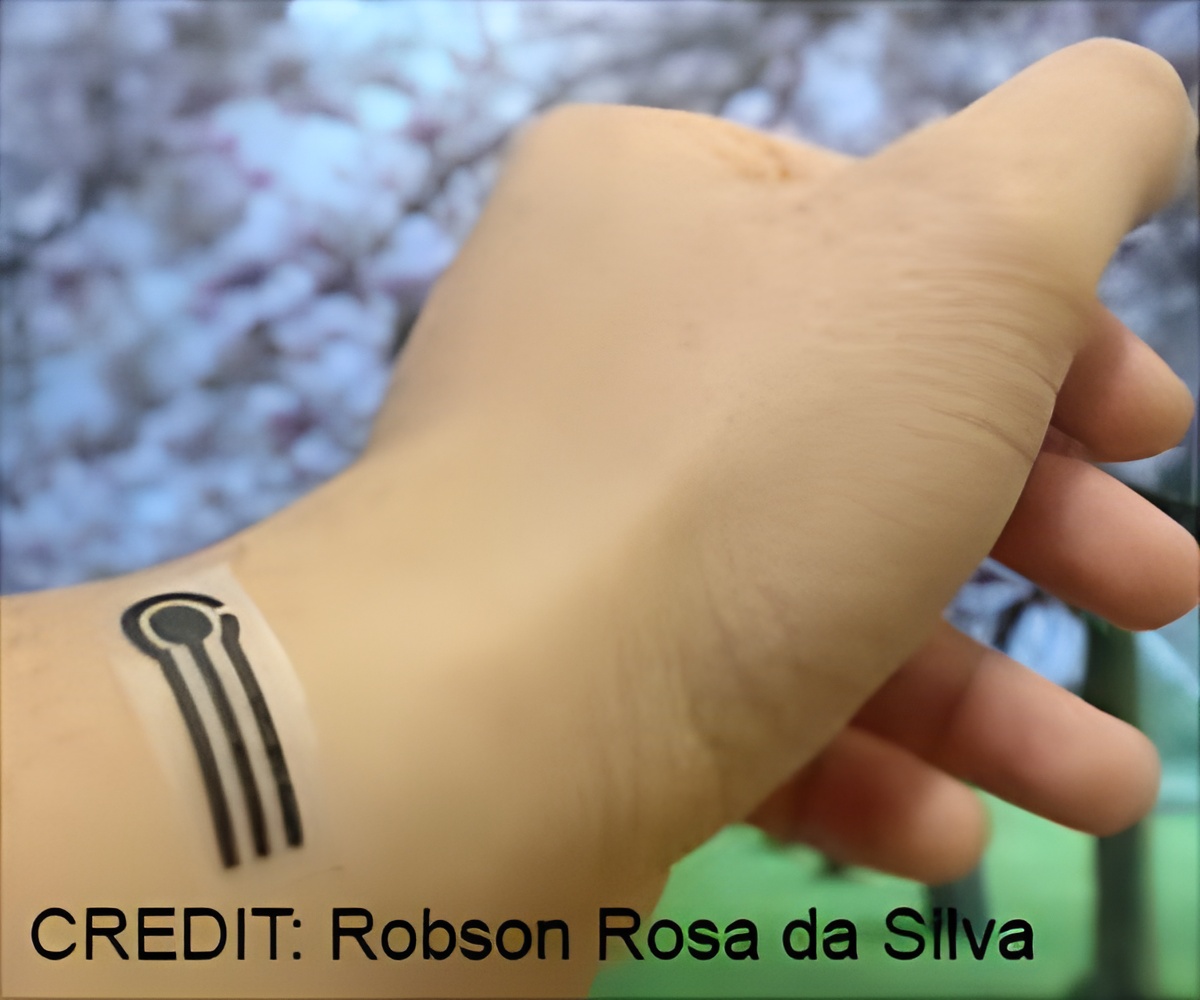
Can health sensors become so thin and natural that people forget they are wearing them?
Researchers from the Institute of Industrial Science, The University of Tokyo and collaborating institutions have developed ultrathin, stretchable on-skin electrodes that are almost invisible when worn on the face.
The new sensors, reported in Science Advances, can measure biological signals while remaining difficult to detect by sight or touch.
This could help overcome one of the major problems with current wearable health sensors: they can be awkward, visible and uncomfortable enough to affect the very signals they are designed to measure.
Advertisement
Ultrathin Sensors Were Designed to Disappear on the Skin
The new electrodes are made using an ultrathin elastic film about 200 nanometers thick and transparent conductive nanowires. This design allows the sensor to closely match the appearance and texture of natural skin.
The device reduces reflections and avoids the shiny, artificial look that often makes wearable electronics noticeable.
In experiments, neither wearers nor outside observers could reliably detect the electrodes by sight or touch. The researchers also reported that the devices remained comfortable and breathable during use.(1✔ ✔Trusted Source
Reduction of appearance artifacts in wearable on-skin electronics
Advertisement
Wearable Sensors Can Change Natural Behavior
Many wearable sensors are designed to collect health signals from the body, but their visibility can create a problem. Devices placed on the face may draw attention, make users self-conscious and affect social interactions.
Researchers describe this as an appearance artifact. An appearance artifact occurs when a person’s behavior or psychological state changes because they are wearing a visible device.
For health monitoring to reflect real life, sensors need to collect data without changing how people act, feel or interact with others.
The new skin-like electrodes aim to solve this problem by blending into the background.
Advertisement
Sensors Tracked Eye, Muscle and Brain Signals
The electrodes were not only designed to be invisible. They also performed their monitoring function. The research team successfully recorded electrooculography signals from eye movements.
They also recorded electromyography signals from facial muscles and electroencephalography signals from brain activity.
These biological signals can provide useful information for healthcare monitoring, cognitive assessment, emotional-state tracking and human-machine interaction.
For several signal types, the new electrodes produced better signal quality than conventional gel electrodes. The researchers attributed this improvement to lower skin impedance.
Better Comfort Could Support More Natural Health Monitoring
Comfort is important for wearable health technology. If a device is irritating, obvious or difficult to wear, people may remove it or behave differently while using it.
The new electrodes were designed to be soft, stretchable, breathable and nearly undetectable. This could make them better suited for monitoring under natural daily-life conditions.
Such sensors may be especially useful for tracking subtle facial or neurological signals without making the wearer feel watched or judged. This matters because emotional state, facial expression, eye movement and brain signals can be influenced by social discomfort.
Technology Could Help Human-Machine Interaction
The sensors may also support future human-machine interaction. Eye movements and facial expressions could potentially be used to control devices, virtual-reality systems or assistive technologies.
Because the electrodes are difficult to see and feel, they may allow more natural interaction than bulky visible devices. This could be useful in healthcare, rehabilitation, communication aids and immersive digital environments.
However, the technology is still at the research stage and would need further testing before broad medical or consumer use.
Invisible Sensors Could Reduce Social Discomfort
One of the most important parts of the study is its focus on social acceptability. Wearable technology is often judged by performance, but comfort and appearance can strongly influence real-world use.
A sensor that works well in the laboratory may fail in daily life if people feel embarrassed or uncomfortable wearing it.
By making the device nearly invisible, the researchers hope to reduce self-consciousness and allow more natural health tracking.
This could be especially important for sensors worn on the face, where devices are more noticeable than on the wrist or chest.
Future Uses May Include Emotional and Cognitive Monitoring
The research team believes future applications could include subtle monitoring of emotional state and cognitive function. Because the sensors can record eye, facial muscle and brain signals, they may help track changes linked to attention, fatigue, stress or neurological activity.
They could also support new ways to interact with machines using facial expressions or eye movements.
More broadly, invisible sensors could help create wearable technology that adapts to people instead of forcing people to adapt to technology.
More Testing Is Needed Before Everyday Use
Although the findings are promising, the technology will need further development before it becomes part of routine health monitoring.
Future studies may need to test long-term wear, durability, safety, signal stability, privacy protection and performance across different daily environments.
Researchers will also need to examine how such sensors perform during movement, sweating, facial expression changes and extended use.(1✔ ✔Trusted Source
Reduction of appearance artifacts in wearable on-skin electronics
If these challenges are addressed, ultrathin invisible sensors could become an important step toward seamless digital health monitoring.
Wearable Health Tracking Could Become Less Noticeable
The study points to a future in which health sensors are functional but almost unseen. Instead of bulky devices that interrupt daily life, skin-like electrodes could quietly collect useful signals while preserving comfort and natural behavior.
The researchers suggest that making wearable electronics both effective and nearly invisible may bring health monitoring and human-machine interaction closer to everyday use.
For patients, clinicians and technology developers, the message is clear: the next generation of wearable health sensors may need to be not only accurate, but also socially and physically unobtrusive.
References:
- Reduction of appearance artifacts in wearable on-skin electronics- (https://www.science.org/doi/10.1126/sciadv.aee6417)
Source-Medindia