

Close Menu

    Subscribe to Updates

    Get the latest news information from worldwide businesses.

    What's Hot

    As Climate Extremes Collide, Attribution Science Evolves

    July 16, 2026

    Rusty Wallace admits his bias twice before North Wilkesboro’s first Cup points race in 30 years

    July 16, 2026

    The BMW iX4 looks more like a GT than an SUV [Images]

    July 16, 2026
    Facebook Instagram YouTube LinkedIn X (Twitter)
    Trending
    • As Climate Extremes Collide, Attribution Science Evolves
    • Rusty Wallace admits his bias twice before North Wilkesboro’s first Cup points race in 30 years
    • The BMW iX4 looks more like a GT than an SUV [Images]
    • The Best New York City Theater Shows to See Right Now—On and Off Broadway
    • Is this routine hurting your gut health?
    • This alien planet never has sunrise or sunset. It may support life
    • Why more Indian couples are being diagnosed with secondary infertility
    • Daratumumab Shows Promise for Rituximab-Refractory Pemphigus, suggests study
    Newspublicly
    • About Us
    • Advertise & Partner with us
    • Pitch Your Story
    • Contact Us
    Facebook Instagram LinkedIn X (Twitter)
    Subscribe
    • Home
    • World News
      • Asia
      • India
      • USA
      • UK & Europe
      • Middle East
    • Economy & Business
      • Global Economy
      • Corporate & Industry
      • Finance & Markets
      • Policy & Trade
    • Technology
      • Gadgets & Devices
      • Software & Apps
      • AI & Machine Learning
      • Robotics & Automation
    • Health & Medicine
      • Fitness & Nutrition
      • Research & Innovation
      • Disease & Treatment
      • Doctors, Clinics & Patient Care
    • Travel & Tourism
    • Automobile
      • Electric & Hybrid Vehicles
      • Auto Industry Insights
    • Sports
    • More
      • Education
      • Real Estate
      • Environment & Climate
      • Space & Astronomy
      • War & Conflicts
    Newspublicly
    Home»More»Space & Astronomy»Astronomers discover landslides on Pluto large enough to bury entire cities on Earth
    Space & Astronomy

    Astronomers discover landslides on Pluto large enough to bury entire cities on Earth

    AdminBy AdminJuly 16, 2026No Comments3 Mins Read0 Views
    Share
    Facebook Twitter LinkedIn Copy Link WhatsApp


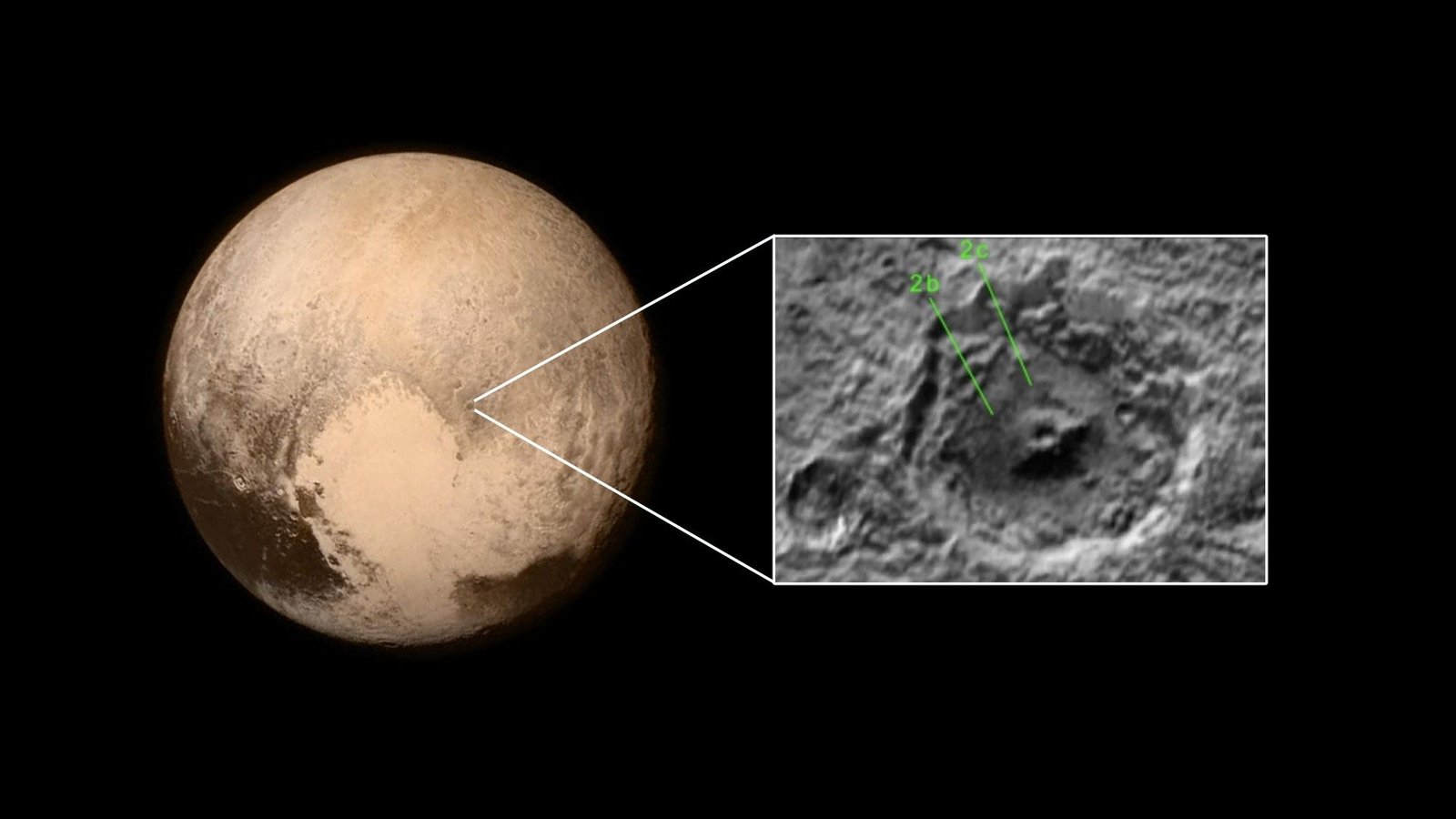
    The aftermath of landslides have been found in images of Pluto’s surface taken when the New Horizons mission flew past the dwarf planet in 2015. The landslides are evidence that the icy world is still active, albeit on geological timescales.

    A team led by geologist Marco Emanuele Discenza pored over images taken by New Horizons’ LORRI (Long-Range Reconnaissance Imager) instrument, which was capable of detecting surface features as small as 984 feet (300 meters). They found convincing evidence for six landslides in total that have taken place down the inner walls of three craters on the western edge of Sputnik Planitia, the heart-shaped feature that characterizes Pluto‘s appearance.

    Previously, geological features left behind by landslides have been found on a host of bodies in the solar system, including Mars, Ceres in the asteroid belt, some of the icy moons of the gas giants, and even Pluto’s companion, Charon. However, these are the first to be found on Pluto.

    A landslide that fell 1.4 miles (2.2 kilometers) was identified in Pluto’s Coughlin crater, close to a secondary crater on Coughlin’s rim that may have triggered the landslide in the first place. Two further landslide features were seen in Giclas crater, and another three were spotted in a third, unnamed, crater.

    The landslides were identifiable by their large debris aprons that spilled out onto the crater floors, the distance the landslide material travelled ranging being between 6.3 and 9 miles (10.1 and 14.5 km). Some of these debris aprons appeared bumpy, as if they contain large boulders of solid ice, while the areas around the source of the landslides feature well-defined, concave-shaped cliffs where material has broken away and tumbled down the craters’ steep walls.


    You may like

    The great lengths that the debris rolled means that Pluto’s landslides are among the most mobile in the solar system, a product of low gravity and low-friction icy rubble. The largest of the debris aprons covers 50 square miles (130 square kilometers), which would be large enough to bury a small city or a large town.

    Landslides are important processes in shaping planetary surfaces, enabling the transport of material across great distances. The trigger for Pluto’s landslides, however, is not yet clear. While the landslide in Coughlin appears to have been caused by a smaller impact nearby, the other five have less certain origins. One possibility is thermal stresses in the surface ice caused by the slight temperature changes that cause Pluto’s volatile materials – among them molecular nitrogen, carbon monoxide and methane – to periodically sublimate and then condense again. These temperature changes are the result of Pluto subtly heating up and cooling down as its elliptical orbit brings it slightly closer to the sun, crossing inside Neptune‘s orbit, and then moving farther away again.

    Space

    There is also evidence for more landslides in other craters, but New Horizons’ coverage of Pluto’s surface was limited as it hurriedly flew past on July 4, 2015, and the imagery required to confirm these other landslides is lacking.

    The findings were published in the journal Icarus.


    Source link

    Author

    • Admin

      NewsPublicly.com is News & Articles Platform that creating SEO-focused articles on travel, lifestyle, and digital trends.

    Admin
    • Website

    NewsPublicly.com is News & Articles Platform that creating SEO-focused articles on travel, lifestyle, and digital trends.

    Related Posts

    SpaceX Starship Flight 13 launch updates: Elon Musk’s future moon rocket is ready for liftoff today

    July 16, 2026

    An animated sci-fi rom-com wasn’t on our wish list, but we’ll be damned if ‘Not Alone’ doesn’t look sweet, stylish, and hilarious

    July 16, 2026

    Astronomers discover 1st atmosphere around a rocky Earth-like planet in the habitable zone

    July 16, 2026
    Leave A Reply Cancel Reply

    Demo
    Top Posts

    The Blue Moon rises on May 30— Where and when to see the second full moon of the month

    May 30, 202640 Views

    New SOCOM rifle allows barrel swapping and cartridge changes

    June 1, 202633 Views

    “Inside Gemini Robotics 1.5: How Robots Learn to Reason & Act

    November 22, 202526 Views

    525 pounds of cocaine seized after Nebraska K9 alerts troopers on I-80

    May 28, 202624 Views
    Don't Miss

    As Climate Extremes Collide, Attribution Science Evolves

    July 16, 20268 Mins Read0 Views

    A new assessment from the United States’ most influential science advisory panel says climate attribution…

    Rusty Wallace admits his bias twice before North Wilkesboro’s first Cup points race in 30 years

    July 16, 2026

    The BMW iX4 looks more like a GT than an SUV [Images]

    July 16, 2026

    The Best New York City Theater Shows to See Right Now—On and Off Broadway

    July 16, 2026
    Stay In Touch
    • Facebook
    • Twitter
    • Instagram
    • YouTube
    • LinkedIn
    • WhatsApp

    Subscribe to Updates

    Get the latest creative news from SmartMag about art & design.

    Demo
    NEWSPUBLICLY
    Facebook X (Twitter) Instagram LinkedIn

    Home

    • About Us
    • Leadership
    • Advertise & Partner With Us
    • Pitch Your Story
    • Media Kit & Pricing
    • Career
    • FAQs

    Guidelines

    • Editorial & Submission
    • Partnership
    • Advertising & Sponsor
    • Intellectual Property Policy
    • Community & Comment
    • Security & Data Protection
    • Send Your Opinion

    Quick Links

    • Cookie Policy
    • Payment & Billing Terms
    • Refund & Cancellation
    • Copyright Policy
    • Complaint & Support
    • Sitemap
    • Contact Us

    Subscribe Us

    Get the latest news and updates!

    Copyright © 2026 Newspublicly (DIGITALIX COMMUNICATION). All Rights Reserved.
    • Privacy Policy
    • Terms of Use
    • Disclaimer