

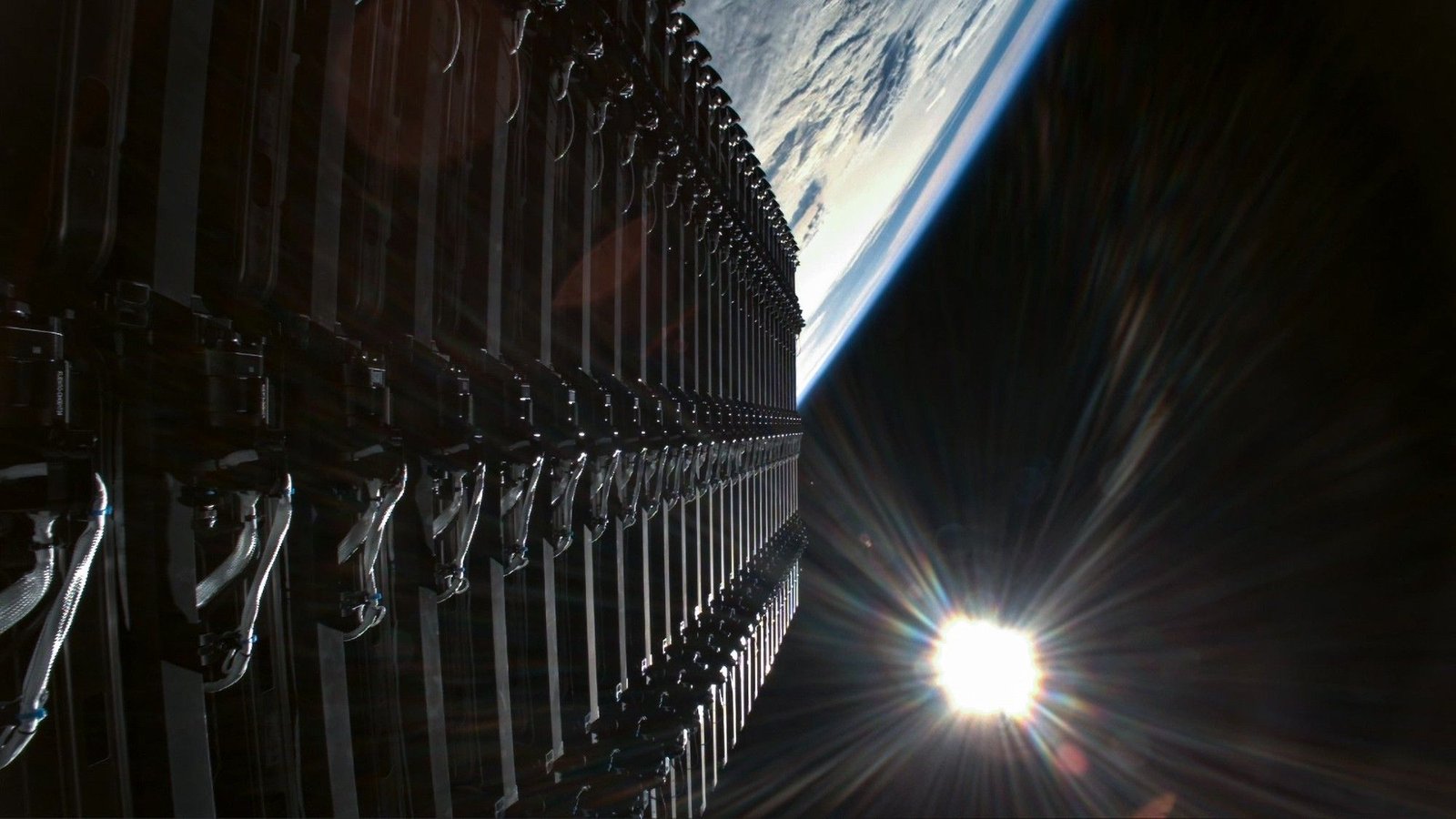
SpaceX’s Starlink satellites made over 355,000 collision avoidance maneuvers throughout the past year, with each satellite now dodging debris and other spacecraft on an almost weekly basis.
The numbers are based on disclosures made by SpaceX in its latest semiannual report to the Federal Communications Commission (FCC). According to the latest report, Starlink satellites performed an overall 207,152 avoidance maneuvers between December 2025 and May 2026, up nearly 60,000 from the 148,696 reported in the previous half year. That brings the yearly total to over 355,000, more than three times as many as the constellation performed in 2024. On average, each Starlink satellite performed more than 40 space dodging maneuvers per year between June 1, 2025 and May 31, 2026.
Experts fear the situation might soon get out of hand. “I think we’re heading towards a situation where there will be a collision involving an operational satellite in the constellation,” Hugh Lewis, a space sustainability expert and professor of astronautics at the University of Birmingham in the U.K., told Space.com. “And it will not be for the lack of trying to avoid those things. It will be in spite of all those maneuvers.”
The increase coincides with the growth of the internet-beaming constellation and the overall number of satellites in space in the past five years. Starlink grew from about 6,000 satellites in 2024 to more than 10,000 as of June 2026. Over the same time period, the overall number of operational spacecraft in orbit rose from around 10,000 to about 16,000.
The SpaceX constellation orbits at altitudes between 298 miles (480 km) and 342 miles (550 kilometers) and uses an autonomous collision avoidance system that initiates a maneuver when the probability of a collision appears higher than 3 in 10 million. Lewis says that although SpaceX is “doing an excellent job” managing orbital traffic, the steep growth cannot continue without risks.
“The avoidance maneuvers reduce the probability of a collision to about one in a million, which is so small that it’s negligible,” Lewis said. “The problem is that if you make a million maneuvers and you have a residual probability of one in a million, you end up with an aggregate risk across your entire constellation that you can’t get rid of.”
Lewis points out that with the expected continued rise in avoidance maneuvers (SpaceX has applied to the FCC to increase the size of its constellation to 100,000 satellites), SpaceX will have made a million avoidance maneuvers over the lifetime of the Starlink constellation as early as June 2027. By 2030, the constellation may be making more than a million maneuvers every year. At that point, the one in a million risk of a collision may no longer be negligible at all.
Tommaso Sgobba, the Director of the International Association for the Advancement of Space Safety, told Space.com that the increase in collision avoidance maneuvers is a predictable certainty.
“The more satellites you pack into [an orbital] shell, the more pairs of satellites exist that could potentially cross paths,” Sgobba wrote in an email. “Adding satellites does not just add risk one unit at a time, it multiplies the number of possible pairings. Double the satellites in a shell and you roughly quadruple the number of pairs that need to be watched.”
Sgobba also said that the collision probabilities predicted are highly inaccurate as the effects of air drag, which change frequently with space weather, are currently impossible to predict.
He said that due to the vast uncertainties in satellite trajectory predictions “operators lack tools to tell a real threat from statistical confusion,” adding that “satellites are frequently dodging ghosts, burning fuel and shortening their operational lives in the process.”
SpaceX, being the largest constellation currently in orbit, takes the bulk of responsibilities for orbital maneuvering. Instead of communicating with the other operator to decide who will make the dodge, Starlink satellites automatically avoid other objects — both space debris fragments or operational satellites — whenever there is a conjunction alert.
Other ambitious constellations, such as Amazon LEO or China’s Thousand Sails, or Qianfan, are currently being deployed, actively adding to the high number of satellites operating in low Earth orbit.

Lewis said that the only way to safely manage multiple constellations is to make sure their orbits do not intersect. That, however, is not the case based on available information. The Thousand Sails constellation, in particular, is expected to occupy similar regions as Starlink. Many of the recently announced orbital data center projects want to launch into particular orbital regions that are convenient for their operations and are therefore likely to overlap.
“The safe thing to do is to separate the constellations,” Lewis said. “But then you are talking about orbital carrying capacity and the first mover benefit, because if I go into a particular altitude with my constellation, then nobody else can use it.”
Sgobba calls for predicted numbers of collision avoidance maneuvers based on satellite numbers to be mandatorily disclosed to regulators before applications are granted.
“Right now, there is no clear requirement for a company to say, before launch, how many collision avoidance maneuvers a constellation of this size and density will need every year and whether the satellites carry enough fuel and automation to actually perform them all,” Sgobba wrote.
“In short, the crowding of orbit is not an accident waiting to happen. It is a manageable, predictable engineering workload and the argument worth making publicly is that regulators should be treating it that way, by asking for these numbers up front rather than reacting to headlines about near misses after the fact.”