

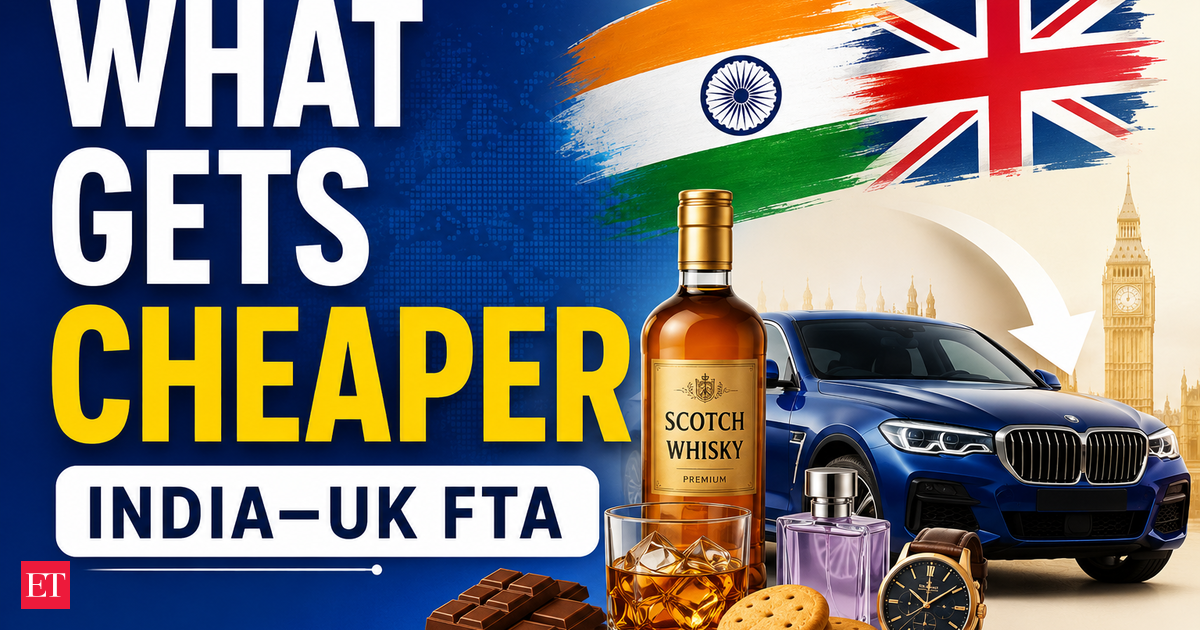
The India-UK trade deal was signed in London on July 24, 2025 by Commerce and Industry Minister Piyush Goyal and UK Secretary of State for Business and Trade Jonathan Reynolds, in the presence of Prime Minister Narendra Modi and UK Prime Minister Keir Starmer. It took effect nearly a year later, on July 15, 2026.
Also read: India-UK FTA: Rolls-Royce, Range Rover cars to get cheaper in India
Here’s a look at what could get cheaper, and when.
Under the agreement, 99% of India’s tariff lines get duty-free entry into the UK. In return, India will lower import duties on select British goods, most of them in stages over five to ten years rather than immediately.

Import duty on fully built UK cars, currently as high as 110%, will be reduced to 10% over ten years through an annual quota system.
- Petrol and diesel models get concessional treatment from the outset.
- Electric, hybrid and hydrogen vehicles will get preferential access only from the sixth year onward, giving India’s domestic EV makers about five years of protection.
- Over the first 15 years, India will allow import of 3.78 lakh fully built conventional engine passenger vehicles from the UK, including mass market models, at concessional duty.
- Brands such as Rolls Royce, Aston Martin, McLaren, Jaguar and Land Rover are expected to benefit from the tariff reduction.
 TIL Creatives
India-UK FTA: Cars to get cheaper
UK trucks also see duty cuts. The existing 44% duty on fully built trucks will fall to 8.8% by the fifth year within a quota, and the annual quota will rise from 2,500 to 3,500 trucks. Trucks imported beyond the quota will see duty ease to 22% by year ten.
2. Scotch whisky and gin
Import duty on Scotch whisky will fall from 150% to 75% immediately, then to 40% over the next ten years.
- Gin will see a similar phased reduction.
- Other premium spirits, including cider, mead, sake, brandy, bourbon, rum, vodka, liqueurs and tequila, will see duty fall from 150% to 110% in year one, and to 75% by year ten.
- These cuts apply only above a minimum import price, generally around $5 to $6 per litre, or roughly $3.75 to $6 for a 750 ml bottle.
TIL CreativesIndia-UK FTA: Scotch, whisky and gin to get cheaper
3. Chocolates, biscuits, soft drinks and cosmetics
Import duties will also come down over time on a broader set of British consumer goods, including chocolates, sweet biscuits, soft drinks, cosmetics, cosmetic soaps, perfumes, shaving creams and nail polish. Salmon and lamb are also among the UK food exports covered under the phased tariff reductions.
TIL CreativesIndia-UK FTA: Chocolates get cheaper
4. Medical devices and healthcare equipment
Reduced tariffs are expected to lower costs on some imported UK healthcare equipment, including surgical instruments, diagnostic equipment, ECG machines and X-ray systems.
5. Silver
Silver is Britain’s largest export to India by value. Under the agreement, India will gradually reduce the import tariff on silver to zero over ten years. According to the Global Trade Research Initiative (GTRI), silver and aerospace are among the sectors where the UK is expected to gain the most.
6. Luxury and lifestyle goods
Select British luxury products, including fashion and lifestyle items, are expected to see lower prices as tariffs decline under the agreed schedule.
What stayed outside the deal?
India has kept several sensitive domestic sectors out of the tariff concessions. These include dairy products, cereals, millets, pulses, edible oils, oilseeds, fresh apples, walnuts, whey and modified whey, blue veined cheese, specified seed categories, gold bars, gold jewellery, lab grown diamonds, smartphones, optical fibre, critical energy products and marine vessels.
Also read: India-UK FTA comes into effect today, unlocking duty-free access for Indian exports
In total, India has opened 89.5% of its tariff lines, covering 91% of British exports, but only 24.5% of UK exports get immediate duty-free entry. The rest are phased in over five, seven or ten years, particularly for sectors covered under Make in India and the Production Linked Incentive (PLI) scheme.
What India gains in return?
Indian exporters get zero-duty access to the UK across sectors that earlier faced tariffs of up to 70% on processed food, 21.5% on marine products, 18% on engineering goods and auto components, 16% on leather and footwear, 12% on textiles and clothing, and 8% on chemicals and pharmaceuticals.
Trade between the two countries stood at $56 billion at the time the deal was signed, with both governments targeting a doubling by 2030. According to GTRI, Britain imported goods worth $928.9 billion in 2025, of which India’s share was $15.2 billion, or 1.6%.
The agreement also extends the Double Contribution Convention, under which Indian professionals on temporary UK assignments will be exempt from dual social security contributions for up to five years, up from three years earlier. The government estimates this will benefit more than 75,000 professionals and over 900 companies, with savings of more than ₹4,000 crore.
GTRI founder Ajay Srivastava has said that tariff access alone will not guarantee higher exports, and that Indian exporters will still need to meet UK quality, food safety, traceability and certification requirements.
Similarly, most of the price cuts on British goods in India are staggered over five to ten years, so their effect on prices is likely to unfold gradually rather than all at once.