

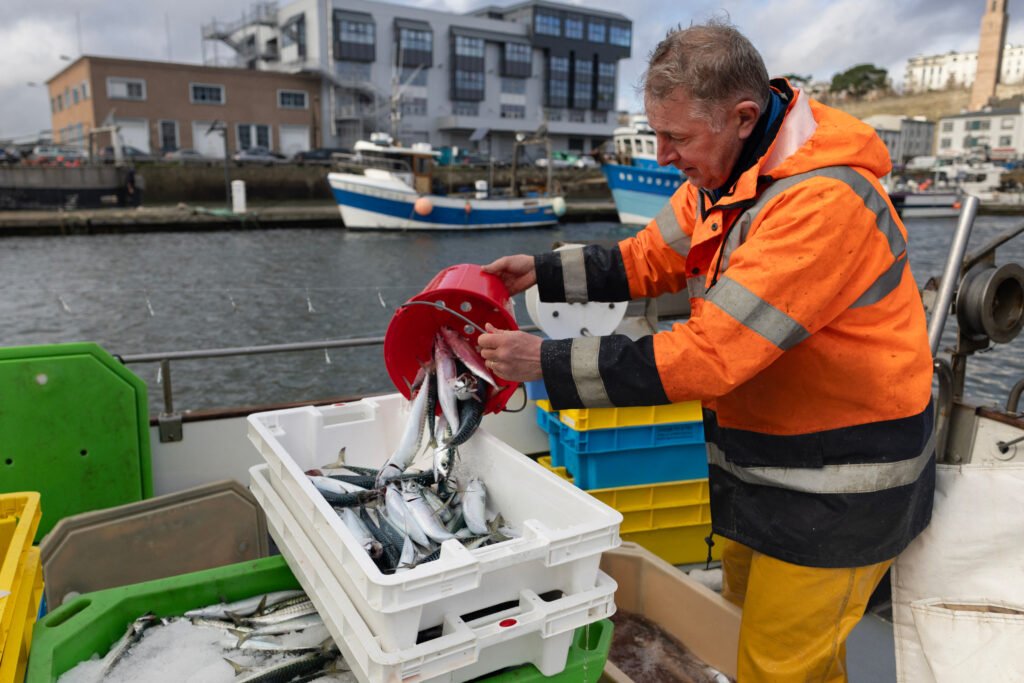
Norway, Denmark, Iceland, the United Kingdom, the European Union and Russia all share the world’s largest and most lucrative Atlantic mackerel supply, an industry valued at more than $1 billion annually. But they can’t agree on who gets what slice of the pie.
In the midst of the disagreement, the population of adult mackerel has been in free fall for a decade. With each party refusing to lose out to its neighbor, the stock has declined by over 10 million tons since 2014, driven by aggressive overfishing.
While scientists warn the current trajectory will lead to ecological collapse, skippers from Scotland’s Shetland Islands to the Arctic Circle’s Murmansk are eager to fish what’s left, fiercely competing for their share of the shrinking stock.
“Even an advanced, well-resourced, technologically sophisticated fishery can go from being a flagship, profitable, stable fishery to a kind of geopolitical mess and, ultimately, a collapsing fishery,” said Dan Steadman from the international fisheries team at The Pew Charitable Trusts.
“It’s a bit of a cautionary tale about what happens if you treat mackerel as this self-contained system that you can just keep taking from without really considering it to be a wild animal,” Steadman said, predicting that warming oceans and acidification will likely exacerbate quota disagreements as scarcity worsens.
Yet, in the latest twist in the contentious world of the North East Atlantic Fisheries Commission (NEAFC), allegations of a backdoor quota grab by a gang of bureaucratic bandits are swirling.
In September 2025, the International Council for the Exploration of the Sea (ICES)—whose data is used to determine annual catch limits—called for a 70 percent reduction in mackerel landings.
This decrease, from roughly 575,000 to 175,000 metric tons, was the result of rampant overfishing placing unsustainable pressure on the species’ reproductive rates.
Despite annual closed-door meetings and proclaimed commitments to “the protection of marine resources,” the Total Allowable Catches (TACs) set by NEAFC over the last few years overshot scientific advice by an average of 39 percent.
Ultimately, all six states are to blame for this tragedy of the commons.
“It’s hard to put into words how outrageous the behavior of all of them is,” said Jonny Hughes, senior policy manager at Blue Marine Foundation, a British ocean conservation charity. “It’s really hard to fathom the extent of the badness of the management.”
In the U.K., where mackerel is the nation’s top landed fish, retailer Waitrose reacted to the scientific advice by pulling its products off shelves to “make a stand against overfishing.” But within NEAFC itself there was further division.
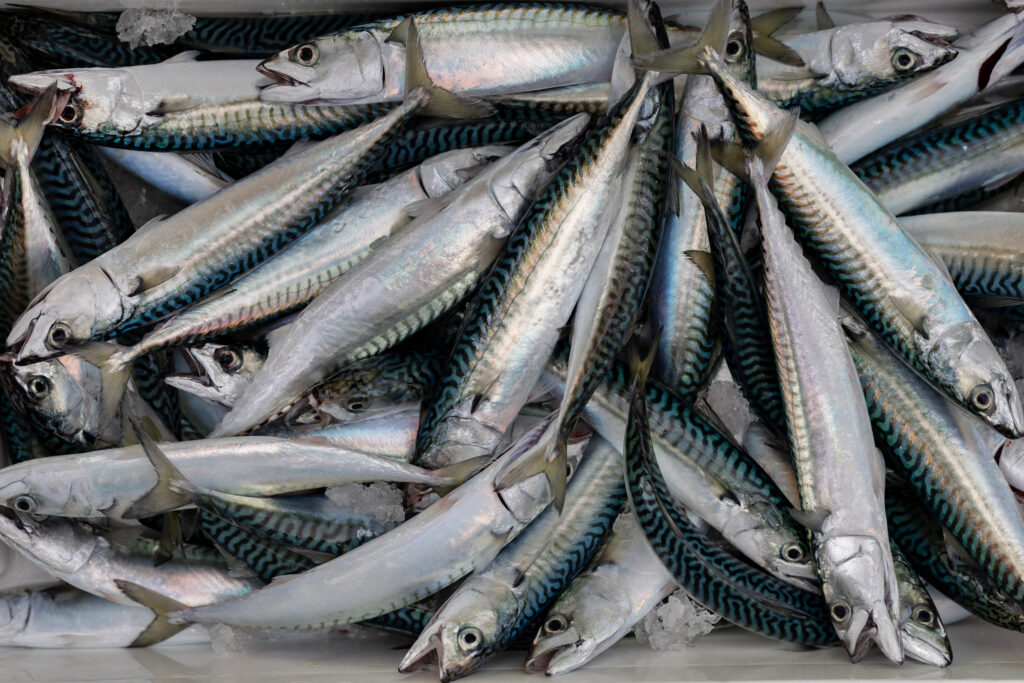
Following a failure to agree on a new TAC, four parties split off and forged their own deal. The U.K., Norway, Iceland and Denmark’s Faroe Islands agreed to a total limit of just under 300,000 tons—a 48 percent reduction from the prior year.
With Russia excluded from negotiations, it asserted its right to just over 67,500 tons of the silvery, Omega 3-rich pelagic fish. And now, the European Union, excluded from either decision, has fired back.
While the EU had advocated for a full 70 percent reduction, it has instead sided with the gang of four on a 48 percent reduction. And, to balance the totals, all NEAFC members except Russia have agreed to limit the Russian catch of mackerel in international waters to just 1,495 tons—less than one percent of the total catch allowance—citing suggestions that Russia is the biggest driver of overfishing.
“Given Russia has historically caught about 20 to 22 percent of the stock, this is a pretty obvious quota grab,” said Hughes, highlighting how the U.K. has simultaneously increased its share by 10 percent, exploiting Russia’s current pariah status for its own economic gain.
When asked for comment, a European Commission spokesperson clarified to Inside Climate News that mackerel are not found in Russian waters and stressed that the imposition of a 1,495-ton quota applies to international waters only.
The spokesperson denied suggestions of a quota grab, stating: “The NEAFC Recommendation neither sets a quota for Russia nor transfer [sic] any Russian quota to other Parties.” Rather, they framed the controversial 1,495-ton limit as a “stock protection reserve level” in response to “Russia’s fivefold unilateral increase in its claimed share.”
Brussels also justified the more publicly punitive approach by pointing to Moscow’s history of opaque fishing practices, with NEAFC members further agreeing to ban at-sea refuelling or catch collection services to Russian fishing vessels that exceed the limit in European, British, Icelandic and international waters. Russian vessels carrying mackerel quantities that exceed the limit will also be banned from entering these nations’ ports.
While the European Commission channels its criticism and condemnation through bureaucratic briefings, critics contend that its claim that Russia alone has been unduly increasing its take contains significant accounting errors.
This story is funded by readers like you.
Our nonprofit newsroom provides award-winning climate coverage free of charge and advertising. We rely on donations from readers like you to keep going. Please donate now to support our work.
“This absurd EU argument that Russia has increased its quota share is just untrue,” said Hughes, criticizing, for example, “the gap between how Norway presents itself as an environmentally conscious country and how it behaves in the sea. It’s staggering.”
The Russian fleet is not happy. Konstantin Drevetnyak, the general director of Russia’s Union of Fishermen for the North, told IntraFish: “A quota of 1,495 metric tons can hardly be called a quota,” protesting that Moscow has already reduced their catch limit by 38 percent compared to the previous year.
Behind the smokescreen of political condemnation is a brewing ecological disaster: The NEAFC framework has failed once again, with the total forecasted catch is now double what ICES has recommended.
The breakdown is so clear that even member states admit the system is broken.
“The Commission is deeply concerned by the current failure to ensure sustainable management of the North-East Atlantic mackerel stock,” said a European Commission spokesperson. “Despite the EU [sic] sustained efforts to promote sustainable management, the results achieved to date remain clearly insufficient.”
Unexpectedly candid, a commission spokesperson highlighted that the last independent performance review of NEAFC, carried out in 2014, found that parts of the process “lacked transparency and inclusiveness, failed to deliver sustainable management of the stock, and had a negative impact on NEAFC processes.”
Steadman, whose organization advocates for an ecosystem-based fisheries management program instead, is hardly surprised by these developments: “You ignore ecosystem signals and climate signals at your peril.” Rather than viewing individual species as operating in a self-contained silo, Steadman believes in a more holistic approach that assesses mackerel health as a determinant of their environment and their role in complex food webs.
Building in environmental signals that account for, for example, the annual average sea surface temperature or the predation rates from seals and seabirds would provide a far more sophisticated multi-species management plan.
This approach is possible. In 2023, Peru temporarily shut down the billion-dollar anchovy season after El Niño rolled through its waters, with government ministers citing the need to protect long-term fisheries populations over short-term economic gain.
The existing framework is also ill-equipped to deal with the climate migration of mackerel, according to critics.
As waters warm and shoals of mackerel move polewards, the existing framework stubbornly resists change. In 2010, Iceland joined NEAFC as mackerel stocks arrived off their subarctic shores. Yet, other countries were unwilling to cede their quotas. The result was intense diplomatic disagreements, further overfishing and the start of the “mackerel wars.”
While it is a single, solitary species, mackerel is a harbinger of the escalating natural resource disputes to come as climate pressures intensify.
“We are clearly dealing with a changed ocean environment,” said Steadman. “So do you just kind of ignore that, use your old tools and hope for the best, or do you rip up the rulebook and say, ‘OK, maybe we need to prepare for the worst.’”
About This Story
Perhaps you noticed: This story, like all the news we publish, is free to read. That’s because Inside Climate News is a 501c3 nonprofit organization. We do not charge a subscription fee, lock our news behind a paywall, or clutter our website with ads. We make our news on climate and the environment freely available to you and anyone who wants it.
That’s not all. We also share our news for free with scores of other media organizations around the country. Many of them can’t afford to do environmental journalism of their own. We’ve built bureaus from coast to coast to report local stories, collaborate with local newsrooms and co-publish articles so that this vital work is shared as widely as possible.
Two of us launched ICN in 2007. Six years later we earned a Pulitzer Prize for National Reporting, and now we run the oldest and largest dedicated climate newsroom in the nation. We tell the story in all its complexity. We hold polluters accountable. We expose environmental injustice. We debunk misinformation. We scrutinize solutions and inspire action.
Donations from readers like you fund every aspect of what we do. If you don’t already, will you support our ongoing work, our reporting on the biggest crisis facing our planet, and help us reach even more readers in more places?
Please take a moment to make a tax-deductible donation. Every one of them makes a difference.
Thank you,
Fisheries Reporter
Johnny Sturgeon is a London-based reporter covering fisheries and aquaculture. Joining us from the Outlaw Ocean Project, he has experience producing in-depth maritime investigations for nonprofit newsrooms. A former boatbuilder, he holds a B.A. in History & Politics from the University of Oxford, and an M.S. from Columbia Journalism School.