

For weeks, the Central Board of Secondary Education has been trying to put a troubled exam season behind it. It hasn’t quite managed to do that.
“Many students, including me, have still not received our CBSE re-evaluation results despite the board announcing that most results have been released,” he wrote on social media.
Vedant had earlier become the face of a controversy that snowballed into one of the most discussed CBSE issues in recent years. When he sought a copy of his Physics answer script during the review process, the answer sheet he received was not his own. It was reportedly mixed up with that of another student. After he shared the issue online, hundreds of students began posting similar complaints, alleging discrepancies in marks, unawarded answers, and answer-sheet mix-ups.
Read | CBSE Class 12 student scores 500/500 after re-evaluation of two papers
The board later provided what appeared to be Vedant’s actual answer script. But the document raised fresh questions. Observers noted that the paper carried red-ink markings typically associated with manual evaluation by an examiner, even though CBSE has increasingly relied on digital evaluation systems, including On-Screen Marking (OSM).
As the board attempts to draw a line under a difficult examination season, Vedant’s unresolved case continues to fuel questions about the transparency and consistency of the re-evaluation process.
Story continues below this ad
CBSE did, last week, clarify its position, stating that results for approximately 87 per cent of students who applied for re-evaluation had been announced, with the remainder to follow. But that clarification, while intended to reassure, has done little to address the lived reality of those still waiting, or of those who received their rechecked results and found them wanting.
Not just delayed timelines: Discrepancies that survived the recheck
The issue, it turns out, has two dimensions. One is the backlog. The other, arguably more troubling, is that several students who have received their re-evaluation results say the problems haven’t gone away. The Indianexpress.com spoke to several students who allege mismatches in their scores even after re-evaluation.
‘Correct answers, but no marks’
For Harshit Gupta, a Commerce student from Gurgaon, the grievance was never purely about numbers. It was about what he saw as a pattern: answers he believed were demonstrably correct receiving zero credit, even after the official review.
Physical Education was the subject that troubled him most. Harshit says he has never scored as low in the subject during his school years as he did in the boards, despite finding the paper manageable. After obtaining his evaluated answer sheets, he identified specific instances where his responses, including one on the benefits of yoga asanas, appeared to substantially align with accepted explanations, yet earned him no marks.
Story continues below this ad
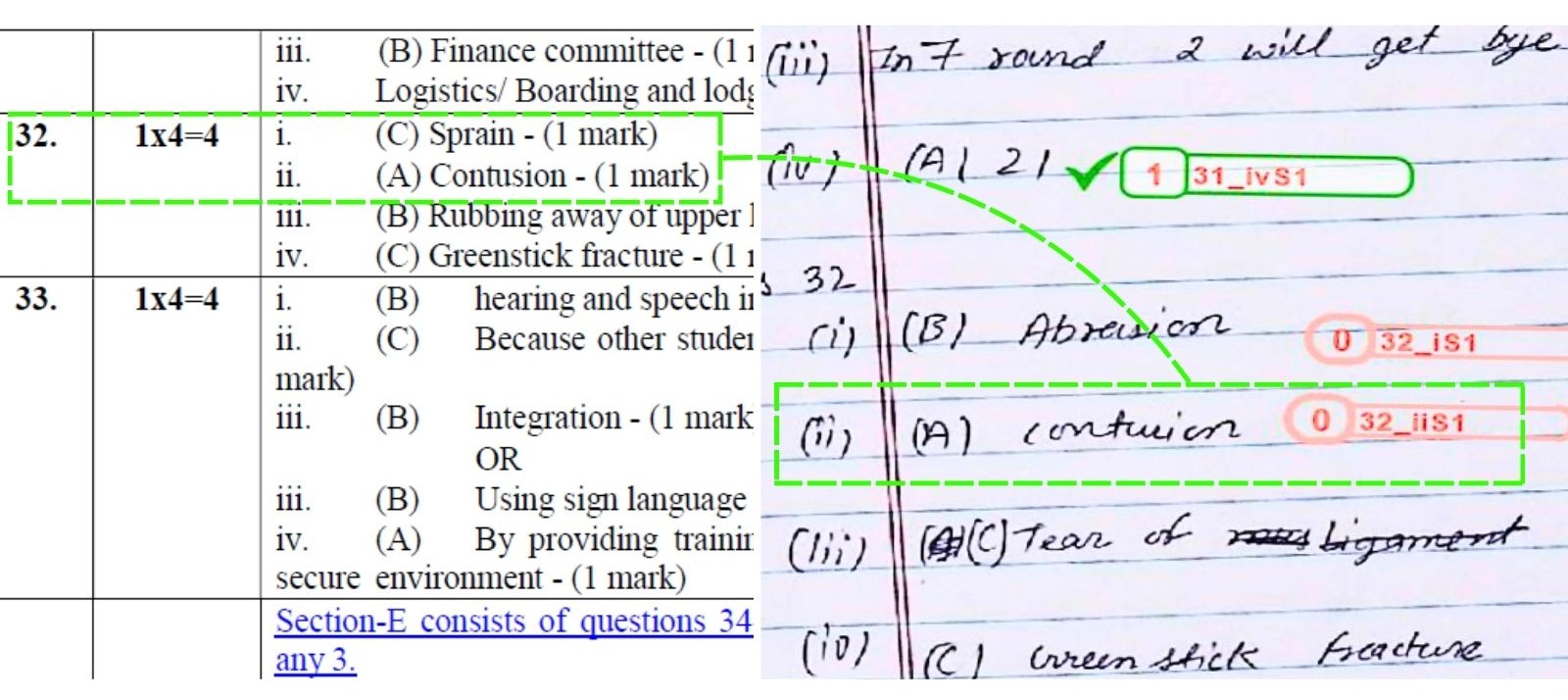 CBSE 12th student Harshit’s marksheet (Right), and the answer key (left)
His teachers encouraged him to pursue the rechecking route. The outcome, however, left him unconvinced. While he accepts that some deductions in Accountancy may reflect legitimate valuation judgment calls, he believes the broader problem lies in how subjective answers in Physical Education were handled. His final score of 73 per cent, lower than his consistent school performance, has reinforced his sense that the mechanism didn’t address what he actually raised.
Marks changed, and didn’t; CBSE never revealed where or why
Praveen Yadav’s frustration is of a different kind, not that the process failed to find errors, but that it corrected them without ever explaining what went wrong.
A science student whose family is based in West Bengal and whose father serves in the defence forces, Praveen had expected to clear 75 per cent but finished with 68.79 per cent. He applied for re-evaluation of his Biology and Mathematics papers. In Mathematics, the exercise yielded a nine-mark increase, a revision significant enough to suggest that his original concerns were justified.
But CBSE didn’t tell him which questions were reassessed, or where those nine marks came from. Biology remained unchanged, with no explanation for why one subject saw a substantial correction while the other did not. The opacity, Praveen says, is the heart of his complaint: students are expected to accept mark revisions without being shown the reasoning behind them.
Story continues below this ad
Also Read | CBSE 12th candidates with ‘no change’ in scores can approach regional offices offline
The uncertainty also cost him in practical terms. Alongside the board-related back-and-forth, he was simultaneously preparing for JEE, NEET, and a compartment examination in Chemistry, and says the prolonged focus on rechecking ate into that preparation time.
Re-evaluation moved the needle, but not enough
For Sarthak Gupta, a PCM student from Jammu, the re-evaluation outcome is best described as a partial acknowledgement that something went wrong, one that fell far short of addressing the scale of what he believes the errors amounted to.
Sarthak had cleared Class 10 with over 97 per cent. His board results in Class 12 came as a genuine shock: 65 out of 100 in Physics, and 54 out of 100 in Chemistry, with the theory component in Chemistry leaving him just one mark above the pass threshold. After reviewing photocopies of his answer sheets, he identified multiple responses, including some carrying three or five marks, that he claims were awarded zero credit despite being substantially correct.
Got just 1 mark out of 2 marks even when the answer is more detailed than the answer key. /4 pic.twitter.com/r6xPcu1ZnO
— Sarthak Gupta (@sarthakguptadev) June 22, 2026
Story continues below this ad
He estimated that discrepancies across subjects could account for over 100 additional marks.
Re-evaluation brought increases: Physics up by four marks, Chemistry by two, Informatics Practices by two. His overall percentage settled at 85.6 per cent, comfortably clearing eligibility thresholds for further studies.
But for Sarthak, that’s almost beside the point. The modest revisions confirmed that errors existed, but also suggested the process didn’t go far enough to find all of them. The two subjects he felt most wronged by remain, in his view, substantially undervalued. The re-evaluation, as he sees it, validated the problem without solving it.