

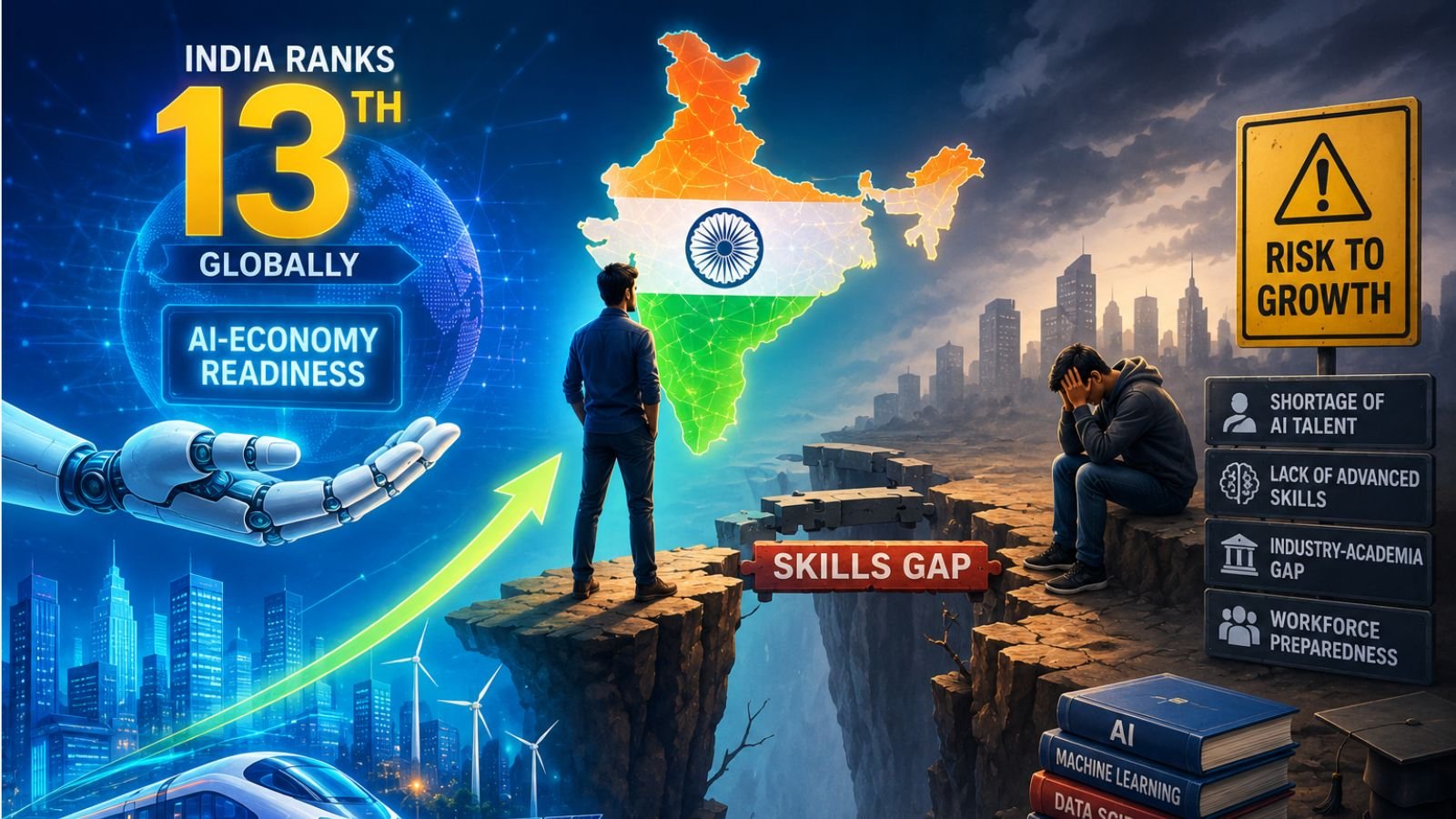
India has secured the 13th position globally in AI-economy readiness, according to the QS World Future Skills Index 2027, released today by QS Quacquarelli Symonds, the global higher education analytics firm. While the ranking positions India as the leader among South Asian and lower-middle-income nations, the report flags a widening mismatch between the country’s booming labour market transformation and the quality of skills its universities are producing.
India achieved a perfect score of 100 on QS’s Economic Capacity sub-indicator — the highest in the world — driven by its consistent GDP growth, labour market investment, and aggressive infrastructure spending. India has been the fastest-growing economy in the G20 for three consecutive years, and its AI-related investments have already reached $90 billion as of February 2026.

Global Leaderboard: Where India Stands
QS World Future Skills Index 2027 — Top 15 Nations
| Rank | Economy | Overall Score (/100) | Primary Strength |
|---|---|---|---|
| 1 | United States | 99.2 | Skills Alignment |
| 2 | Australia | 97.5 | Academic Readiness |
| 3 | United Kingdom | 96.6 | Academic Readiness |
| 4 | Germany | 95.5 | Future of Work |
| 5 | Canada | 93.7 | Academic Readiness |
| 6 | South Korea | 93.4 | Economic Transformation |
| 7 | China | 92.5 | Economic Transformation |
| 8 | Netherlands | 91.9 | Academic Readiness |
| 9 | Spain | 91.7 | Academic Readiness |
| 10 | Switzerland | 91.6 | Academic Readiness |
| 11 | France | 91.2 | Academic Readiness |
| 12 | Singapore | 91.1 | Economic Transformation |
| 13 | India | 89.4 | Future of Work |
| 14 | Sweden | 89.2 | Economic Transformation |
| 15 | Japan | 89.0 | Skills Alignment |
Yet, the same report shares that India ranks only 73rd on the Human Capital Index, a measure of graduate quality and institutional output. In other words, India is producing graduates at an extraordinary volume — it holds the largest number of tertiary-educated individuals in the world — but the median quality of that talent is not keeping pace with what employers, particularly in AI, digital and green sectors, are demanding.
The $500 billion opportunity at stake
According to projections cited in the report from IBM’s 2026 research, successful AI adoption could add $500 billion in economic value to the Indian economy by 2030. India also possesses the world’s largest IT services workforce — 5.8 million professionals — contributing $300 billion annually to the national economy, according to Nasscom’s 2026 Technology Sector Review.
But the report warns that these strengths cannot be taken for granted. India’s large Business Process Outsourcing (BPO) and call centre industry is identified as particularly vulnerable to automation, while the agricultural sector — which still employs a significant share of the workforce — offers fewer opportunities for AI augmentation compared to knowledge-intensive industries.
Quantity vs Quality: The challenge
Nunzio Quacquarelli, President of QS, put the dilemma, “The size of India’s digital workforce is rapidly attaining a scale that few other countries can match. It already possesses the world’s largest IT workforce and the largest number of tertiary-educated individuals in the world. These ingredients give India the potential to be the fastest-growing economy in the world over the next decade.”
However, he underscores that the critical challenge is now raising the median quality of talent that its institutions produce, as well as addressing capacity hurdles.
Story continues below this ad
Quacquarelli pointed to India’s National Education Policy (NEP) 2020 as an ambitious structural response to these challenges, but cautioned that its implementation must be scaled evenly across regions to be effective. He also called for greater uptake of transnational education partnerships, including branch campuses and collaborative delivery models, to close skills gaps faster and expand global talent pipelines.
India leads its peer groups by a wide margin
Despite the internal challenges, India’s position relative to comparable economies is commanding. The QS Index groups nations by income level and geography, and by both measures, India is in a class of its own:
–South Asia: India ranks 1st; nearest regional peer is Bangladesh at 67th globally
–Lower-Middle Income Nations: India ranks 1st; nearest income-group peer is the Philippines at 38th globally
Story continues below this ad
India’s Performance by Indicator — QS World Future Skills Index 2027
| Indicator | Score (/100) | Global Rank |
|---|---|---|
| Economic Capacity | 100.0 | 1 |
| Future of Work | 96.0 | 5 |
| Economic Transformation | 93.3 | 14 |
| Academic Readiness | 85.7 | 22 |
| Skills Alignment | 82.7 | 18 |
| Overall | 89.4 | 13 |
As mentioned in the report, it is not just economic size but a genuine structural advantage that India has built through decades of investment in engineering education, technology infrastructure, and IT sector development.
What needs to change
The report states that higher education is struggling to equip graduates who are needed more for a rapidly changing labour market. At the same time, employer demand for AI, digital, and green skills is rising faster than traditional educational models can respond. For India, three priorities emerge from the QS report:
1. Implementation of NEP 2020: The policy’s ambitions are sound, but regional disparities in implementation risk creating a two-tier graduate workforce.
2. AI-Augmented over AI-Automated jobs: Nations like the US, UK, Australia and Germany lead not because they are adopting AI faster, but because a greater share of their workforce is in roles where AI enhances rather than replaces human productivity. India must steer its economy in the same direction — particularly through investment in healthcare, financial services, agricultural technology and business services.
Story continues below this ad
3. Green talent pipeline: With India committed to reaching net-zero carbon emissions by 2070 under its Viksit Bharat 2047 vision, building a pipeline of green-skilled graduates is not optional — it is an economic imperative.