

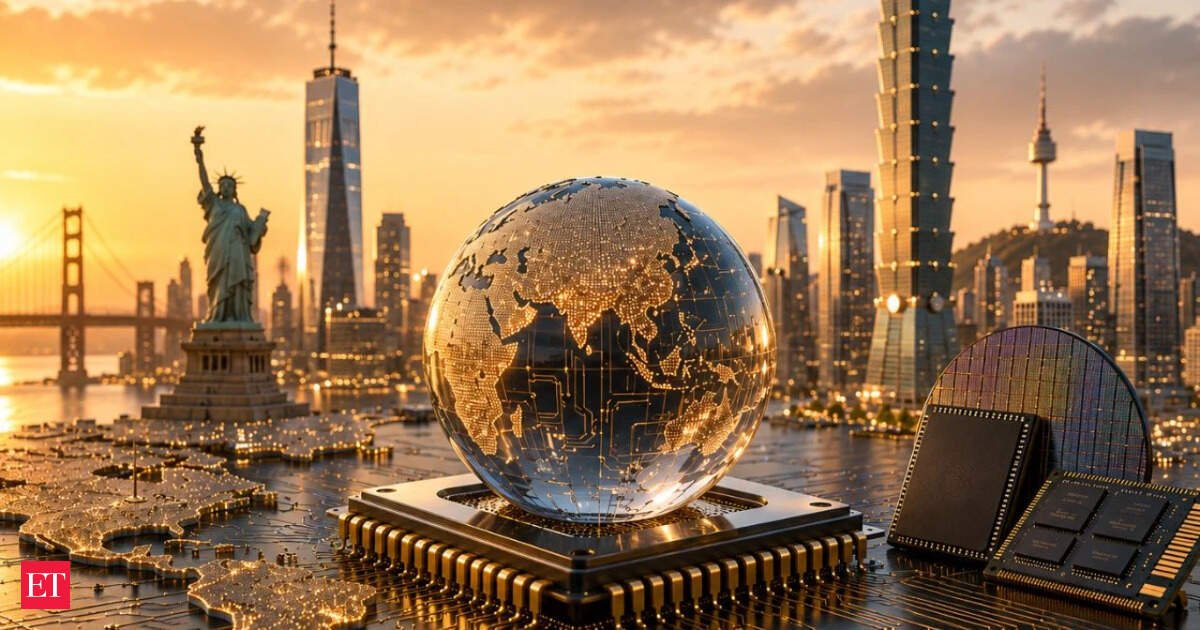
It may actually be something much bigger.
For much of the last century, countries that controlled oil shaped global trade, geopolitics and economic growth. Today, a growing number of nations are finding that influence through semiconductors.
Prime Minister Narendra Modi hinted at that shift earlier this year when he said: “In the 20th century, nations that possessed oil gained prosperity and power. In the 21st century, that same power lies in small chips.”
The comparison is becoming harder to ignore.

Also Read: TSMC reports $54.55 billion profit in 2025 as AI-driven chip demand boosts earnings
Taiwan’s importance to the global economy is increasingly tied to Taiwan Semiconductor Manufacturing Company (TSMC). South Korea’s stock market is being reshaped by the fortunes of Samsung Electronics and SK Hynix. In the United States, Nvidia’s rise has turned a chipmaker into one of the most important companies in the world.The countries gaining influence in the AI era are not necessarily the ones sitting on oil reserves. Increasingly, they are the ones sitting at critical points in the semiconductor supply chain.
That matters because semiconductors are no longer just another technology product. They are becoming the infrastructure behind artificial intelligence.
Every ChatGPT query, every AI-generated image and every large language model ultimately runs on chips. The more companies spend on AI, the more demand flows through the semiconductor industry.
Follow the money
The numbers illustrate the scale of the shift.
Global semiconductor sales surged 25.6% to a record $791.7 billion in 2025, according to the Semiconductor Industry Association (SIA), putting the industry within touching distance of the $1 trillion mark expected in 2026.
“Semiconductors are the foundation of nearly all modern technology,” SIA President and CEO John Neuffer said while announcing the figures.
But the bigger story may not be the growth of chip companies. It is how semiconductors are increasingly reshaping stock markets, capital flows and national economic fortunes.
Market capitalisation is not a measure of economic size. It is a measure of where investors believe future growth and profits will be created. By that metric, global capital is increasingly gravitating toward countries that occupy critical positions in the AI supply chain.
According to Bloomberg data, Taiwan’s market capitalisation climbed to $4.95 trillion this year, making it the world’s fifth-largest equity market behind only the United States, mainland China, Japan and Hong Kong. The rise was powered largely by TSMC, whose shares surged 46% amid investor enthusiasm around artificial intelligence.
The chipmaker now accounts for roughly 42% of Taiwan’s benchmark stock index, making it one of the most concentrated major equity markets in the world.
South Korea has experienced a similar transformation. Bloomberg data show the market capitalisation of Korean-listed companies climbed to about $5 trillion, up 86% this year, driven largely by gains in Samsung Electronics and SK Hynix as investors poured money into companies seen as critical to the AI buildout.
“Markets with limited exposure to tech hardware are increasingly being overshadowed by tech hardware-heavy markets such as Taiwan and Korea,” Yi Ping Liao, a fund manager at Franklin Templeton, told Bloomberg.
Also Read: South Korea, Taiwan leapfrog India, but the race was lost decades ago
According to Bloomberg, Gerald Gan, chief investment officer at Reed Capital Partners, described it as part of a broader shift in global capital flows toward economies helping power the next wave of technological innovation.
The message from investors is becoming increasingly clear: in the AI era, semiconductor leadership is emerging as a source of economic value in its own right.
The rise of semiconductor states
Consider Taiwan.
An island of just 23 million people has become one of the most strategically important economies in the world, largely because of a single company.
TSMC manufactures the world’s most advanced chips and supplies companies ranging from Nvidia and Apple to AMD and Qualcomm. Every major AI investment cycle eventually leads back to its factories.
Its influence extends far beyond manufacturing. TSMC’s growing weight in Taiwan’s market prompted regulators to loosen investment restrictions for domestic funds earlier this year. JPMorgan estimated the move could unlock more than $6 billion in additional inflows into the company, according to Bloomberg.
That dependence has become so significant that Taiwan’s semiconductor industry is now regularly referred to as a “silicon shield” — shorthand for the idea that the island’s role in global chip supply chains makes it strategically indispensable.
Few companies have exerted such influence over a country’s economic standing, stock market and geopolitical relevance.
A similar story is playing out in South Korea.
The AI boom has triggered a surge in demand for high-bandwidth memory, or HBM, a crucial component used alongside AI processors. According to SIA data, global memory-chip sales jumped 34.8% in 2025 to $223.1 billion, making it the second-largest semiconductor category after logic chips.
That surge has turned SK Hynix into one of Nvidia’s most important suppliers and helped it overtake Samsung Electronics in market value earlier this year, ending a hierarchy that had largely remained intact since 2000.
“The emergence of customised AI memory fundamentally changed the industry’s economics and allowed SK Hynix to establish itself as the market leader,” Kim Sunwoo, a senior analyst at Meritz Securities, told Reuters.
For South Korea, this is not merely a corporate success story.
Semiconductors are one of the country’s most important export industries. Together, Samsung and SK Hynix have become so central to the AI trade that they helped propel South Korea up the global equity rankings, underscoring how semiconductor leadership is increasingly translating into national economic influence.
The same trend is visible in the United States.
A decade ago, Nvidia was primarily known for gaming graphics cards. Today, it sits at the centre of the global AI economy.
Technology giants including Microsoft, Amazon, Google and Meta are spending tens of billions of dollars on AI infrastructure every year. A significant portion of that money ultimately flows into Nvidia’s ecosystem.
 ET Online
Its $5 trillion valuation is not simply a reflection of investor optimism around one company. It is a reflection of the belief that computing power is becoming one of the world’s most important economic resources.
Why governments are scrambling
The rise of AI has also changed what governments consider strategically important.
For decades, policymakers worried about access to oil fields, pipelines and shipping routes. Today, they are increasingly worried about access to computing power.
That helps explain why countries around the world are pouring billions of dollars into domestic chip production.
Also Read: India’s lost chip dream: The mysterious 1989 fire that may have cost the nation the AI race
The United States has the CHIPS Act. Europe has launched its own semiconductor strategy. Japan is investing heavily in advanced manufacturing. India is offering incentives for semiconductor manufacturing, chip packaging and AI infrastructure as it seeks to build capabilities across the value chain.
The race is no longer simply about building better technology. It is about securing a place in the economic architecture of the AI era.
Why chips aren’t oil
Still, chips are not oil in the literal sense. Oil is extracted. Semiconductors are engineered.
A country can discover a new oil field. It cannot simply discover a TSMC.
Oil powered the industrial economy. Chips are powering the intelligence economy.
And as Nvidia’s $5 trillion milestone suggests, the countries that control the infrastructure behind that economy are beginning to accumulate a level of influence that increasingly resembles the oil powers of the last century.
The race to control oil defined much of the 20th century. The race to control compute may end up defining the 21st.