

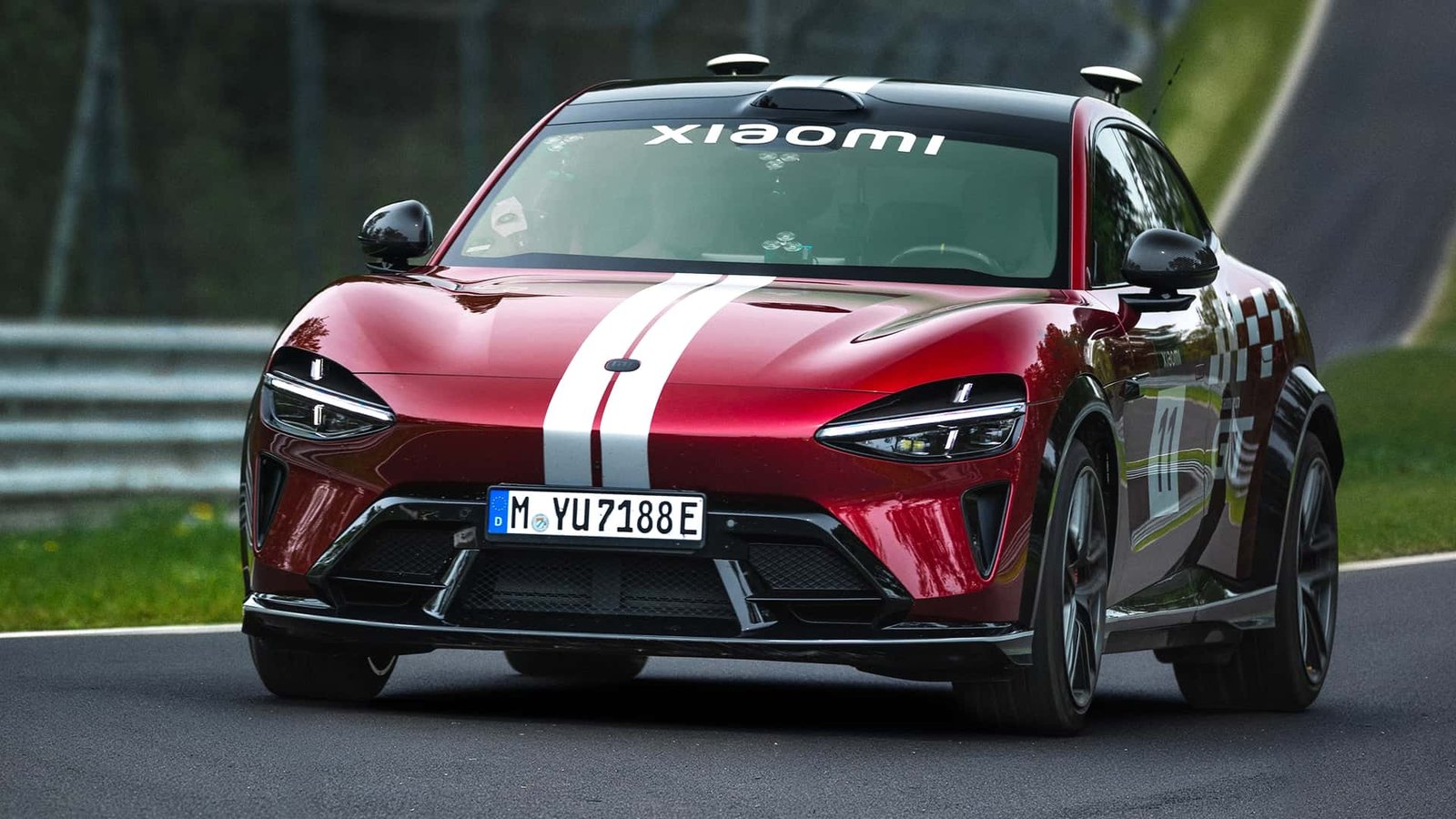
- Xiaomi’s YU7 GT completed a driverless Nurburgring lap, but it was over three minutes slower than the human run.
- The 10-minute lap shows autonomy can survive the Nordschleife, but not yet attack it like a pro driver.
- Xiaomi’s run is impressive, but the closed-track setup leaves big questions about how autonomous it really was.
Driverless laps of racetracks are nothing new. A lap of the Nurburgring Nordschleife with nobody behind the wheel is different just because of how much longer and more challenging this track is.
Xiaomi says its YU7 GT electric high-rider completed a fully autonomous lap of the nearly 13-mile (21-kilometer) German circuit in 10:29.483. That is not quick by Nurburgring standards, or even by YU7 GT standards. But it is still strange and impressive seeing nobody behind the wheel.
The Chinese company is no stranger to the Nurburgring. Its SU7 Ultra electric fastback once held the EV lap record before it was beaten by another Chinese car, BYD’s YangWang U9 Xtreme. But while these cars can post lap times under the 7-minute mark, the driverless YU7 GT took much longer.

With nearly 1,000 horsepower and a sprint to 62 mph (100 km/h) in under 3 seconds, the YU7 GT has the hardware to put most other SUVs to shame around a track. With a human behind the wheel, it clocked a 7:34.931 lap, making it the fastest SUV around the Ring, outpacing the two previous record holders, the Audi RS Q8 Performance and the Porsche Cayenne Turbo GT, by two and four seconds, respectively.
It also looks like the YU7 had the track all to itself—it encounters no other cars that we could see in the onboard video. So while this is still impressive for a first attempt, it would have been even more so if we had seen it autonomously pass other cars or let faster ones go past, adapting to what was around it.
Comparing its human and driverless laps, you can clearly see that during the latter, it goes on the brakes a lot earlier, avoids using the curbs, and generally behaves very cautiously around the corners. That’s why it was nearly three minutes slower, which is a lot, even on an ultra-long track like the Nordschleife. However, as Xiaomi itself admits, this is just the start of something, hinting that we can expect more of this in the future and likely quicker driving.
It announced on its official Weibo account this lap as the track record for autonomous driving, adding that “this is not the end, but a new beginning to reach even greater heights!” What we don’t know is how Xiaomi prepared this lap, what went into it, and how much track-specific training it received. It’s frankly unclear just how autonomous this lap really was, and not knowing what went into it somehow makes it less impressive.