

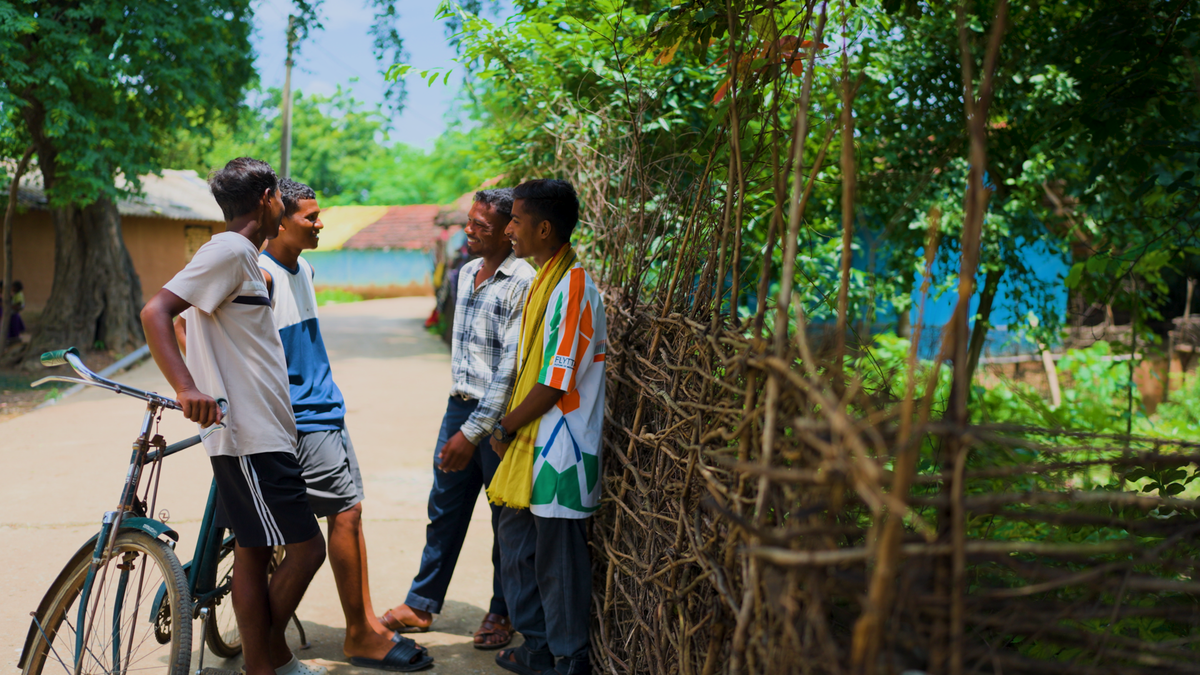
Dumbi, a tall, muscular teenager, walks silently outside his village, which consists of about 70 houses, mostly of the Adivasi Ho community, in Jharkhand. The sixteen-year-old lost his father when he was in class 5. Now, as an elder brother to three siblings, he has to both study and provide economic support to the family.
Dumbi was earlier a vivacious boy. Football had been a major source of joy, and an activity that gave him an identity. Friends regularly invited him to matches in nearby villages. But over time, he stopped playing almost entirely. Persistent worries about work and family began overshadowing activities that once brought him happiness. The burden of caring for the family at the age of 15 made him sullen and withdrawn, and also led to his coping with locally-brewed liquor.

The missing many
Mental health is gaining ground in our everyday conversations, thanks to increased awareness, battles to beat stigma and a growing number of people with lived experience who are talking about it. The people at the forefront of these conversations, however, remain primarily urban-centric and from privileged socio-economic groups. Young people from Adivasi communities remain missing from most of these conversations.
A recent analysis in The Lancet reveals that mental health conditions such as anxiety and depression are among the top causes of long-term illness and disability worldwide. They have become leading contributors to the global burden of disease, with the burden particularly high among adolescents and young people.
India has the largest population of indigenous communities in the world. And yet, information about the mental health of these communities is scarce.

The adolescent mind
Globally, mental health problems affect nearly one in seven adolescents aged 10–19 years, with anxiety, depression, and behavioural disorders among the most common conditions. India has one of the world’s largest adolescent populations, but mental health support for young people remains deeply inadequate. The 2015–16 National Mental Health Survey estimated that 7% of adolescents aged 13–17 years experience mental health problems, though most are unlikely to receive any formal care.
Evidence from rural and Adivasi communities in mental health research remains remarkably limited despite these communities constituting around 9% of India’s population. What makes this lacuna even more concerning is that Adivasi communities continue to face deep social, economic, environmental, and health inequities, with the most affected being young people.
Very little is known about how Adivasi adolescents understand and express emotional distress. The small amount of available research, though, suggests that the burden may be substantial and widely neglected. A multi-state survey among Adivasi adolescents in Gujarat, Tamil Nadu, and Meghalaya reported a 16% prevalence of mental disorders, more than double the national adolescent estimate. Another survey among adolescent girls in rural Adivasi blocks of Jharkhand found that 12% experienced symptoms of emotional or behavioural distress.
These numbers, however, reveal only part of the story.

Poverty and mental health
For many young people in Adivasi communities, family responsibilities begin at an early age. Financial insecurity is the norm rather than the exception. The most basic of needs including clothing and school costs are difficult to meet, a reality that Adivasi children understand from the time they are very young. But this premature awareness frequently comes at the cost of adolescence itself, quietly compressing what should be a carefree period with constant worry, restraint, and emotional burdens they are inadequately prepared for. When this is compounded by the loss of one or both parents, it often places adolescents under intense emotional and psychological stress.
This burden is not carried by boys alone.
Fourteen-year-old Nitima has dropped out of school and spends most of her day caring for her younger sibling, grazing cattle, and managing household work. She says she wanted to study, but family circumstances did not allow it. Her father had remarried and lived elsewhere, leaving the family in an impecunious position. Caregivers described how the girl constantly worried about her mother’s future and silently carried anxieties far beyond her age.
What appears in these children externally as “maturity” is often chronic anxiety and emotional exhaustion. Nitima spoke not in the language of depression or mental illness, but through worry, overthinking, sadness, and responsibility.
These experiences rarely enter formal mental health statistics and go unrecognised by the system, but they shape the emotional worlds of Adivasi adolescents every day.
Migration intensifies this burden. Seasonal migration has long existed among Adivasi communities as a response to chronic poverty and land insecurity. Young people migrate to brick kilns, mines, factories, construction sites, and cities in search of income and dignity.
What often remains invisible are the emotional costs of this transition: loneliness, uncertainty, grief, interrupted education, substance use, fractured social ties, and a growing sense of disconnection from both village and city life.
Yet distress is not always expressed in ways recognised by formal mental health systems.

Systemic disconnect
In recent work with Adivasi adolescents in rural Jharkhand, researchers found that young people, caregivers, teachers, and community health workers often described distress through local idioms, bodily complaints, silence, irritability, social withdrawal, or changes in behaviour rather than psychiatric labels such as “depression” or “anxiety”. Adolescents rarely used clinical terminology. Instead, distress was embedded within everyday struggles, relationships, and social realities.
This has important implications.
Mental health systems frequently assume that emotional suffering will present itself in clinically recognisable forms. But among many Adivasi communities, distress may be communicated through stories, metaphors, behaviour, or withdrawal from social life. When professionals fail to understand these expressions, communities themselves begin to appear ‘silent’.
The problem, therefore, is not merely that Adivasi youth do not seek help. It is also that systems often do not know how to hear them.

Disappearing spaces
There is another quieter transformation taking place in villages: the erosion of intergenerational spaces. Ajay, a young community facilitator in one village from Jharkhand, reflected recently that earlier, evenings were spent sitting with elders, listening to stories and experiences. “That was our learning space,” he said. “Now most young people spend time outside villages on their smartphones .”
This is not simply nostalgia for a disappearing past. It reflects the weakening of informal spaces where emotions, identity, memory, and belonging were once shared collectively.

What is needed
India’s response to mental health among Adivasi youth cannot be limited to expanding psychiatric services into rural areas, though accessible care remains essential. A more meaningful response requires strengthening community spaces, reducing social and economic precarity, listening to local languages of distress, and creating systems where young people can speak without fear or shame.
Mental health among Adivasi youth is not only a medical concern. It is also a question of dignity, justice, cultural continuity, and whether young people are allowed to imagine futures beyond survival.
Until India learns to hear these quieter forms of suffering, many young people like Dumbi will continue walking silently at the margins of our collective attention.
With inputs from Yadav Leyangi, Pankaj Pan, Savitri Banra and Kamala Pan.
(Dr. Sachin Barbde is a public health physician working with Adivasi communities in Jharkhand on community-led mental health initiatives. sachin.ekjut@gmail.com; Dr. Christianez Ratna Kiruba is an internal medicine physician and a freelance health journalist based in Guwahati, Assam. christianezdennis@gmail.com )
.