

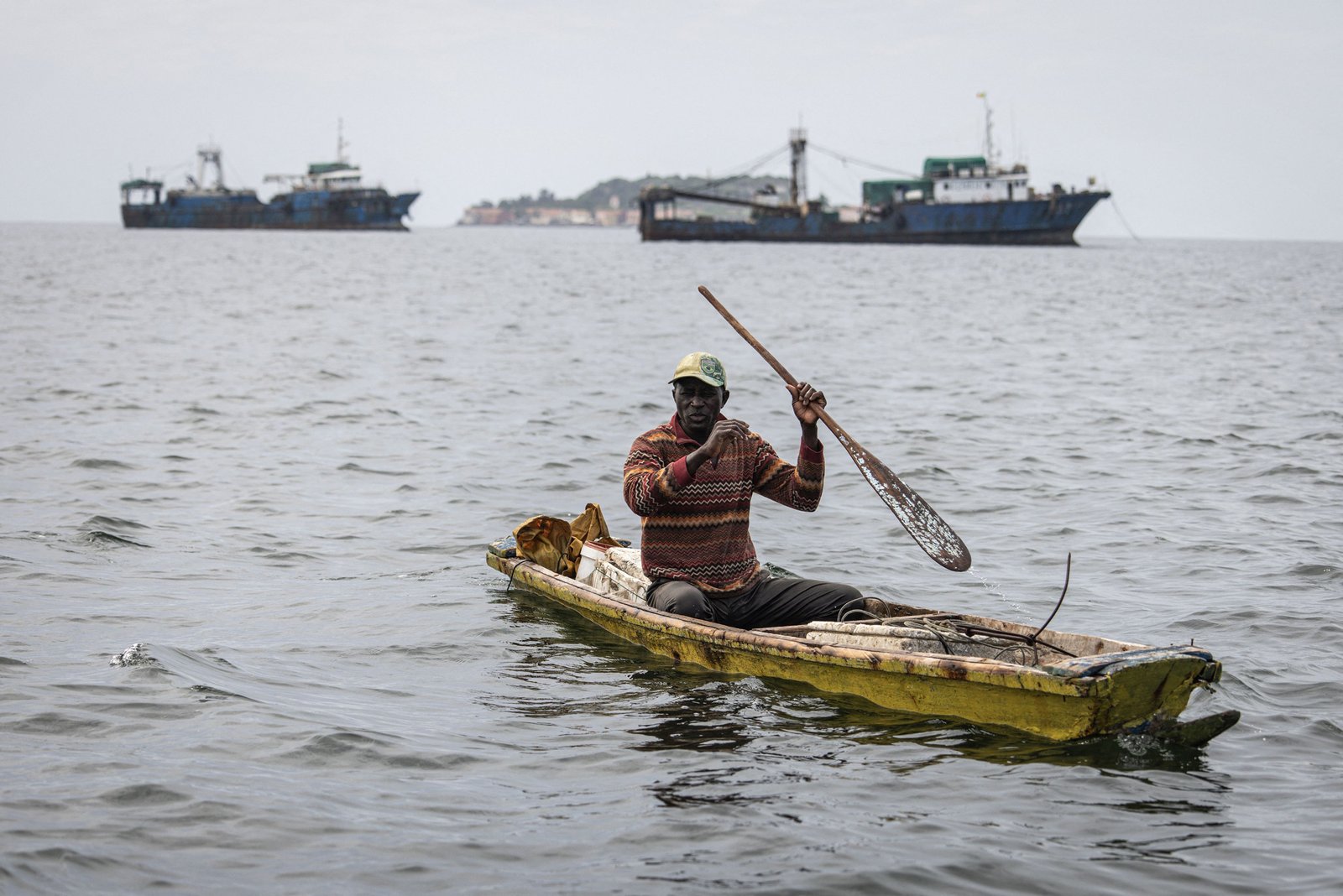
Mamadou Sarr remembers when an artisanal fisherman in Dakar only had to helm his wooden pirogue a single kilometer offshore to find a rich bounty of sardines and cuttlefish. For generations, Senegal’s near shore was the staging ground for a noble trade passed down from father to son.
Today, as a result of industrial overfishing by foreign fleets and the effects of climate change, local fishermen must brave an often dangerous journey almost 100 kilometers into the Atlantic to find the same seafood their communities have depended on for generations.
“The resource is depleting,” said Sarr, president of the Platform of Artisanal Fishing Stakeholders in Senegal, a group that represents more than 50 fishing communities from Saint-Louis down to Cap Skirring. “With the scarcity, the fishermen who aren’t very aware become poor.”
Senegal’s struggles are emblematic of a $50 billion global crisis, with illegal fishing fleets vacuuming unprotected fish stocks around the world. But a landmark piece of international cooperation signed this week at the Our Ocean Conference in Mombasa, Kenya, aims to shine a much-needed light on the malpractice.
Sixteen countries from across Africa, Asia, the Caribbean, Europe and the Pacific pledged to aggressively combat illegal fishing. The solution, they believe, lies with transparency.
The Mombasa Declaration targets increased enforcement, updated vessel registries and improved corporate accountability to crack down on the illegal trade that’s wreaking environmental havoc.
“When you try to fight illegal fishing and associated crime without transparency, you’re literally chasing ghosts,” said Amélie Giardini, the global lead for fisheries transparency at the Environmental Justice Foundation, highlighting the challenges of getting fishing nations to agree. “The fact that this declaration exists, as much as it could look like another piece of paper, and that we convinced countries to sign it, to me, that’s really important,” noting Senegal’s last -minute withdrawal from the agreement and Chile and Gabon’s eleventh-hour participation.
Nearly one in five fish is currently caught outside the law: “If we do not know who is fishing, what, where, when and how, we will never be able to tackle illegal fishing,” Giardini said.
From Peru to Papua New Guinea and Somalia to South Korea, the declaration seeks to unite “nations committed to strengthening ocean governance and leading global action on fisheries transparency.”
“When you try to fight illegal fishing and associated crime without transparency, you’re literally chasing ghosts.”
— Amélie Giardini, Environmental Justice Foundation
Such coastal and island nations are home to small-scale fisheries and maritime economies that suffer the direct consequences of illegal, unregulated and unreported fishing, which decimates fish stocks and undermines food security.
“Our very existence depends on fish,” said Hon. Emelia Arthur, the Ghanaian fisheries and aquaculture minister, in a press release. Sixty percent of the country’s animal protein comes from the Gulf of Guinea, and one in ten Ghanaians works in the fishing industry.
Yet 37 percent of fish caught in West African waters are taken illegally, robbing populations of key stocks like sardinella, anchovies and mackerel, costing the region over $1 billion annually. “Fisheries are a matter of culture and national security for us,” Arthur said.
Senegal and Ghana are not alone. Illegal fishing remains a pervasive scourge from the jeweled waters of remote Pacific atolls to the iceberg fields of Antarctica.
And compared to other extractive sectors, fishing remains opaque. “Fishing has just sort of been left behind,” said Giardini, underscoring how vulnerable the $400 billion industry is to the proliferation of criminality.
“In everything—every community, every regulation, every decision, every management—if there is no transparency, we go in the wrong direction,” said Sarr, warning how West African waters are defenseless against European, Asian and American fleets operating off their coasts.
While Senegal reversed on its early indications of signing the Mombasa Declaration, Sarr remains clear about the need to improve international oversight: “Transparency is something that must be part of the global credo, so that everything people do is legible.”
This story is funded by readers like you.
Our nonprofit newsroom provides award-winning climate coverage free of charge and advertising. We rely on donations from readers like you to keep going. Please donate now to support our work.
The declaration commits to increased accountability through a digitized global vessel registry database, the implementation of unique vessel identifiers for small-scale boats and tracking down the owners profiting from boats caught illegally fishing.
Without greater transparency, existing enforcement sometimes targets the wrong people. “Often the sanction they apply [goes] to the captain or the registered person because we can’t actually find the beneficial owners,” Giardini said. “It’s a bit like we’re taking the small drug dealers off the street and then don’t hit the head of the cartel.”
Similarly, the 16 signatories have pledged to upgrade their existing monitoring, control and surveillance assets to better track bad actors operating in coastal waters or on the High Seas.
Operating beyond the purview of current international enforcement efforts, illegal fishing is often linked to serious human rights abuses, including forced labor, physical violence and death. Indeed, there are over 128,000 fishers trapped in forced labor at sea, according to a 2022 estimate from the United Nations’ International Labour Organization.
Illegal fishing is also known to fuel environmental crimes such as shark finning and ecologically unsustainable rates of bycatch.
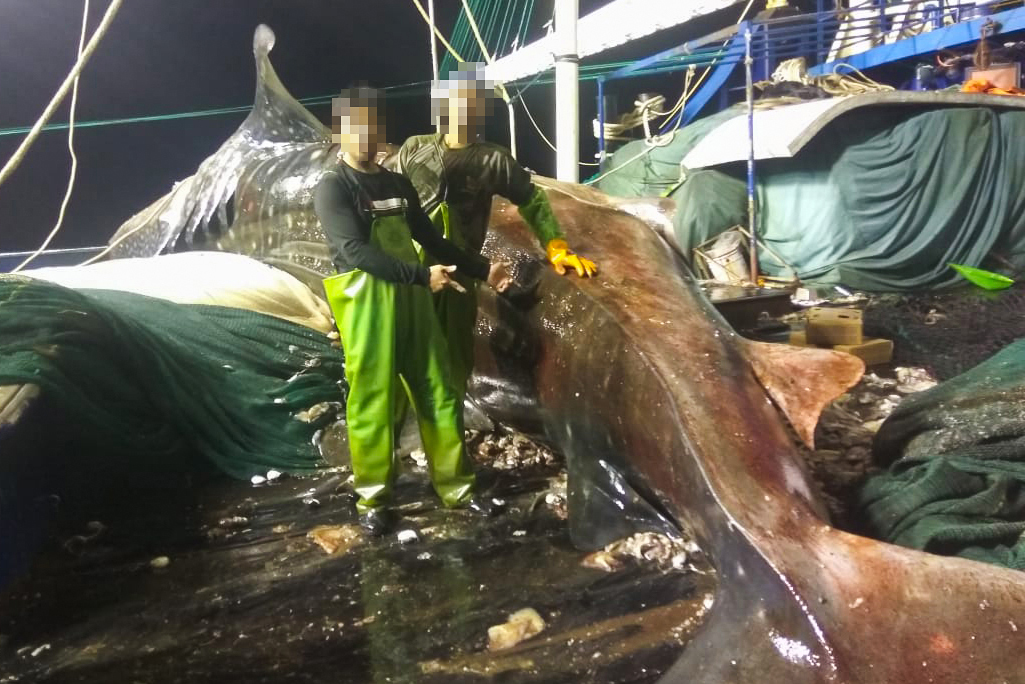
Bycatch refers to fish and other marine animals accidentally ensnared by fishermen using huge nets or long lines baited with thousands of hooks.
Developed with the support of the Coalition for Fisheries Transparency—a global network of more than 60 NGOs working to improve ocean transparency—the declaration views effective fisheries management as central to protecting the long-term health of marine ecosystems.
Among the 16 signatories, perhaps the most important are Liberia and Panama.
Despite having just 10 million citizens combined, they’re central to the “flags of convenience” system whereby international companies register ships in nations with lower taxes and limited environmental and labor regulations. Holding the first- and second-largest ship registries in the world respectively, their participation indicates a willingness to crack down on foreign-owned vessels committing crimes under their nations’ red, white and blue banners.
In 2020, for example, a fleet of more than 250 Chinese-owned ships was intercepted while illegally fishing in the bountiful and endangered-species-rich waters of the Galápagos Islands. The Ecuadorian Navy discovered that many of the reefers—refrigerated cargo vessels that collect and process fish at sea—were in fact registered in Panama.
Additionally, the inclusion of two European Union member states—Belgium and France—sets a strong precedent for the economic bloc to follow suit, said Vera Coelho, the executive director and vice president of Oceana Europe.
“The Mombasa declaration puts in place a roadmap to improve transparency by 2028,” said Coelho, highlighting the need for a solution that ultimately combines sustained political will with strong domestic laws and international action.
However, it’s just the start: “It is up to us, as civil society and the international community, to hold them accountable to these commitments.”
About This Story
Perhaps you noticed: This story, like all the news we publish, is free to read. That’s because Inside Climate News is a 501c3 nonprofit organization. We do not charge a subscription fee, lock our news behind a paywall, or clutter our website with ads. We make our news on climate and the environment freely available to you and anyone who wants it.
That’s not all. We also share our news for free with scores of other media organizations around the country. Many of them can’t afford to do environmental journalism of their own. We’ve built bureaus from coast to coast to report local stories, collaborate with local newsrooms and co-publish articles so that this vital work is shared as widely as possible.
Two of us launched ICN in 2007. Six years later we earned a Pulitzer Prize for National Reporting, and now we run the oldest and largest dedicated climate newsroom in the nation. We tell the story in all its complexity. We hold polluters accountable. We expose environmental injustice. We debunk misinformation. We scrutinize solutions and inspire action.
Donations from readers like you fund every aspect of what we do. If you don’t already, will you support our ongoing work, our reporting on the biggest crisis facing our planet, and help us reach even more readers in more places?
Please take a moment to make a tax-deductible donation. Every one of them makes a difference.
Thank you,
Fisheries Reporter
Johnny Sturgeon is a London-based reporter covering fisheries and aquaculture. Joining us from the Outlaw Ocean Project, he has experience producing in-depth maritime investigations for nonprofit newsrooms. A former boatbuilder, he holds a B.A. in History & Politics from the University of Oxford, and an M.S. from Columbia Journalism School.