

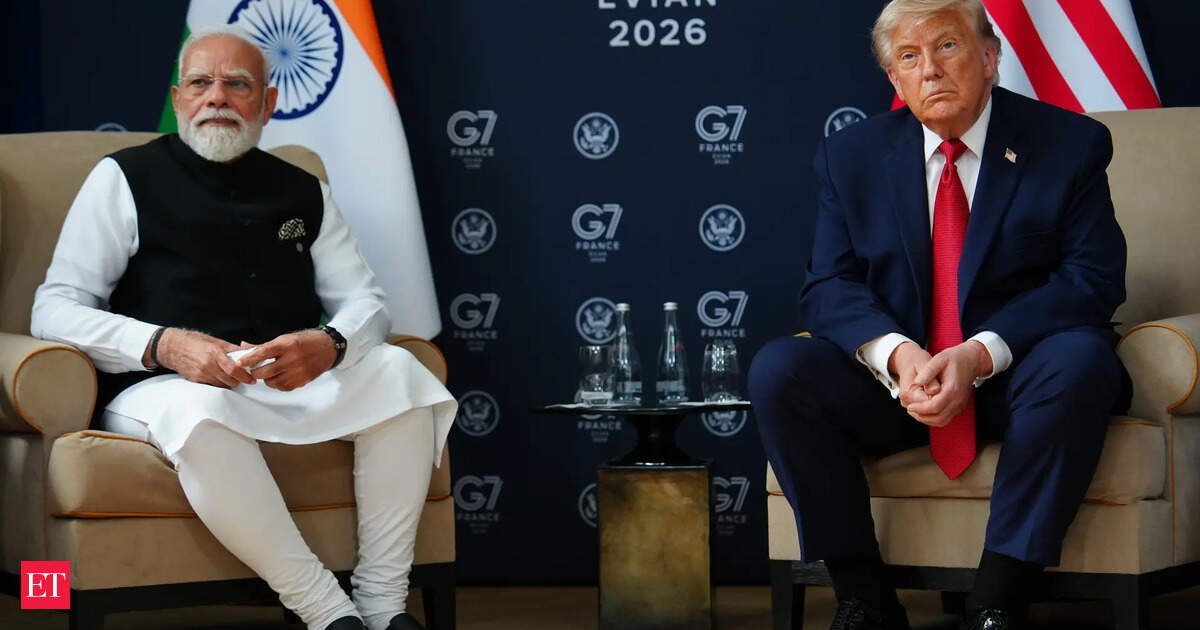
He called Modi a long-time friend and described him as a shrewd negotiator on trade, who may look “like an angel, but actually, he’s as tough as a killer.”
Modi, by contrast, was relatively restrained. Sitting next to Trump after the two held a bilateral meeting on the sidelines of the Group of Seven summit, Modi largely spoke from prepared notes. He said the two sides had productive meetings and thanked Trump for his role in restoring peace in the Middle East, but stopped short of calling the US president a friend, as he’d done in the past.
ALSO READ | PM Modi and Trump direct officials to fast-track ‘commercially meaningful’ trade pact
The tone suggests a new cautiousness from New Delhi as both sides look to reset their relationship after more than a year of tensions over everything from tariffs, to Russian oil, to Pakistan and now, the Iran war. With many of those frictions remaining, analysts say it will take more than friendly handshakes and smiles to get ties back on track.

“The past eighteen months have been a wake-up call about the risks of placing too many eggs in the American basket,” said Milan Vaishnav, director of the South Asia Program at the Carnegie Endowment for International Peace in Washington. “India will remain engaged with the United States, but it will also become more cautious and intensify its efforts to diversify its partnerships.”
ALSO READ | PM Modi and Trump direct officials to fast-track ‘commercially meaningful’ trade pactModi used part of his trip to the G7 meeting in France to do just that. He prioritized meetings with so-called middle power nations, like Canada and the UK, to showcase growing economic ties. On Wednesday, the UK announced its £4.8 billion ($6.4 billion) trade deal with India would enter into force on July 15, while agreements with Canada and the European Union are expected to be signed later this year.
India was one of the first in line to begin negotiating a trade deal with the US when Trump returned to the White House last year, but still an agreement remains elusive. Although Trump said Wednesday the two sides are “very close,” analysts say there’s reason to be skeptical.
“We’ve been hearing for months that the trade deal is close, and that it’s just around the corner, and yet there’s still no deal, and that suggests a problem,” said Michael Kugelman, a senior fellow for South Asia at the Atlantic Council.
US Trade Representative Jamieson Greer is scheduled to visit India next week to push the talks forward. Indian officials maintain that finalizing the deal is unlikely until the outcome of two so-called Section 301 trade probes the US is conducting to lay the groundwork for more tariffs.
Beyond difficult trade negotiations, New Delhi has been unsettled by Washington’s renewed engagement with Pakistan. Trump has repeatedly claimed credit for helping end the brief four-day military clashes between India and Pakistan last year, an assertion New Delhi has firmly rejected.
Islamabad embraced Trump’s claims and the US president has since gone on to foster close ties with Pakistan’s leaders. He turned to them, especially the country’s powerful army chief Asim Munir, for help in brokering a peace deal with Iran.
“Even with the modest stabilization in ties, these US actions have not gone down well in India,” said Kugelman. “You have a series of entrenched tensions that have made it difficult for the two sides to experience a true reset in ties.”
Fresh points of friction have also emerged. Earlier this month, a US strike on three Indian-crewed vessels in the Gulf of Oman left at least three sailors dead, prompting a rebuke from New Delhi. The ships were targeted as part of a US blockade of vessels sailing to and from Iranian ports.
Modi has been criticized by his political opponents for not publicly condemning the US’s actions. On Wednesday, he told Trump that the safety of the thousands of Indian seafarers must be ensured in the conflict. Trump later sidestepped a question from a reporter over whether the US had any remorse for the loss of lives.
Another point of concern for New Delhi came just before the meeting. The Pentagon said it would rename the Indo-Pacific Command as the US Pacific Command, reversing a change made during Trump’s first term. Analysts said the move could signal a shift in how Washington views the region. The addition of “Indo” was widely seen as elevating India’s role in US strategy and reinforcing its position as a counterweight to China.
Another key uncertainty in the relationship is India’s ability to secure oil supplies from Russia. Trump imposed a 50% tariff on Indian exports to the US last year — one of the highest rates for a major nation — partly to get New Delhi to halt its purchases of Russian oil. During the Iran war, Washington granted temporary waivers that allowed Indian refiners to resume buying Russian oil. With a peace deal now in place and the waivers not renewed, India’s ability to continue buying Russian oil without US pressure remains an open question.
Still, the US remains a crucial partner for India, both as a market and as a source of investment. India is reliant on US technology and has increased defense ties over the years.
That suggests New Delhi has to be pragmatic about its relationship, said Vivek Mishra, deputy director of strategic studies program at the Observer Research Foundation.
“There’s two and a half decades of investment in the bilateral relationship that I don’t think even the Trump administration, despite its whims and fancies, would want to throw away,” he said. “The personal chemistry, of course, helps, but I think behind that there’s also a lot riding in the form of stakes for the bilateral relationship.”