

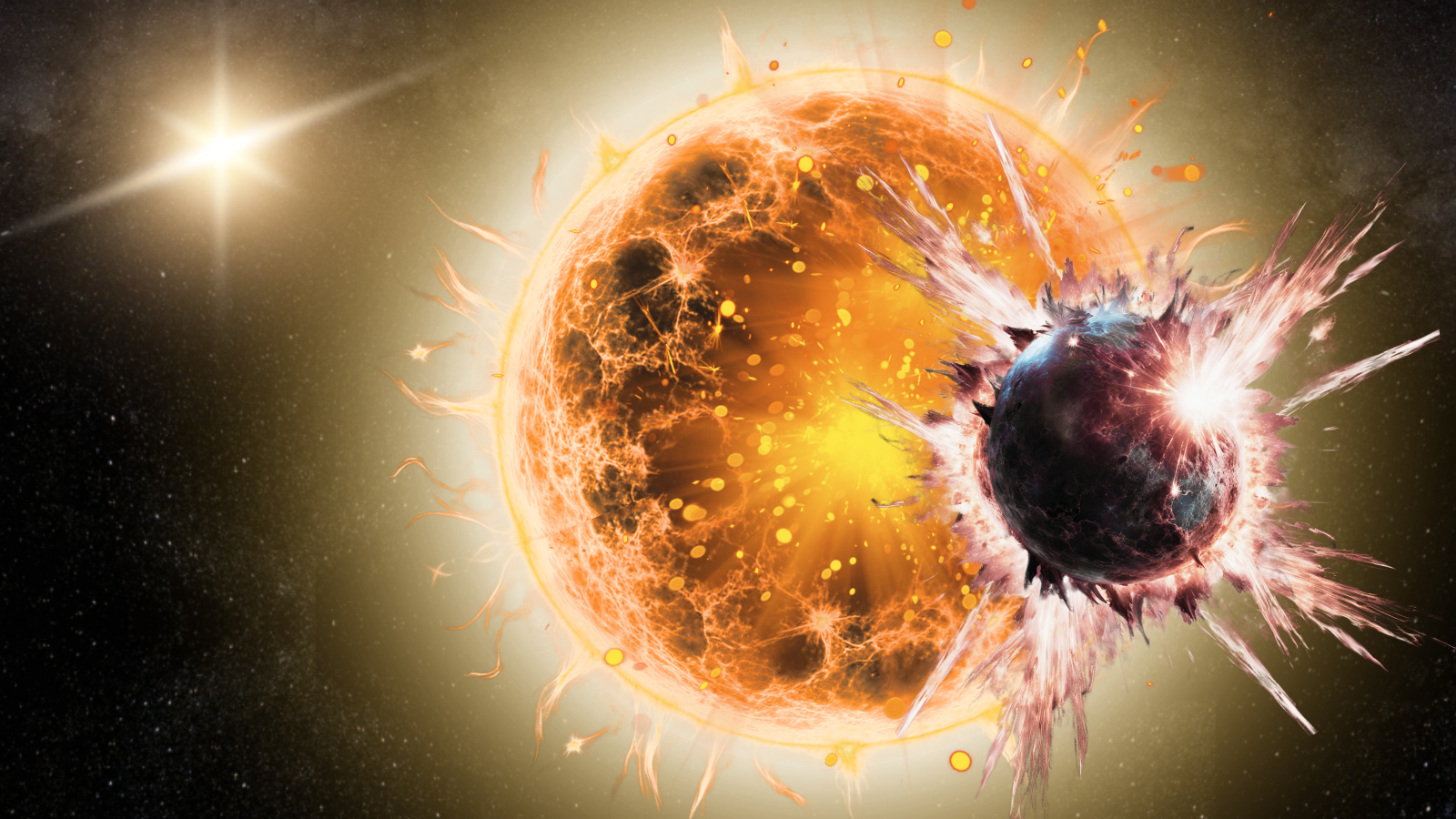
Astronomers have discovered chemical differences between binary stars that indicate one is a cosmic cannibal that has devoured at least one planet.
Binary stars should have the same chemical composition because each star is formed from the same vast cloud of gas and dust; however earlier this year the team behind this new research discovered that the two stars of HD 81809, located around 101 light-years away, are chemically different. One of the stars, HD 81809B, has a much greater concentration of elements heavier than hydrogen and helium, which astronomers call “metals,” at its surface than its binary partner HD 81809A.
This new research suggests that the reason for the metal enrichment of HD 81809B is that this star has consumed an exoplanet which was between 50 and 75 times the size of Earth.
“This is the first binary system to be found with this chemical difference, which is very unusual,” team leader Nuno Moedas of the Technical University of Denmark told Space.com. “Binary systems are ‘like siblings’ in that they are born from the same molecular cloud, meaning they have the same chemical composition. As with siblings, some differences in element abundances can appear due to physical processes. However, these differences will be much smaller than those of HD 81809.”
Moedas added that there are only two possible explanations for the differences between HD 81809B and HD 81809A.
“One is that the stars are not ‘real siblings’ and were born from different molecular clouds containing different elements,” Moedas said. “The other explanation is that star HD 81809B suffered a more drastic event during its evolution, such as ingesting a planet, which could have changed its chemical composition.”
There is a “smoking gun” piece of evidence that planetary engulfment is the correct explanation for the metal enrichment of HD 81809B, however.
“It could be very hard to distinguish the two scenarios, but the main evidence for a planet’s engulfment is the high abundance of lithium in HD 81809B that is not normal,” Moedas said. “Lithium is a very volatile element, and it is easily destroyed in stars, so we expect very low abundances of this element when observing stars. For the case of HD 81809B, the most viable explanation for the large presence of lithium is an ingestion of a planet.”
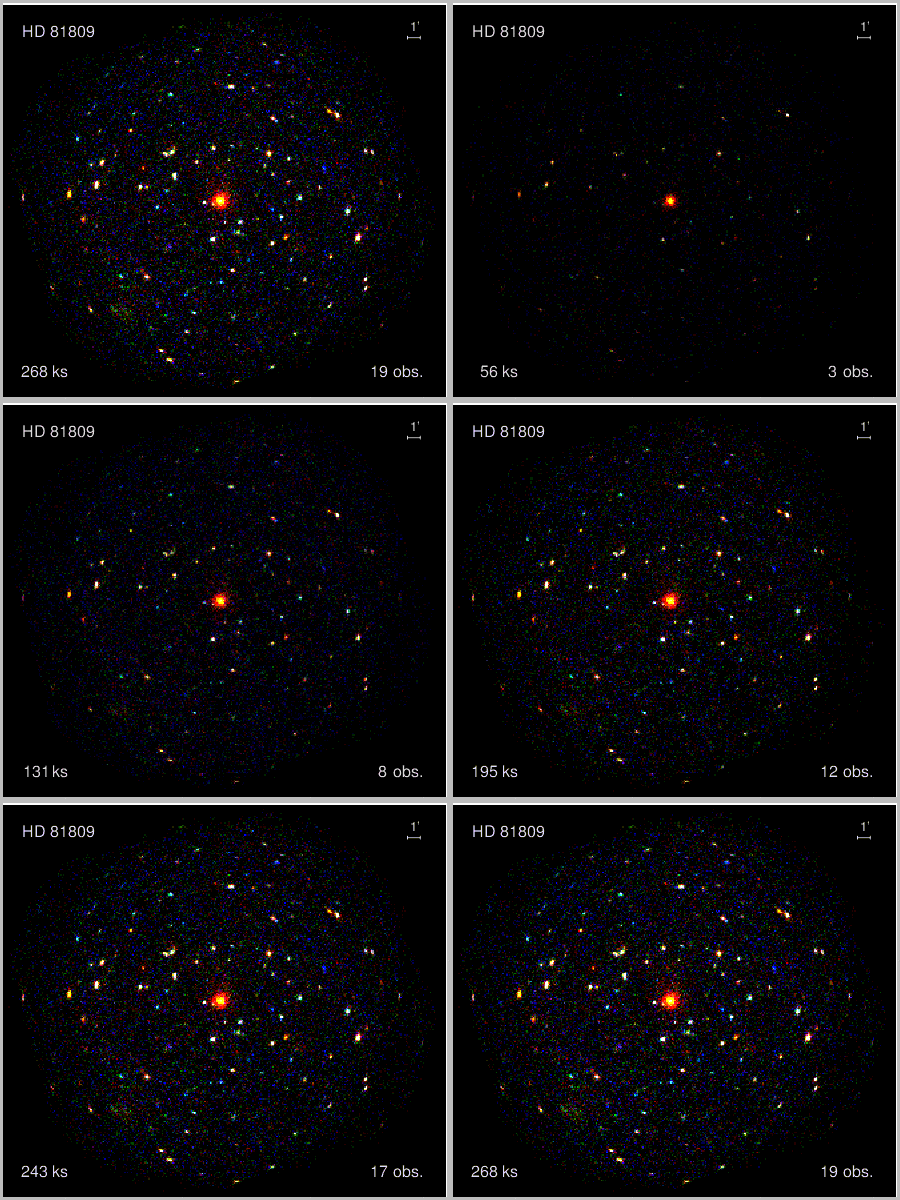
The team isn’t quite sure how HD 81809B came to feast on one of its planets, but Moedas suggests it could be the result of gravitational interactions between the binary stars disrupting the orbit of the unfortunate planet, resulting in it falling into one of its stars. The question also remains of how many planets HD 81809B has devoured.
“We can only estimate the amount of planetary material required, which we find to be 75 times the mass of Earth. It is possible that the star ingested three planets, each 25 times more massive than Earth,” Moedas said. “The event happened a few million years ago, and there are physical processes in the star that will ‘clean up’ the evidence and try to make the star’s chemical abundance similar to that before the event.”
Because of the physical processes within HD 81809B, the team can’t tell much more about the planet, or planets that were devoured. However, there is a possibility that this information may be recovered from a dusty disk of debris detected in this system.
“We still do not know the exact location, but if it is around the secondary star, it could be the remains of a planet falling into the star,” Moedas said. “We could use this to understand the composition of the planet. However, we are far from being able to study this debris disk with the current instruments we have. We probably still need to revisit this system, as there is still a lot we don’t know.
“There is a lot to discover.”A pre-peer-reviewed version of the team’s research appears on the paper repository site arXiv.