

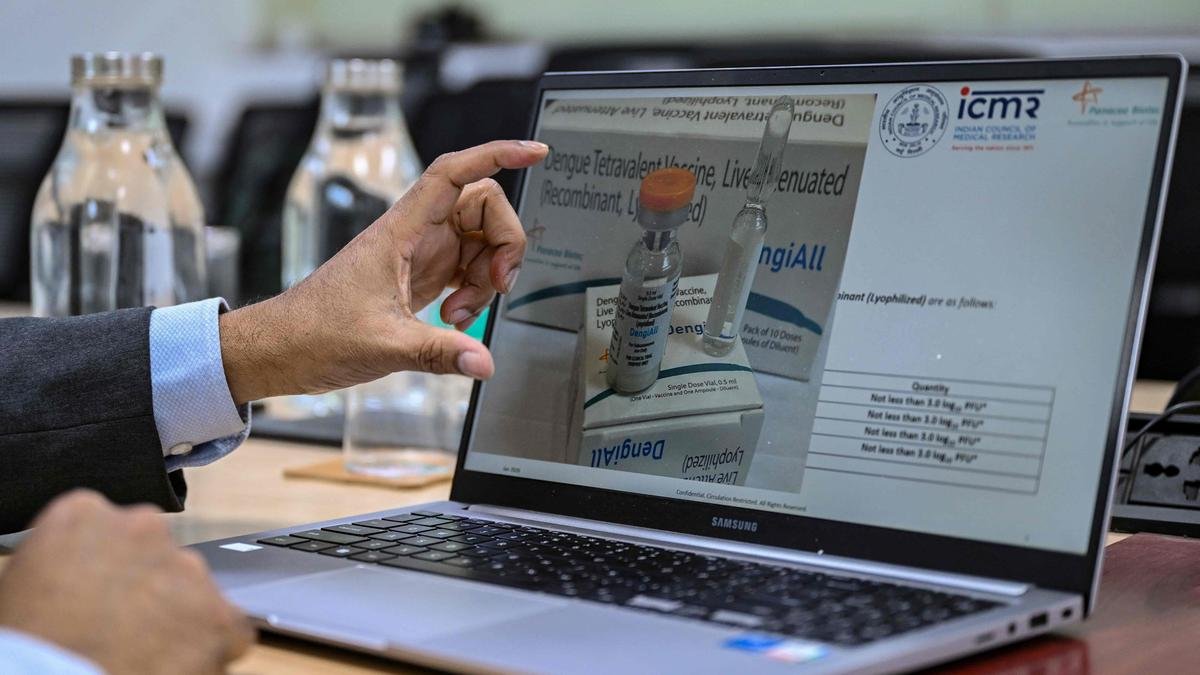
The recent death of two people in Brazil during its dengue vaccination campaign, leading to the shot’s suspension on June 8, is a crucial wake-up call for India. This is because the dengue vaccine in Brazil, Butantan-DV, is pretty similar, if not identical, to India’s soon-to-be-launched dengue vaccine, DengiAll.
Both the Brazilian and Indian vaccines have been several years in the making. Both are made up of live but weakened (attenuated) versions of dengue viruses (DENVs). And both vaccines are said to be tetravalent because each vaccine is in fact a physical mixture of four live, weakened DENVs.
Indeed, DENVs come in four versions, or serotypes: called DENV-1, -2, -3 and -4. All four serotypes are known to be prevalent in Brazil and India. Each DENV serotype has an outer shell adorned with specialised envelope proteins, called E proteins — akin to the spike protein of coronaviruses. Even though the four DENV serotypes are very similar, their E proteins are different enough to warrant immunisation against each of the four serotypes.
Antibody-dependent enhancement
When weakened DENV is used in a vaccine, it will prompt several kinds of antibodies that can be grouped into two classes: type-specific antibodies and cross-reactive antibodies. The type-specific antibodies, often made in small amounts, are specific to unique regions on the E protein of a given serotype. That is, the type-specific antibodies recognise only one particular serotype and excel in blocking infections by that serotype alone.
On the other hand, the cross-reactive antibodies are made usually in large amounts and are specific to similar regions on the E proteins of all four serotypes. That is, they can recognise any of the four serotypes and block an infection — provided they are present in adequately high levels. When their levels decrease, the cross-reactive antibodies don’t just fail to block a new DENV infection: they enhance it, leading to a severe and potentially fatal form of dengue.
This phenomenon is called antibody-dependent enhancement (ADE). The risk of potential ADE during dengue vaccination is considered a serious adverse event. If untreated it can lead to death.
In Brazil’s dengue vaccination campaign, of 42 vaccine recipients who displayed serious side-effects, two people died and one had to receive intensive care. These side-effects included severe abdominal pain, persistent vomiting, and bleeding, none of which the phase 3 clinical trials revealed. These signs are disturbingly reminiscent of viral haemorrhagic fevers such as dengue in its severe form. Medical researchers should look into whether this could be due to ADE.
They should also clarify if DengiAll will manifest a similar risk when it is rolled out in India.

Issues with Dengvaxia
Butantan-DV and DengiAll are both based on the efforts of scientists at the U.S. National Institutes of Health (NIH). Over many years, they separately weakened each DENV serotype to make monovalent vaccines, assessed each one for its capacity to induce an immune response without causing disease, and finally mixed all four monovalent vaccine viruses to generate tetravalent vaccines. Two of them, called TV003 and TV005, and the monovalent vaccine viruses were licensed to Instituto Butantan in Brazil and Panacea Biotec in India, among others, for further development.
Butantan-DV is not the first dengue vaccine to be linked to such events. A little over a decade ago, Sanofi Pasteur developed the first tetravalent dengue vaccine to be licensed. It differed from the NIH’s TV003 and TV005 in that the four weakened serotypes were hybrid viruses, each covered on its surface with the E protein of one of the DENV serotypes (plus another protein).
This shot, called Dengvaxia, was given to more than 8 lakh children in the Phillipines, a dengue-endemic country like Brazil and India. Severe adverse events occurred three years after vaccination. Further study revealed Dengvaxia worked like a monovalent vaccine, provoking antibodies to only a single serotype, DENV-4. That is, mixing four live yet weakened viruses to create a tetravalent vaccine didn’t automatically ensure tetravalent immunity. Why? There is no clear answer yet.
Taken together, the severe adverse events linked to Butantan-DV raise many questions. Is Butantan-DV really functionally tetravalent? Is there a possibility of viral interference compromising its functionality? Could ADE be the reason for the potentially fatal outcomes in two instances?
Gap in phase 3 trials
These questions are rendered more challenging by a lacuna in the vaccine efficacy data collected in the phase 3 trials. Reports in January 2024, November 2024, and March 2026 indicated that Butantan-DV’s efficacy against DENV-3 and DENV-4 is unknown as these serotypes were not prevalent in Brazil at the time of the trials.
Panacea Biotec’s DengiAll phase 3 trials, together with the Indian Council of Medical Research, completed its enrollment target of 10,335 healthy volunteers in January this year. The trial began in August 2024; its participants will be followed for two years post-vaccination. Once all the data have been collected and analysed, the researchers (with the company) will approach the Indian drug regulator for market approval.
There is no solid reason to deny that DengiAll may not face the potentially fatal issues that have come up with Butantan-DV. However, India can proactively do some things to mitigate safety concerns ahead of DengiAll’s future rollout. First, Panacea must analyse a representative subset of sera from vaccinated volunteers for type-specific antibodies against all four serotypes. And the drug regulator must ensure such data is available and rules out potential risk of ADE.

Robust pharmacovigilance
Further, once DengiAll is launched, the regulator must implement a robust pharmacovigilance programme for an extended period of time. Vaccine recipients must be clinically monitored periodically and their blood must be collected at regular intervals to check for viruses, antibodies, and other parameters to implement remedial measures quickly. Continuous real-world monitoring is key to identifying rare or long-term adverse events.
The ADE concerns also apply to another tetravalent dengue vaccine, Qdenga, which is also a physical mix of four weakened versions of the DENV serotypes. Japan-based Takeda markets it and its India approval is imminent.
Brazilian authorities have stressed that the 42 cases of severe adverse events out of half-a-million vaccinated represent only 0.008%. There is no doubt that it is a small risk at the population level. At the individual level, however, even one life lost to a severe adverse event is one too many.
S. Swaminathan is retired professor of biology from BITS Pilani-Hyderabad and a former scientist in the area of dengue vaccinology at ICGEB, New Delhi.
Published – June 15, 2026 08:00 am IST