

Close Menu

    Subscribe to Updates

    Get the latest news information from worldwide businesses.

    What's Hot

    Ancient Denisovan DNA still shapes human immunity today

    June 14, 2026

    Preoperative Frailty Predicts Cognitive Decline in Elderly Surgical Patients, Suggests Study

    June 14, 2026

    How to watch most of the World Cup matches with free trials

    June 14, 2026
    Facebook Instagram YouTube LinkedIn X (Twitter)
    Trending
    • Ancient Denisovan DNA still shapes human immunity today
    • Preoperative Frailty Predicts Cognitive Decline in Elderly Surgical Patients, Suggests Study
    • How to watch most of the World Cup matches with free trials
    • TechCrunch Mobility: SpaceX rockets past Tesla
    • Shipping authority directs placement agencies to restrict deployment of Indians in conflict zone
    • Lebanon says three killed in Israeli strike on Beirut suburb
    • Indian Seafarer Death Oman: ‘Bring back his mortal remains’: Wife of Indian seafarer who died aboard vessel in Oman seeks ‘justice’ | India News
    • Assam CEE 2026 provisional answer keys shortly at astu.ac.in: How to raise objections | Education News
    Newspublicly
    • About Us
    • Advertise & Partner with us
    • Pitch Your Story
    • Contact Us
    Facebook Instagram LinkedIn X (Twitter)
    Subscribe
    • Home
    • World News
      • Asia
      • India
      • USA
      • UK & Europe
      • Middle East
    • Economy & Business
      • Global Economy
      • Corporate & Industry
      • Finance & Markets
      • Policy & Trade
    • Technology
      • Gadgets & Devices
      • Software & Apps
      • AI & Machine Learning
      • Robotics & Automation
    • Health & Medicine
      • Fitness & Nutrition
      • Research & Innovation
      • Disease & Treatment
      • Doctors, Clinics & Patient Care
    • Travel & Tourism
    • Automobile
      • Electric & Hybrid Vehicles
      • Auto Industry Insights
    • Sports
    • More
      • Education
      • Real Estate
      • Environment & Climate
      • Space & Astronomy
      • War & Conflicts
    Newspublicly
    Home»More»Space & Astronomy»New moon of June 2026 brings stunning views of Mercury, Venus and Jupiter
    Space & Astronomy

    New moon of June 2026 brings stunning views of Mercury, Venus and Jupiter

    AdminBy AdminJune 14, 2026No Comments5 Mins Read0 Views
    Share
    Facebook Twitter LinkedIn Copy Link WhatsApp


    June’s new moon is finally upon us, bringing with it a handful of precious dark nights in which to explore the wonders of the starry sky, before the familiar sight of the waxing lunar crescent returns to hide fainter targets from view.

    This month’s new moon phase occurs at 10:54 p.m. EDT on June 14 (0254 GMT on June 15), when the lunar disk passes between the sun and Earth, leaving the nights surrounding it blissfully free of moonlight.

    The lack of moonlight allows us to appreciate the myriad treasures of the post-sunset realm, including faint constellations that are so easily overlooked in favor of their brighter counterparts during the rest of the month.

    Visible planets

    Look to the western horizon at sunset on June 14 to find the steady light of Venus shining a little over three degrees above Jupiter, just a few days on from their close conjunction on June 9.

    Look to the lower right of Jupiter to spot Mercury shining above the horizon. The two will be separated by approximately 10 degrees — roughly the width of a clenched fist held at arm’s length against the night sky — to form a crooked planetary lineup in the night sky.


    You may like

    A starmap showing the positions of Venus, Jupiter and Mercury in the evening sky close to prominent constellations.

    Venus, Jupiter and Mercury shine in the western sky at sunset. (Image credit: Created by Anthony Wood in Canva.)

    Mercury is putting on one of its best displays of the year. just one day out from reaching its point of greatest eastern elongation, when it appears farthest from the sun in the evening sky. Nonetheless, you’ll need a clear view of the western horizon if you hope to spot the elusive planet before it sets less than two hours after the sun.

    Early risers will find the red light of Mars glistening less than 10 degrees above the eastern horizon in the predawn hours on nights surrounding the new moon phase, while Saturn will shine higher to the east, among the stars of the constellation Pisces.

    Space

    Neptune can also be found hiding a little under 10 degrees to the upper right of the gas giant. It’s too dim to be spotted with the naked eye, but an 8-inch telescope should let you see its disk as a small blue dot from a dark sky location.

    Stars and constellations

    The new moon phase is the ideal time to head away from city lights to hunt the ancient sparkle of faint constellations that make themselves known in the absence of moonlight.

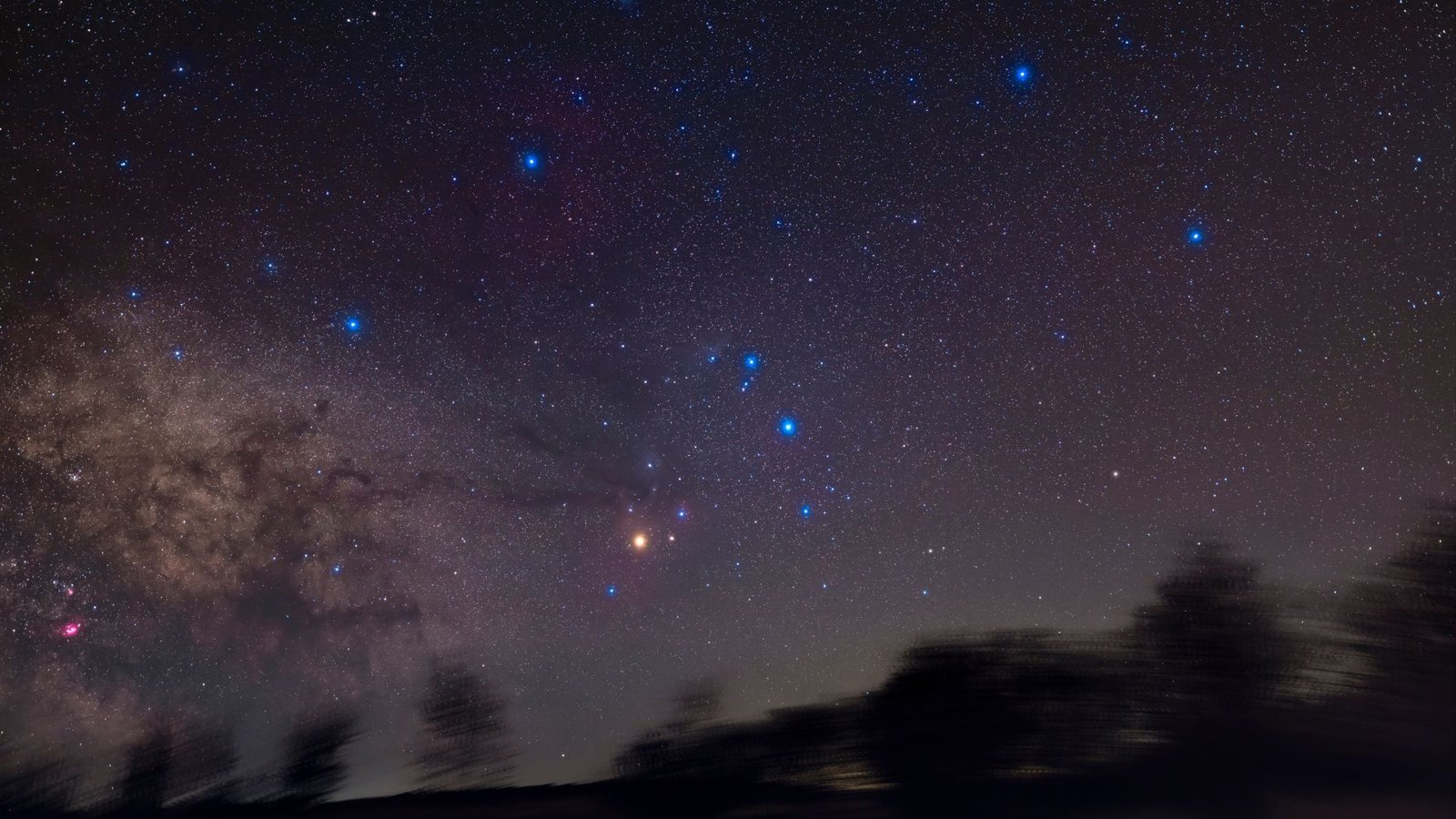
    Turn to the southeast after sunset in mid-June and look out for the red light of the supergiant star Antares glowing between 10 and 20 degrees above the horizon. Antares sits at the heart of the constellation Scorpius, while the three bright stars to its upper right — Dschubba, Pi Scorpii and Acrab — represent the claws of the celestial predator.


    What to read next

    Look above the stellar claws to find the kite-formation of stars that marks the constellation Libra, which represents a cosmic set of weighing scales. It’s the only constellation to be fashioned and named after an inanimate object and has long been associated with harmony and balance.

    A starmap showing the positions of prominent constellations in the evening sky.

    Ophiuchus the “snake handler” glows above Scorpius in the southern sky. (Image credit: Created by Anthony Wood in Canva.)

    To Libra’s left is the constellation Ophiuchus, the “snake bearer“, which some consider to be the 13th zodiacal constellation, thanks to the fact that the sun passes through its southern extreme for two weeks each year, according to the astronomy website In-The-Sky.org.

    Celestron NexStar 4SE

    Celestron NexStar 4SE Computerized Telescope

    (Image credit: Amazon)

    The Celestron NexStar 4SE is ideal for beginners wanting quality, reliable and quick views of the night sky. It’s sturdily built, quick to set up and automatically locates night sky targets and provides crisp, clear views of them. For a more in-depth look at our Celestron NexStar 4SE review

    Ophiuchus was recorded in the 2nd century AD by the ancient Greek philosopher and astronomer Ptolemy and is often depicted as a man holding a vast celestial snake. This snake is actually a second constellation known as Serpens, which is divided into two parts that extend on either side of Ophiuchus.

    Dark, moonless skies also reveal one of summer’s finest sights: the bright core of the Milky Way, which can be seen as a magnificent glowing arc extending upward from the southern horizon through the summer triangle formed from the bright stars Vega, Altair and Deneb around midnight in late spring and early summer.

    Want to capture your own photos of our galaxy glowing in the night sky? Then be sure to check out our guide detailing how to photograph the Milky Way, along with our roundups of the best lenses and cameras for imaging the post sunset realm.

    Editor’s Note: If you would like to share your astrophotography with Space.com’s readers, then please send your photo(s), comments, and your name and location to spacephotos@space.com.


    Source link

    Author

    • Admin

      NewsPublicly.com is News & Articles Platform that creating SEO-focused articles on travel, lifestyle, and digital trends.

    Admin
    • Website

    NewsPublicly.com is News & Articles Platform that creating SEO-focused articles on travel, lifestyle, and digital trends.

    Related Posts

    Catch Mercury shining at its best on June 15 before it slips back into the sun’s glare

    June 14, 2026

    How Jules Verne predicted the Artemis 2 mission to the moon almost 160 years ago

    June 14, 2026

    ‘We were astonished’: Millions of exoplanets could be born near active supermassive black holes

    June 14, 2026
    Leave A Reply Cancel Reply

    Demo
    Top Posts

    The Blue Moon rises on May 30— Where and when to see the second full moon of the month

    May 30, 202640 Views

    New SOCOM rifle allows barrel swapping and cartridge changes

    June 1, 202633 Views

    “Inside Gemini Robotics 1.5: How Robots Learn to Reason & Act

    November 22, 202525 Views

    525 pounds of cocaine seized after Nebraska K9 alerts troopers on I-80

    May 28, 202624 Views
    Don't Miss

    Ancient Denisovan DNA still shapes human immunity today

    June 14, 20264 Mins Read0 Views

    A major new study led by Yale University is helping fill a longstanding gap in…

    Preoperative Frailty Predicts Cognitive Decline in Elderly Surgical Patients, Suggests Study

    June 14, 2026

    How to watch most of the World Cup matches with free trials

    June 14, 2026

    TechCrunch Mobility: SpaceX rockets past Tesla

    June 14, 2026
    Stay In Touch
    • Facebook
    • Twitter
    • Instagram
    • YouTube
    • LinkedIn
    • WhatsApp

    Subscribe to Updates

    Get the latest creative news from SmartMag about art & design.

    Demo
    NEWSPUBLICLY
    Facebook X (Twitter) Instagram LinkedIn

    Home

    • About Us
    • Leadership
    • Advertise & Partner With Us
    • Pitch Your Story
    • Media Kit & Pricing
    • Career
    • FAQs

    Guidelines

    • Editorial & Submission
    • Partnership
    • Advertising & Sponsor
    • Intellectual Property Policy
    • Community & Comment
    • Security & Data Protection
    • Send Your Opinion

    Quick Links

    • Cookie Policy
    • Payment & Billing Terms
    • Refund & Cancellation
    • Copyright Policy
    • Complaint & Support
    • Sitemap
    • Contact Us

    Subscribe Us

    Get the latest news and updates!

    Copyright © 2026 Newspublicly (DIGITALIX COMMUNICATION). All Rights Reserved.
    • Privacy Policy
    • Terms of Use
    • Disclaimer