

Reproductive agency, the power to decide whether, when, and how to bear children is a vital and necessary component of women’s empowerment, and yet, is often not taken into account when metrics of income, education, mobility and political representation are analysed.
India’s demographic transition, as reflected in the latest round of the National Family Health Survey (NFHS-6, 2023–24), besides revealing incremental changes in health indicators, also signals a structural shift in the domain of reproductive agency. Contraception, once framed primarily as an instrument of population control, is increasingly emerging as a marker of women’s reproduction agency.

History of contraceptive use
India’s engagement with contraception dates back to 1952, when it became the first country to launch an official family planning programme but with women bearing a disproportionate share of the required responsibility.
The following data, drawn from the NFHS-6 (2023–24) survey of currently married women aged 15–49 years, maps the reproductive and contraceptive landscape across urban and rural India, and against the NFHS-5 baseline:
Child marriage, compounded fertility exposure
A striking finding in the NFHS-6 data is the persistence of early marriage. Nationally, 20.1% of women aged 20–24 was married before the age of 18, with the rural figure reaching 23.3% — unchanged from NFHS-5. Among men, 15.9% aged 25–29 was married before 21. These trends are not only legal failures, they are also healthcare setbacks.
A girl married before she has had the opportunity to complete secondary education or enter the paid workforce, confronts a significantly extended reproductive window. When contraceptive access is limited, awareness of healthcare attenuated, or agency within the family is negligible, unhealthy pregnancies, unsustainably more births, and heightened maternal and child health risk are the consequences. The data bears this out: 6.7% of women aged 15–19 were already mothers or pregnant at the time of the survey rising to 7.9% in rural areas.
From a public health standpoint, early marriage is not merely a social problem, it is a reproductive health emergency with lifelong consequences. Girls married young are less likely to know their contraceptive options, less likely to be able to negotiate their use, and more likely to undergo less spaced-out pregnancies. The cumulative physiological burden of anaemia, obstetric complications and maternal mortality is concentrated precisely in this demographic. Yet policy conversations about fertility routinely overlook the role of early marital unions, seeking to unsuccessfully treat the symptom (high fertility) while ignoring the structural cause (constrained reproductive agency).
The rural–urban divide in these figures is striking. Urban women tend to marry later, complete more schooling, and are exposed to a broader suite of contraceptive options. Rural women face the inverse: earlier marital unions, relatively less agency, and a healthcare infrastructure that, as we shall see, defaults to unattainable permanent solutions rather than investing in what is relevant: public healthcare.

Public health failure, personal burden
Female sterilisation remains the dominant contraceptive method in India, accounting for 36.5% of all contraceptive use nationally and is as high as 38.1% in rural areas. Male sterilisation, by contrast, stands at a negligible 0.5%. This gargantuan skew is the consequence of policy design and gender disempowerment.
The NFHS-6 data also shows a modest decline in female sterilisation from 37.9% (NFHS-5) to 36.5%, alongside a sharp rise in traditional method use (from 10.3% to 16.4%) and a slight decline in modern reversible methods (from 56.4% to 52.7%). Read together, these trends suggest that some women are able to step back from sterilisation — but into informal, less medically supported methods rather than towards reversible scientific methods that would authentically enhance reproductive autonomy.
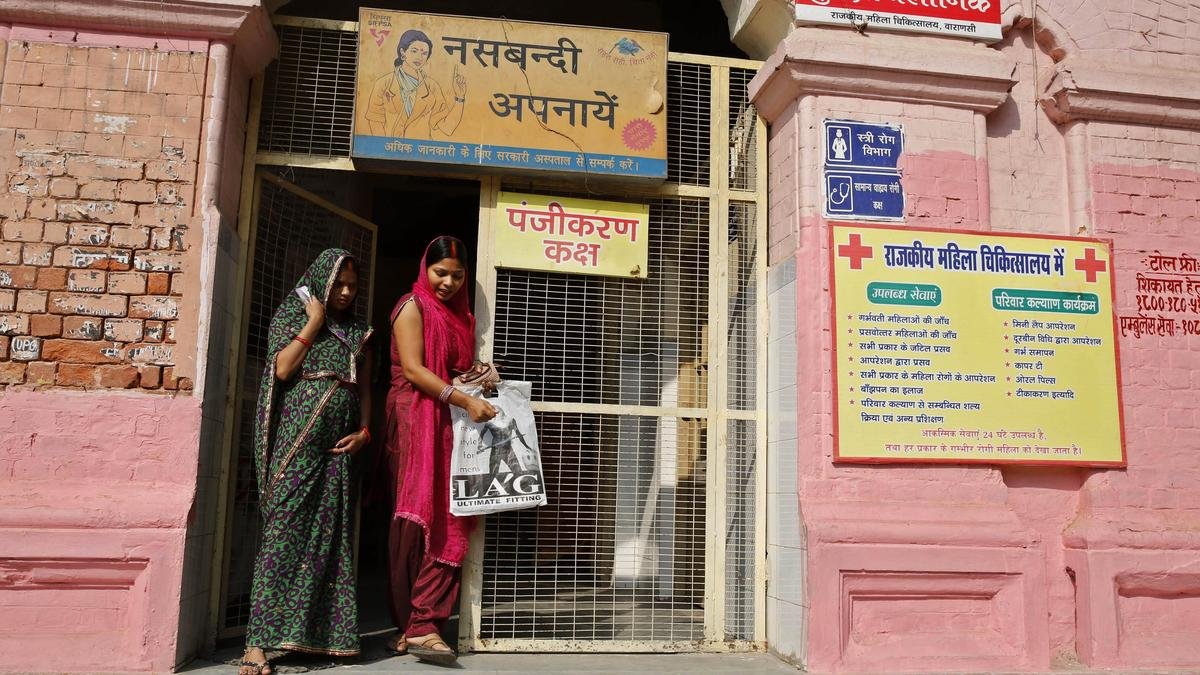
Female sterilisation in India’s public health system has a troubled history. The mass sterilisation camps epitomised by the Bilaspur tragedy of 2014, in which 13 women died following a single-day mass sterilisation drive are not aberrations but logical consequences of a system that treats women’s reproductive capacity as a population management problem to be solved at scale, cheaply and rapidly. Tubectomies and sterilisation surgeries done in rural government hospitals can sometimes be risky — these facilities are overcrowded, staff are not always well-trained, and the focus is on performing as many procedures as possible rather than on scientific patient care. Women who go through these surgeries can get infections, complications from maladministered anaesthesia or failed procedures resulting in persistent morbidity. Most women are compelled to access what they can afford, namely underfunded public healthcare. Most women undergoing such procedures are not empowered to make an informed choice due to their being at the short end of the stick of the social reproduction and social production processes.

Towards reproductive agency
An analysis of the NFHS-6 data demonstrates that contraception in India is no longer merely about limiting births, but about enabling reproductive agency by overcoming the underlying unequal social architecture.
Three policy imperatives follow from such an analysis. First, early marriage must be addressed as a reproductive health crisis by retaining girls in school, fully implementing the Prohibition of Child Marriage Act and investing in rural secondary education for girls. Second, policy must pivot from unsustainable permanent methods of contraception toward increasing access for reversible scientific contraception through augmenting community based public healthcare. Third, the diminishing of the gender skew in contraception must become a programmatic priority of policy
Sustainable demographic transition presupposes reproductive agency of women.
(Dr. Trishna Sarkar is faculty at the department of economics, Dr. BhimRao Ambedkar College, University of Delhi. trishna.sarkar@gmail.com; Prof C. Saratchand is faculty at the the department of economics,tr Satyawati College, University of Delhi chandcsarat@gmail.com.)
Published – June 09, 2026 04:02 pm IST