

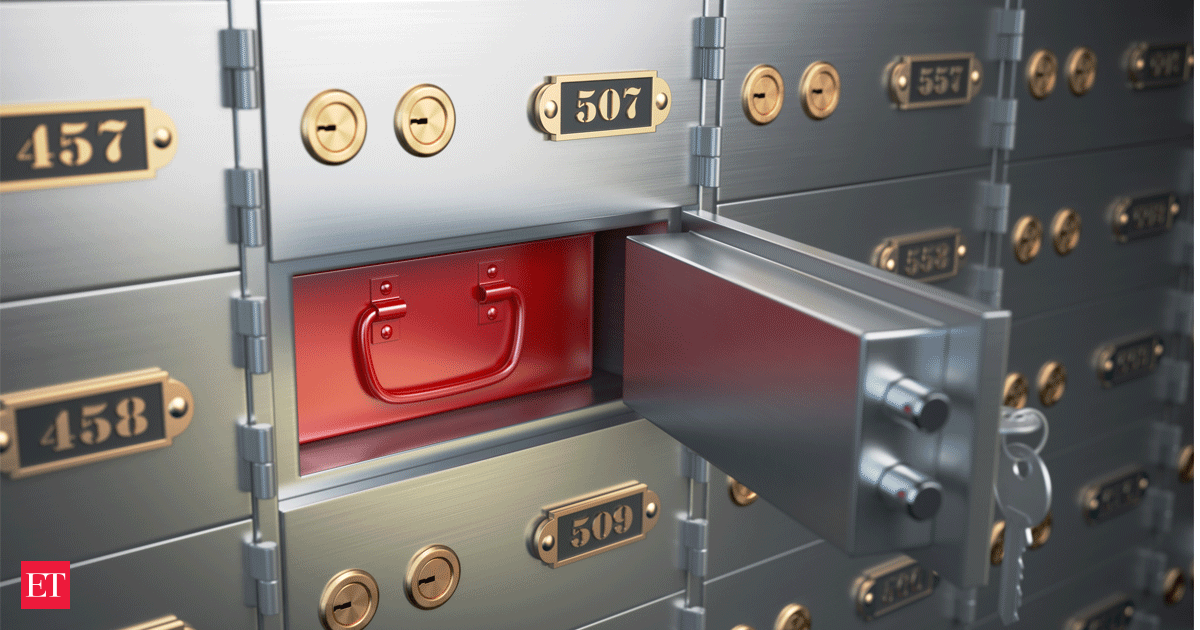
Now that trust is facing scrutiny. Complaints involving missing valuables, alleged fraud, disputed access records and inheritance-related delays are unsettling customers across India. Social media and consumer forums have amplified fears about locker safety.
Yet demand remains stronger than ever. That paradox sits at the heart of India’s evolving locker economy — a business shaped by rising household wealth, a deep cultural attachment to physical assets, technological change, chronic locker shortages and the rise of private vault operators.
Also read | Major change in buyer behaviour as e-scooters race deeper into Bharat
A senior banker says: “This is no longer just about lockers. It is about how India chooses to secure its wealth in a changing economy.”

SAFE & SOUND?
India remains deeply attached to physical assets, particularly gold jewellery. “For many households, lockers are still the default choice for jewellery and important documents,” says the senior banker quoted above. Lockers also remain deeply tied to cultural notions of safety, inheritance and economic protection.
Lockers have a long history in India. Since homes are vulnerable to burglary and theft, bank vaults have been the safest option.Banks also use lockers as a hook for customers to open accounts, making them an important customer-retention tool. If the demographic profile of locker users is mapped today, senior citizens and pensioners would dominate usage, followed by middle-aged households. Non-resident Indians (NRIs), who often prefer to retain family jewellery in India, also form a major customer segment, according to bankers and private vault operators.
Institutional vaults remain a preferred repository for safekeeping valuables. However, the system is far from perfect. First, lockers are in short supply. According to a reply in the Lok Sabha by the Ministry of Finance, 1.10 crore bank lockers were operational in public sector banks as of March 2025, along with 11 lakh in cooperative banks. Separately, according to a report by safe-deposit startup Aurum Vault, the demand is projected to rise to 6 crore by 2030.
Also read | Indian tourists go viral for all wrong reasons. Here’s how not to become the next horror story
A senior executive with a private-sector lender confirms that locker availability is extremely tight in many urban branches: “Demand has structurally increased with rising wealth and gold prices, but capacity expansion has not kept pace.”
Second, reports of operational lapses and thefts add to customer anxiety. This is not assuaged by the fact that rising prices of gold has dramatically increased the value concentration inside lockers. “These are isolated incidents, not systemic failures,” says another banker, referring to reported cases involving locker disputes and theft allegations. “But perception risk is much higher than operational risk.”
Third, public perception is complicated by silence from the industry. Public sector banks, which dominate India’s locker infrastructure, have largely avoided public discussions around utilisation levels, operational risks, security incidents, or locker expansion plans.
The Reserve Bank of India, ICICI Bank and public sector banks such as SBI and PNB did not participate in this story.
CASE FOR REGULATIONS
In2021,RBI revised locker regulations,making banks liable for losses arising from burglary, theft, robbery, fire, building collapse, or employee fraud. However, compensation is capped at 100 times the annual locker rent.
A senior banking executive says the framework attempts to balance customer protection with operational realities. “Banks are accountable for infrastructure failure or internal fraud,” the executive says. “After all, banks are custodians of access, not contents.”
This distinction remains central to the locker business. Banks know who accesses lockers but do not maintain inventories of what’s inside them. This is a major challenge for insurers: since locker contents are neither declared nor independently valued, insurance underwriting becomes difficult. As a result, insurers such as ICICI Lombard have avoided launching dedicated insurance products covering locker contents.
The absence of declared locker inven-tories has created a strange situation: assets worth crores may sit inside highly regulated banking infrastructure without meaningful insurance visibility or protection. Legal experts and banking executives say this may eventually force policymakers to revisit compensation frameworks, operational audits and disclosure norms if public anxiety continues to rise.
INHERITANCE ISSUE
Apart from security concerns, inheritance disputes are a major stress point in the locker ecosystem. Despite RBI guidelines aimed at simplifying transmission procedures after the death of an account holder, legal heirs frequently encounter delays, procedural ambiguity and repeated documentation requirements to access lockers of the deceased.
“Banks that repeatedly em-phasise customer relationships and superior service during the lifetime of an account holder often behave in the most distressing manner when legal heirs approach them for settlement of death claims,” says Rajat Dutta, founder of Inheritance Needs Services. Dutta says grieving families are often put through multiple administrative layers—branch offices, zonal and regional of-fices — without clear accountability.
Many claimants eventually approach banking ombudsmen or consumer courts. The issue is particularly sensitive because lockers frequently contain not only financial valuables but also wills, title deeds and family records critical to succession processes.
While public sector banks remain the backbone of India’s locker infrastructure, private banks are increasingly treating lockers as strategic retail products rather than passive utilities. At HDFC Bank, the locker franchise has witnessed double-digit growth over the last three years.
An HDFC spokesperson says locker business continues to be a strong and steadily growing franchise driven by retail penetration and branch expansion.“Lockers are not standalone products. They deepen customer relationships across liabilities, wealth, lending and investment products,” the spokesperson adds.
The lender has deployed biometric authentication systems across several branches and increasingly factors locker demand into branch planning itself, particularly in affluent urban clusters and NRI-heavy markets.
Axis Bank says digitisation is improving operational transparency without fundamentally changing the custody model. “Digital locker systems strengthen protection through access logs, surveillance integration and traceability,” says a spokesperson of Axis Bank. “This improves transparency in dispute resolution.”
However, banks underline that digital systems do not provide visibility into locker contents, so liability structures remain largely unchanged.
THE NEW SECURITY ECONOMY
As demand for lockers zoom, private vault operators like Aurum Vault, Shreenath Safe Vault and South Delhi Vaults are expanding across urban India. These facilities, which have grown from 5 to 20 in three years, operate outside dedicated banking regulations, but market themselves as high-security alternatives equipped with biometric authentication, multi-layer access controls, CCTV surveillance and armed security.
Amit Maheshwari, COO of Sankalp Safe Deposit Vault, a private operator, says the shift is driven by structural shortages and behavioural changes. He adds, “Customers are increasingly exploring non-bank locker solutions due to limited availability, restricted banking hours and demand for convenience and privacy.” Importantly, private operators are careful not to position themselves as replacements for banks.
Banks provide trust and legacy; private players provide flexibility and access,” says Maheshwari. However, the business is capital-intensive. “Real estate costs and high capital expenditure for secure vault infrastructure are the biggest constraints.”
It comes for a price. While PSU banks charge Rs 1,200-8,000 annually for lockers, the cost goes up to Rs 1,350-25,000 in private banks in metro markets. Meanwhile, a private vault operator like MySafe India charges Rs 36,000-78,000 for a year.
SECURING HOMES
India’s changing locker landscape is also benefiting home-security companies. Thanks to gated communities, biometric access systems, smart locks, CCTV surveillance and professionally managed residential staffing, domestic security has substantially improved over the last decade. Godrej Enterprises Group says consumers are increasingly adopting hybrid storage models, combining home safes with bank-type secure lockers.
Godrej is investing Rs 100 crore over three years in digital locks, CCTV systems and connected safes. Pushkar Gokhale, business head of security solutions at Godrej Enterprises Group, says while the demand for safe deposit lockers is rising steadily, consumers are also increasingly storing valuables at home. “A hybrid model is emerging where frequently accessed valuables are stored at home, and long-term assets remain in bank lockers,” he says. “Security is moving from a functional product to an integrated lifestyle system.”
Meanwhile, new-age vault operators such as Gurgaon-based MySafe India are introducing AI-enabled surveillance systems and automated locker-access technologies designed to reduce human intervention. “Lockers are no longer just storage spaces, they are part of a broader asset protection ecosystem,” says Ajay Sharma, business and project head, MySafe India.
Still, Sharma acknowledges that technology alone cannot solve the industry’s core challenge: “Operational transparency and brand credibility are critical because customers are storing highly sensitive assets.”
Across banks, insurers, private vault operators and security firms, India’s locker ecosystem is not shrinking, it is fragmenting. While banks continue to dominate it, private operators are competing on convenience and accessibility and home-safe manufacturers are tapping into lifestyle-driven demand.
As India grows wealthier, the real question is not whether households will continue storing physical wealth but who they will trust to protect it? There are no safe answers.
New Ways to Store Wealth
- Private vault operators offer biometric access and extended operating hours
- Smart home safes with digital locks, alarms and remote monitoring
- Gold ETFs and digital gold reducing the need to physically hold precious metals
- Connected homesecurity systems integrating safes, CCTV and access controls
Why Bank Lockers Rule
- Homes are vulnerable to theft while banks are safer
- Indians need a repository for the gold jewellery they hold
- Many NRIs prefer storing family valuables in India