

Close Menu

    Subscribe to Updates

    Get the latest news information from worldwide businesses.

    What's Hot

    Shocking Study Reveals Mosquitoes Can Become Attracted to Repellent

    June 4, 2026

    JP Nadda at AIIMS Bhatinda convocation

    June 4, 2026

    Let us filter AI slop, you cowards

    June 4, 2026
    Facebook Instagram YouTube LinkedIn X (Twitter)
    Trending
    • Shocking Study Reveals Mosquitoes Can Become Attracted to Repellent
    • JP Nadda at AIIMS Bhatinda convocation
    • Let us filter AI slop, you cowards
    • Oura Ring 5 review: Thinner, lighter, better
    • Scout from M’Soft is the agentic Autopilot that works across M365
    • From inputs to retail, a monster rages through: As supply-side inflation pressures build, the implications for monetary policy
    • Government rolling out 100 ethanol fuel stations in Delhi-NCR, Maharashtra: Hardeep Singh Puri
    • How ‘no tax on overtime’ could impact behavior in good ways — and bad
    Newspublicly
    • About Us
    • Advertise & Partner with us
    • Pitch Your Story
    • Contact Us
    Facebook Instagram LinkedIn X (Twitter)
    Subscribe
    • Home
    • World News
      • Asia
      • India
      • USA
      • UK & Europe
      • Middle East
    • Economy & Business
      • Global Economy
      • Corporate & Industry
      • Finance & Markets
      • Policy & Trade
    • Technology
      • Gadgets & Devices
      • Software & Apps
      • AI & Machine Learning
      • Robotics & Automation
    • Health & Medicine
      • Fitness & Nutrition
      • Research & Innovation
      • Disease & Treatment
      • Doctors, Clinics & Patient Care
    • Travel & Tourism
    • Automobile
      • Electric & Hybrid Vehicles
      • Auto Industry Insights
    • Sports
    • More
      • Education
      • Real Estate
      • Environment & Climate
      • Space & Astronomy
      • War & Conflicts
    Newspublicly
    Home»Health & Medicine»Research & Innovation»NASA’s Webb detects methane and strange chemistry on interstellar comet 3I/ATLAS
    Research & Innovation

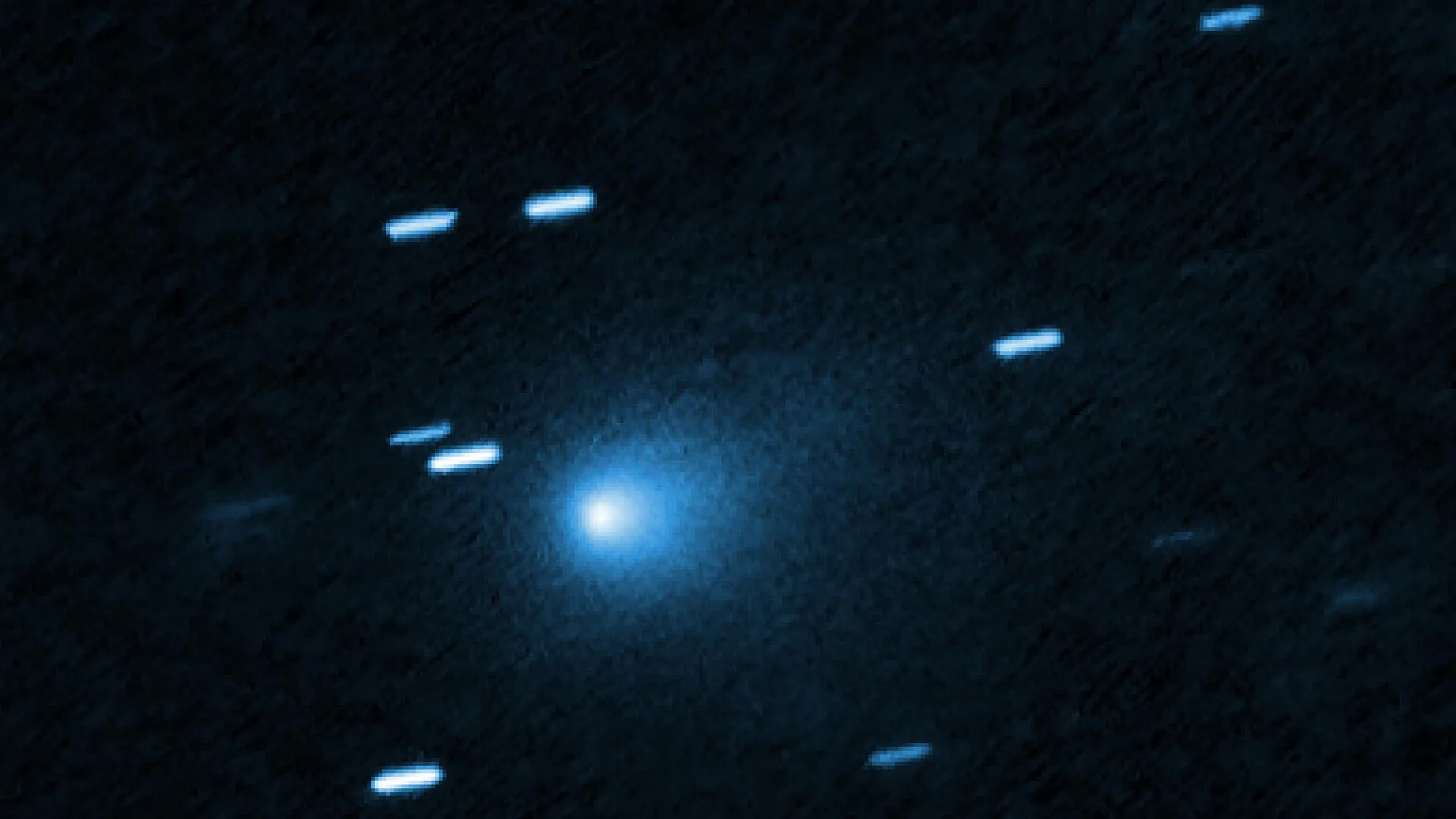
    NASA’s Webb detects methane and strange chemistry on interstellar comet 3I/ATLAS

    AdminBy AdminJune 4, 2026No Comments3 Mins Read0 Views
    Share
    Facebook Twitter LinkedIn Copy Link WhatsApp


    NASA’s James Webb Space Telescope has captured the first mid-infrared chemical fingerprint of an interstellar object, providing new insights into the composition of comet 3I/ATLAS as it traveled away from the Sun. The findings were recently published in The Astrophysical Journal Letters.

    Researchers used Webb’s MIRI (Mid-Infrared Instrument) during two observing sessions after the comet passed its closest point to the Sun. The first set of observations took place on December 15 and 16, when 3I/ATLAS was about 205 million miles (329 million kilometers) from the Sun. A second round followed on December 27, with the comet about 236 million miles (379 million kilometers) away.

    Webb Detects Methane on an Interstellar Comet

    For the first time, scientists directly identified methane gas on an interstellar visitor.

    Methane is an extremely volatile substance that can quickly change from solid ice to gas. Its appearance only after the comet had already passed close to the Sun suggests the methane was buried beneath the surface. According to the research team, the comet’s upper layers likely shielded the methane ice until solar heating penetrated deeper into the icy interior.

    The amount of methane compared to water also surprised researchers. The ratio is much higher than what is typically seen in comets from our own solar system, with only a handful of known examples showing similar characteristics.

    Unusually Rich in Carbon Dioxide

    The observations also confirmed another unusual feature of 3I/ATLAS. The comet releases exceptionally large amounts of carbon dioxide relative to water, far exceeding the levels commonly measured in solar system comets.

    Together, the methane and carbon dioxide measurements point to a formation history that differs significantly from that of most comets that originated around our Sun. The results suggest that 3I/ATLAS formed in a very different chemical environment before beginning its journey through interstellar space.

    Gas Production Drops as the Comet Moves Away

    Webb also tracked how the comet’s activity changed as it moved farther from the Sun.

    Scientists observed a sharp decline in the production of gases, with water showing the steepest decrease. This behavior is expected as the comet receives less solar energy. As temperatures fall, less ice vaporizes from the surface and near-surface layers.

    Water is less volatile than methane or carbon dioxide, which means its gas production shuts down more quickly as the comet cools.

    How Webb Measured the Comet’s Chemistry

    The observations were carried out using MIRI’s Medium Resolution Spectrometer, an instrument that separates infrared light into its individual wavelengths. By analyzing those wavelengths, researchers can determine which gases are present.

    The spectrometer also functions as an integral field unit, allowing scientists to obtain a spectrum at every location across a small region of sky. This capability enabled the team not only to identify gases surrounding the comet’s nucleus, but also to map how those gases were distributed around the object.


    Source link

    Author

    • Admin

      NewsPublicly.com is News & Articles Platform that creating SEO-focused articles on travel, lifestyle, and digital trends.

    Admin
    • Website

    NewsPublicly.com is News & Articles Platform that creating SEO-focused articles on travel, lifestyle, and digital trends.

    Related Posts

    Cancer’s favorite escape trick may actually make it easier to kill

    June 4, 2026

    Scientists discover a quantum effect that could eliminate batteries

    June 4, 2026

    Beluga whales keep switching mates and it may be saving their species

    June 4, 2026
    Leave A Reply Cancel Reply

    Demo
    Top Posts

    The Blue Moon rises on May 30— Where and when to see the second full moon of the month

    May 30, 202640 Views

    New SOCOM rifle allows barrel swapping and cartridge changes

    June 1, 202632 Views

    “Inside Gemini Robotics 1.5: How Robots Learn to Reason & Act

    November 22, 202525 Views

    525 pounds of cocaine seized after Nebraska K9 alerts troopers on I-80

    May 28, 202624 Views
    Don't Miss

    Shocking Study Reveals Mosquitoes Can Become Attracted to Repellent

    June 4, 20265 Mins Read0 Views

    A new study has made shocking revelations about mosquitoes’ behaviour, stating that the insect can…

    JP Nadda at AIIMS Bhatinda convocation

    June 4, 2026

    Let us filter AI slop, you cowards

    June 4, 2026

    Oura Ring 5 review: Thinner, lighter, better

    June 4, 2026
    Stay In Touch
    • Facebook
    • Twitter
    • Instagram
    • YouTube
    • LinkedIn
    • WhatsApp

    Subscribe to Updates

    Get the latest creative news from SmartMag about art & design.

    Demo
    NEWSPUBLICLY
    Facebook X (Twitter) Instagram LinkedIn

    Home

    • About Us
    • Leadership
    • Advertise & Partner With Us
    • Pitch Your Story
    • Media Kit & Pricing
    • Career
    • FAQs

    Guidelines

    • Editorial & Submission
    • Partnership
    • Advertising & Sponsor
    • Intellectual Property Policy
    • Community & Comment
    • Security & Data Protection
    • Send Your Opinion

    Quick Links

    • Cookie Policy
    • Payment & Billing Terms
    • Refund & Cancellation
    • Copyright Policy
    • Complaint & Support
    • Sitemap
    • Contact Us

    Subscribe Us

    Get the latest news and updates!

    Copyright © 2026 Newspublicly (DIGITALIX COMMUNICATION). All Rights Reserved.
    • Privacy Policy
    • Terms of Use
    • Disclaimer