

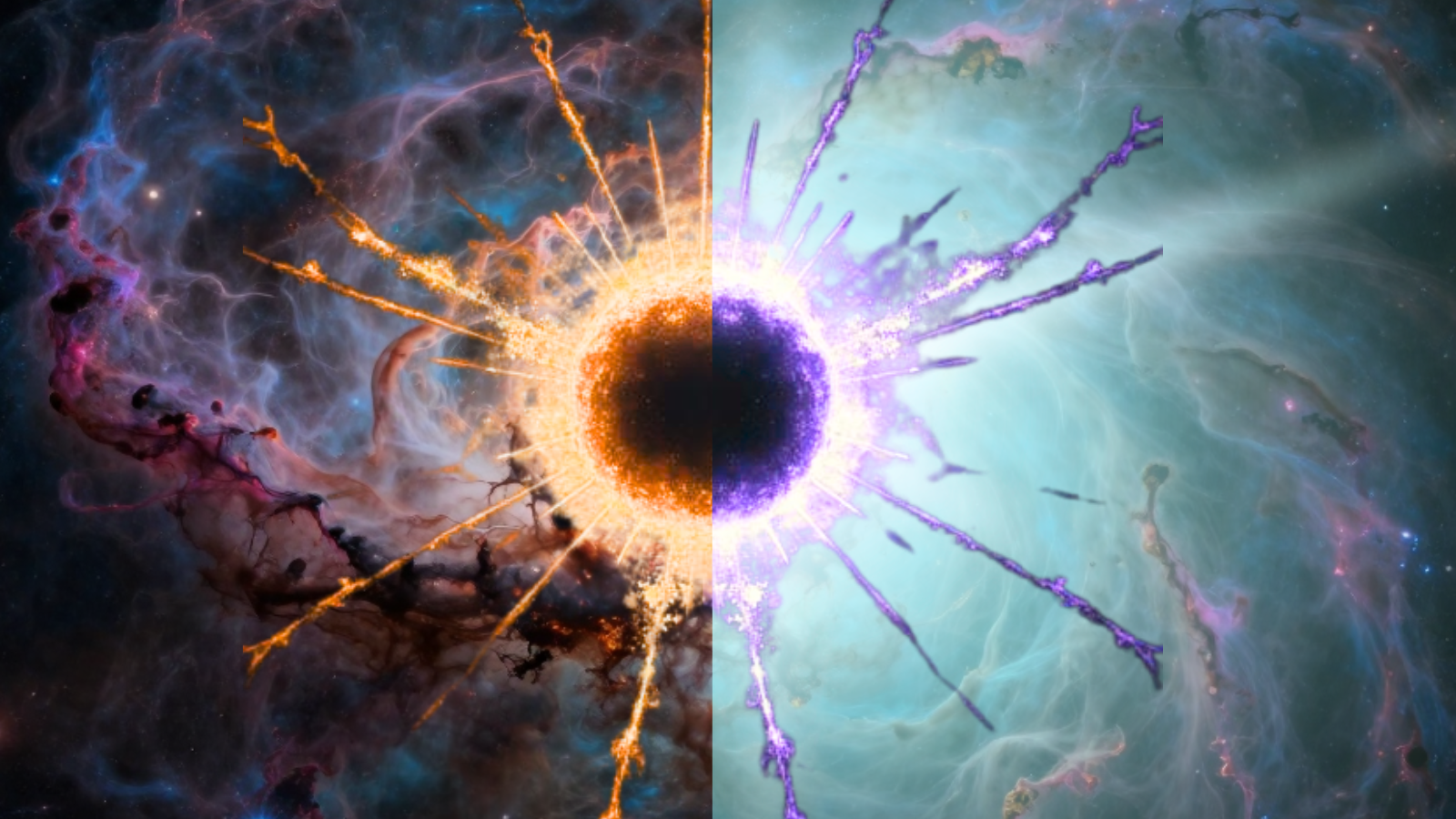
New research suggests that black holes born during the Big Bang could live much longer than previously estimated. In fact, these tiny primordial black holes may live long enough to become energy-spewing white holes with the mass of a human eyebrow hair.
Primordial black holes are proposed to have formed through fluctuations in the incredibly hot and dense matter that filled the universe moments after the Big Bang. This is in contrast to stellar-mass or “astrophysical” black holes that are familiar to us the collapse of massive stars like the. Primordial black holes remain undetected and therefore hypothetical.
Many scientists believe that the failure to detect astrophysical black holes is because they have evaporated and therefore no longer exist in the 13.8 billion year-old cosmos. This is possible because black holes are proposed to “leak” a type of thermal radiation called “Hawking radiation” proposed by Stephen Hawking in the 1970s. The smaller the mass of a black hole, the hotter it is, and thus the faster it leaks Hawking radiation and the more rapidly it evaporates, a process speculated to end with an explosive finale.
Stellar-mass black holes, with up to hundreds of times the mass of the sun, are massive and cool enough to leak slowly enough to outlive the universe itself many times over; primordial black holes with masses way smaller than this, on the other hand, aren’t so lucky — or so we thought. Eberly College of Science researcher Daniel Paraizo and colleagues suggest there is a way that primordial black holes of just the right mass could survive this process to undergo a startling transformation.
“We found that the lifetime of black holes is much longer than previously thought,” Paraizo told Space.com. “The phenomena that we identify are relevant for black holes possibly formed in the early universe. These objects have not been observed yet, but their search is a topic of intense interest as dark matter candidates. Black holes start to die by emitting thermal Hawking radiation. The puzzle is what happens once they reach the Planck mass, which is around 20 micrograms.”
A black hole the size of a flea egg
The Planck mass of around 0.000000022 kilograms is a fundamental unit of mass in physics considered fascinating because it is the point at which the rules that govern subatomic particles and quantum physics as well as those that govern gravity and general relativity as a whole become equally important. Physicists consider this the upper limit for the mass of any single elementary particle, with any particle above this collapsing to birth a microscopic black hole.
In everyday terms, the Planck mass is about equivalent to a human eyebrow hair, or a flea egg, which is about one-fifty-thousandth as heavy as a jelly bean.
Paraizo explained that once a primordial black hole has evaporated to the Planck mass, becoming a so-called Planckian black hole, there are several proposed fates it could encounter. This includes the disappearance of the outer boundary that defines what a black hole is, the light or electromagnetic radiation trapping region known as the event horizon. “The mechanism that we study for the death of this Planck-sized black hole is the gradual disappearance of the horizon that traps radiation,” Paraizo said.
The team performed mathematical calculations that revealed a primordial black hole formed with the initial mass of a medium-size asteroid, around 1 billion tons, decays in about a billion years and emits thermal Hawking radiation until it reaches the Planck mass. However, a primordial black hole born with a mass of just 1 ton would immediately explode, instantly reaching the Planck mass. It is what happens next that sets the team’s findings apart from previous research. “It is then that our results predict something new: previous arguments indicated that the remaining 20 micrograms are radiated in at least 1 second; our estimate shows instead that these 20 microgram remnants are practically stable,” Paraizo explains. “Once the black hole reaches the 20-microgram threshold, we find that it starts emitting purifying radiation [named because it is said to ‘purify’ the quantum state of the universe] due to behavior that is characteristic of a white hole.
“Therefore, even though we do not yet know the physics near a white hole, we identify an object that has exactly the same properties from far away.”

White holes are another hypothetical entity in physics, suggested to be effectively a “time-reversed black hole” that, rather than trap matter and radiation within them as black holes do, endlessly push matter and radiation away.
Any further predictions about the fate of these primordial black holes taking on a white hole appearance would require a theory that unites general relativity and quantum mechanics, known as “quantum gravity,” that has steadfastly evaded physicists since the early 20th century.
“Simple physical assumptions about the physics far away from a black hole can tell us a lot about their lifetime and about their transition to a stable phase that looks like a 20 microgram white hole,” Paraizo said. “The fact that we can infer these properties, using only minimal ingredients from quantum gravity, is remarkable.”
A pre-peer-reviewed version of the team’s research is available on the research repository site arXiv.