

Close Menu

    Subscribe to Updates

    Get the latest news information from worldwide businesses.

    What's Hot

    Wim Wenders withdraws 1975 film featuring 13-year-old Nastassja Kinski topless | Wim Wenders

    June 3, 2026

    Experts warn terrorism threat is rising in Africa as US pulls back

    June 3, 2026

    Day after texting brother about new job, Kolkata girl run over in UK by driver charged with DUI | India News

    June 3, 2026
    Facebook Instagram YouTube LinkedIn X (Twitter)
    Trending
    • Wim Wenders withdraws 1975 film featuring 13-year-old Nastassja Kinski topless | Wim Wenders
    • Experts warn terrorism threat is rising in Africa as US pulls back
    • Day after texting brother about new job, Kolkata girl run over in UK by driver charged with DUI | India News
    • Jodi Huisentruit cold case: PI says tip points to possible suspect
    • Forget ‘Masters of the Universe’, the best live-action He-Man and Skeletor encounter was in an insurance commercial
    • 3 LSG players who must be released after IPL 2026 ft. Rishabh Pant
    • Bluetti sale offers 3,014Wh Elite 300 power station with 350W solar panel + FREE 128Wh Elite 10 Mini for $1,567, Worx robot mowers, more
    • 10% Off Patagonia Promo Codes | June 2026 | Condé Nast Traveler
    Newspublicly
    • About Us
    • Advertise & Partner with us
    • Pitch Your Story
    • Contact Us
    Facebook Instagram LinkedIn X (Twitter)
    Subscribe
    • Home
    • World News
      • Asia
      • India
      • USA
      • UK & Europe
      • Middle East
    • Economy & Business
      • Global Economy
      • Corporate & Industry
      • Finance & Markets
      • Policy & Trade
    • Technology
      • Gadgets & Devices
      • Software & Apps
      • AI & Machine Learning
      • Robotics & Automation
    • Health & Medicine
      • Fitness & Nutrition
      • Research & Innovation
      • Disease & Treatment
      • Doctors, Clinics & Patient Care
    • Travel & Tourism
    • Automobile
      • Electric & Hybrid Vehicles
      • Auto Industry Insights
    • Sports
    • More
      • Education
      • Real Estate
      • Environment & Climate
      • Space & Astronomy
      • War & Conflicts
    Newspublicly
    Home»Health & Medicine»Research & Innovation»Scientists simulated a nuclear fireball and found a surprise in the fallout
    Research & Innovation

    Scientists simulated a nuclear fireball and found a surprise in the fallout

    AdminBy AdminJune 3, 2026No Comments3 Mins Read0 Views
    Share
    Facebook Twitter LinkedIn Copy Link WhatsApp


    When a nuclear weapon detonates or a serious reactor accident occurs, an immense burst of energy is released in less than a millionth of a second. The extreme heat instantly vaporizes nearby air and materials, creating a brilliant, expanding cloud of gas and plasma. As this nuclear fireball grows, it mixes with the surrounding atmosphere, cools, and eventually condenses into tiny solid particles that become nuclear fallout.

    Scientists study how fallout forms because it can provide valuable clues about what happened during a nuclear event and help improve models used for safety assessments. In a new study published in Analytical Chemistry, researchers at Lawrence Livermore National Laboratory (LLNL) investigated how uranium, cerium, and cesium behave as they vaporize, react chemically, and condense under carefully controlled temperature conditions.

    Their findings suggest that some widely used fallout models may overlook important chemical interactions that occur as particles form.

    Recreating Nuclear Fireball Conditions

    “Changing how long materials remain at high temperature can alter chemical reactions and how volatile elements like cesium are incorporated into particles,” said LLNL scientist and author Rakia Dhaoui. “These particles preserve a record of how they formed. By studying these processes in a controlled system, we can replace assumptions with measurements, improve the models used to interpret nuclear debris, and support decision-making when it matters most.”

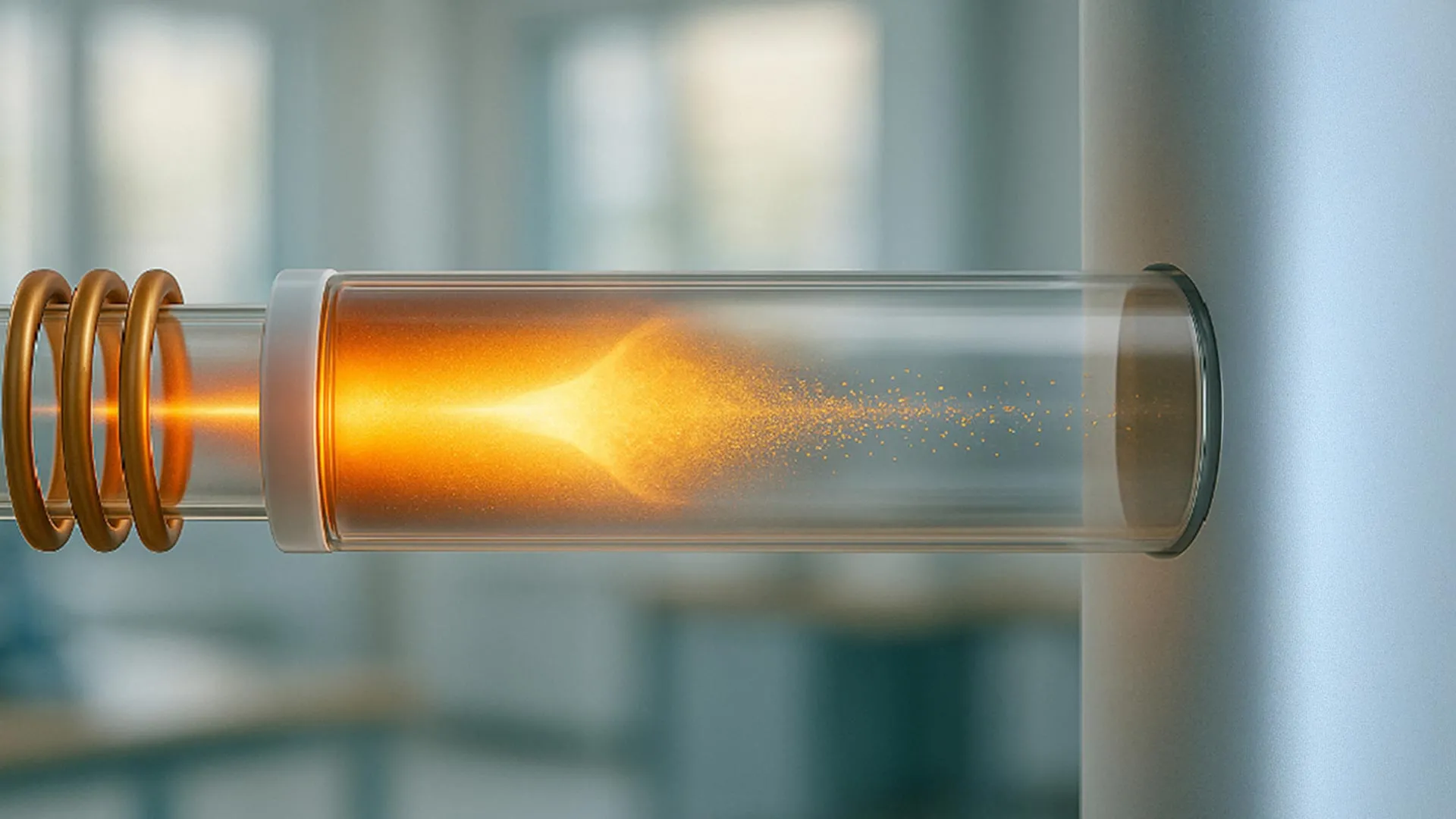
    To investigate these processes, the team used a plasma flow reactor designed to mimic part of the environment inside a nuclear fireball. Specific combinations of materials were introduced into a high-temperature plasma, where they were vaporized. The resulting vapor then traveled through a tube in which temperatures could be carefully controlled as the material cooled.

    The setup allowed researchers to expose the materials to two different cooling scenarios, known as thermal histories. In one scenario, temperatures gradually declined throughout the tube. In the other, the materials remained hot for a longer period before cooling rapidly. Because the reactor operates continuously, samples could be collected at multiple locations, allowing scientists to observe how particles changed as they formed.

    Why Cooling History Matters

    “Historical fallout studies indicate that the path materials take as they cool is important,” said Dhaoui. “Cooling rate and time at elevated temperature can alter chemical speciation and particle formation.”

    The researchers selected uranium, cerium, and cesium because each behaves differently during condensation. Uranium is relatively less volatile and condensed early in the process, making it a useful benchmark. Cerium, which is often used as a stand-in for plutonium, condensed in a similar manner to uranium. However, both elements showed changes in their chemistry depending on the thermal history they experienced.

    Cesium behaved very differently. It condensed much later than the other elements, and when it remained at high temperatures for longer periods, it mixed far more extensively with uranium and cerium.

    Improving Nuclear Fallout Models

    The results indicate that fallout formation depends not only on when different elements condense, but also on how they chemically interact with one another as temperatures drop. Many existing fallout models primarily treat materials as if they behave independently, meaning some of these chemical reactions are only partially represented.

    By isolating the effects of thermal history in a controlled experimental system, the researchers generated data that can be used to evaluate and improve fallout models that have long relied on simplified assumptions.

    The team plans to expand the work by studying more realistic mixtures of materials, with the goal of better capturing the complex processes that govern fallout formation during real-world nuclear events.


    Source link

    Author

    • Admin

      NewsPublicly.com is News & Articles Platform that creating SEO-focused articles on travel, lifestyle, and digital trends.

    Admin
    • Website

    NewsPublicly.com is News & Articles Platform that creating SEO-focused articles on travel, lifestyle, and digital trends.

    Related Posts

    New discovery upends an 80-year-old theory of turbulence

    June 3, 2026

    Scientists reverse anxiety by fixing a tiny brain circuit

    June 3, 2026

    This new diabetes pill burns fat without the downsides of Ozempic

    June 3, 2026
    Leave A Reply Cancel Reply

    Demo
    Top Posts

    The Blue Moon rises on May 30— Where and when to see the second full moon of the month

    May 30, 202640 Views

    “Inside Gemini Robotics 1.5: How Robots Learn to Reason & Act

    November 22, 202525 Views

    New SOCOM rifle allows barrel swapping and cartridge changes

    June 1, 202624 Views

    525 pounds of cocaine seized after Nebraska K9 alerts troopers on I-80

    May 28, 202624 Views
    Don't Miss

    Wim Wenders withdraws 1975 film featuring 13-year-old Nastassja Kinski topless | Wim Wenders

    June 3, 20263 Mins Read0 Views

    German director Wim Wenders has withdrawn from circulation his 1975 film Wrong Move, because of…

    Experts warn terrorism threat is rising in Africa as US pulls back

    June 3, 2026

    Day after texting brother about new job, Kolkata girl run over in UK by driver charged with DUI | India News

    June 3, 2026

    Jodi Huisentruit cold case: PI says tip points to possible suspect

    June 3, 2026
    Stay In Touch
    • Facebook
    • Twitter
    • Instagram
    • YouTube
    • LinkedIn
    • WhatsApp

    Subscribe to Updates

    Get the latest creative news from SmartMag about art & design.

    Demo
    NEWSPUBLICLY
    Facebook X (Twitter) Instagram LinkedIn

    Home

    • About Us
    • Leadership
    • Advertise & Partner With Us
    • Pitch Your Story
    • Media Kit & Pricing
    • Career
    • FAQs

    Guidelines

    • Editorial & Submission
    • Partnership
    • Advertising & Sponsor
    • Intellectual Property Policy
    • Community & Comment
    • Security & Data Protection
    • Send Your Opinion

    Quick Links

    • Cookie Policy
    • Payment & Billing Terms
    • Refund & Cancellation
    • Copyright Policy
    • Complaint & Support
    • Sitemap
    • Contact Us

    Subscribe Us

    Get the latest news and updates!

    Copyright © 2026 Newspublicly (DIGITALIX COMMUNICATION). All Rights Reserved.
    • Privacy Policy
    • Terms of Use
    • Disclaimer