

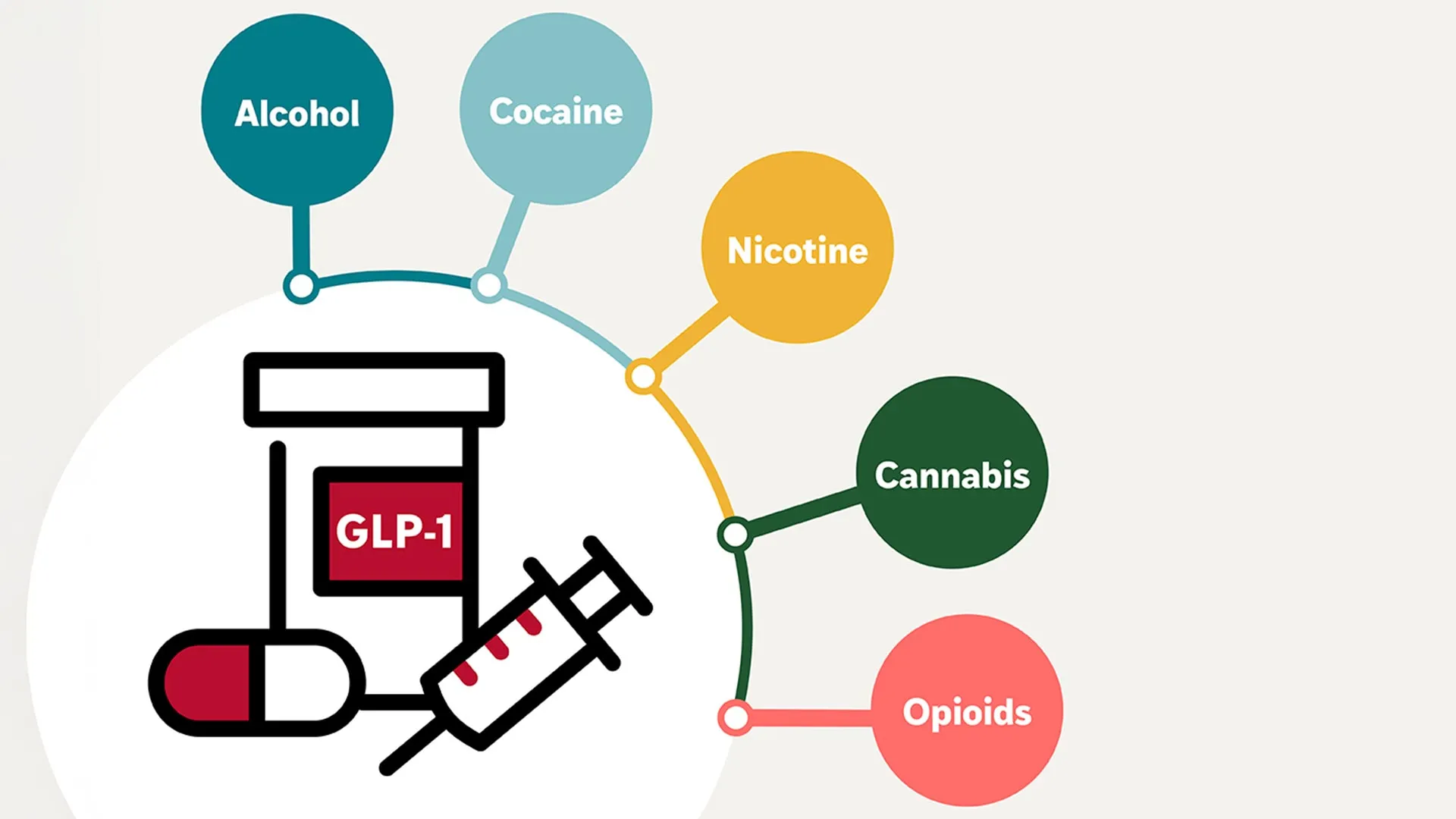
Popular GLP-1 drugs including Ozempic, Wegovy, Mounjaro, and Zepbound have already transformed the treatment of type 2 diabetes and obesity. Now, new research suggests these medications may also help prevent and treat addiction across a broad range of substances.
Researchers at Washington University School of Medicine in St. Louis found that GLP-1 medications were associated with lower risks of developing substance use disorders involving alcohol, nicotine, cannabis, cocaine, opioids, and other substances. The drugs were also linked to fewer overdoses, hospitalizations, and drug-related deaths among people already living with addiction.
The findings were published in The BMJ.
GLP-1 Drugs and Addiction
GLP-1 receptor agonists were originally developed to help manage type 2 diabetes, but their popularity has surged in recent years because of their effectiveness for weight loss. Along the way, researchers began noticing something unexpected.
Some patients reported losing interest in alcohol and cigarettes after starting the medications. Earlier observational studies also found links between GLP-1 treatment and lower risks of alcohol and cannabis use disorders, opioid overdose, and alcohol-related hospitalization.
However, most previous studies focused on individual substances. Researchers wanted to determine whether the effects extended across multiple forms of addiction and whether the drugs could help reduce the most serious consequences associated with substance use disorders.
To investigate, the research team analyzed electronic health records from 606,434 U.S. veterans with type 2 diabetes.
Study Examines More Than 600,000 Veterans
Participants were divided into two groups. One group included people without a substance use disorder at the start of the study. The second group consisted of people who already had a diagnosed substance use disorder.
Researchers reviewed up to three years of health records after participants began taking either a GLP-1 receptor agonist, most commonly semaglutide, liraglutide, or dulaglutide, or an SGLT2 inhibitor, another type of diabetes medication.
Among the 524,817 participants who did not have a substance use disorder when the study began, those taking GLP-1 medications were less likely to develop one over time.
Compared with patients taking non-GLP-1 diabetes medications, GLP-1 users had a 14% lower risk of developing any substance use disorder. Risks were lower across every major substance examined, including alcohol (18%), cannabis (14%), cocaine (20%), nicotine (20%), and opioids (25%).
The researchers estimated that this translated to seven fewer new substance use disorder diagnoses per 1,000 GLP-1 users.
Fewer Overdoses and Drug-Related Deaths
The study also examined outcomes among the 81,617 participants who already had a substance use disorder.
In that group, GLP-1 use was associated with fewer addiction-related emergencies and serious health consequences. After three years, participants taking GLP-1 drugs experienced a 30% reduction in emergency department visits, a 25% reduction in hospitalizations, a 40% reduction in overdoses, and a 50% reduction in drug-related deaths.
Overall, the researchers estimated that GLP-1 use was associated with 12 fewer serious addiction-related events per 1,000 users.
“In addiction medicine, a lot of treatments target just one thing, for example, a nicotine patch helps with smoking, but not alcohol, but there is no medication that works across addictive substances, let alone all of them,” said senior author Ziyad Al-Aly, MD, a WashU Medicine clinical epidemiologist and Chief of the Research and Development Service at the VA Saint Louis Health Care System.
“The revelation about GLP-1 medication is that it really works against all major substances, and it works uniformly, not because it acts against alcohol or opioids or nicotine specifically, but because it is likely acting against the craving itself. It blunts that craving that pulls people toward whatever they’re addicted to.”
Targeting the Biology of Craving
Al-Aly said the study was partly inspired by patient reports describing unexpected changes in behavior after starting GLP-1 treatment.
Researchers also considered evidence showing that GLP-1 receptors are present in brain regions involved in reward processing. That raised the possibility that the drugs could influence the cravings that drive addiction.
The findings suggest that GLP-1 medications may act on a shared biological pathway underlying multiple forms of addiction. Rather than targeting a specific substance, the drugs may be affecting the craving itself.
The idea is particularly significant because some addictive substances, including methamphetamine, currently have no approved medication treatments.
“GLP-1s may offer a dual benefit for patients with chronic conditions like diabetes or obesity who are also struggling with a substance use disorder: one medication can treat both conditions at once,” Al-Aly said.
A Potential New Approach to Addiction Treatment
Millions of Americans already use GLP-1 medications, and that number continues to grow. If future studies confirm these findings, the public health implications could be substantial.
The researchers say the results support conducting clinical trials specifically designed to test GLP-1 drugs as addiction treatments, including studies capable of measuring effects on overdose and drug-related death.
“People taking these drugs for obesity often describe a quieting of ‘food noise,’ the persistent preoccupation with food that drives overeating,” Al-Aly said.
“What our study suggests is something broader: GLP-1 drugs may also quiet what I call ‘drug noise,’ the relentless craving that drives addiction across substances. That cross-substance signal points to a shared biology underlying addiction, and it opens the door to a fundamentally different approach: not treating one addiction at a time, but targeting that common biologic signal, that common craving across addictions. Moving beyond food noise to drug noise, GLP-1s are quieting the roar of addiction.”
The research was funded by the U.S. Department of Veterans Affairs. According to the authors, the funders had no role in the study’s design, data collection, analysis, interpretation, manuscript preparation, review, approval, or publication decisions. The researchers also noted that the findings do not represent the views of the Department of Veterans Affairs or the U.S. government.