

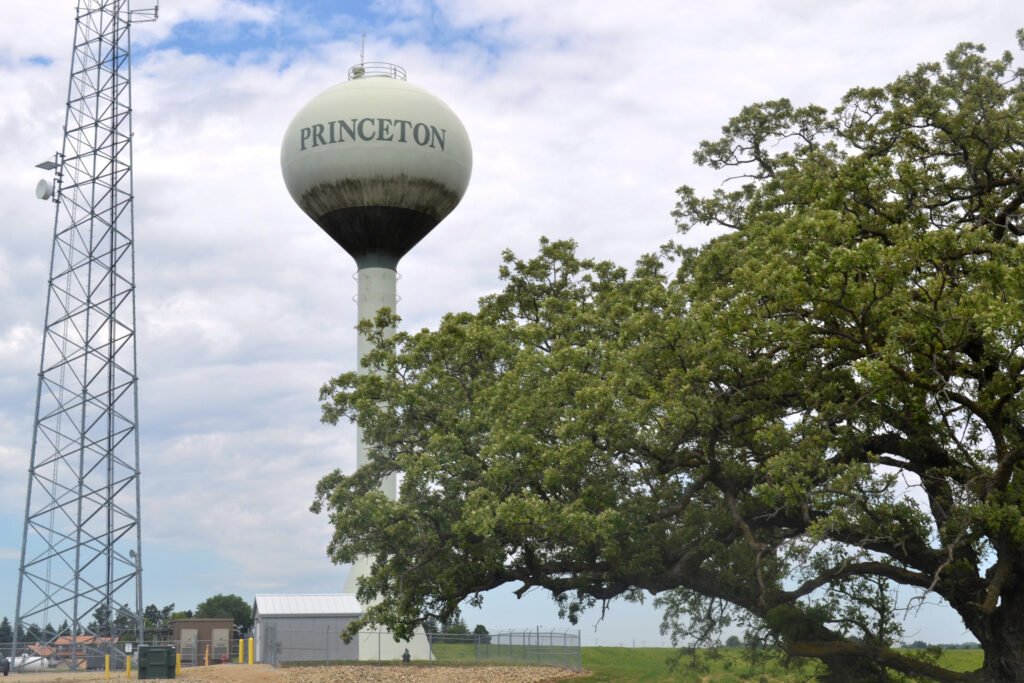
PRINCETON, Iowa—From the beginning, the new well was a headache.
Late in 2022, an overly powerful pump caused eight months of costly water main breaks in Princeton, a town of nearly 1,000 residents on the banks of the silty Mississippi River.
Installing a smaller motor seemed to fix that issue, but revealed a different, all-too-familiar problem: nitrate contamination.
In 2009, Princeton had capped their 40-year-old auxiliary well after several years of racking up state violations for high nitrate levels.
Since then, and after years with no backup water source, the town invested nearly $800,000 to drill a new well and build an accompanying water tower.
City officials hoped the new well would give their riverside community room to grow. Instead, it was pumping undrinkable water.
In September 2024, the Iowa Department of Natural Resources notified the city that its latest water samples had violated the Environmental Protection Agency’s maximum nitrate contaminant level of 10 milligrams per liter.
Water from the well tested at 12.1 milligrams of nitrate per liter, a level deemed unsafe to drink for infants and pregnant mothers. The city immediately shut down the well. That was two years ago.
Princeton’s main well, drilled in 1963, still provides enough clean water for the town’s 350 households and businesses. But relying on just one well is precarious, said Chris Rindler, the city’s public works foreman.
“We have 1,000 people that need water, potable water. And to not give them that reliable backup, well, I don’t think that’s an option,” he said.
Rindler continues to sample the recently decommissioned well for nitrates. Concentrations peaked in spring 2025 at around 16 milligrams per liter, he said. Since shutting down the well, not a single sample has fallen within the allowable range.
Meanwhile, Princeton’s primary well, drilled to the same depth as both decommissioned wells, has yet to run afoul of nitrate water quality standards, a fact that baffles Rindler and geologists he brought in to investigate Princeton’s case.

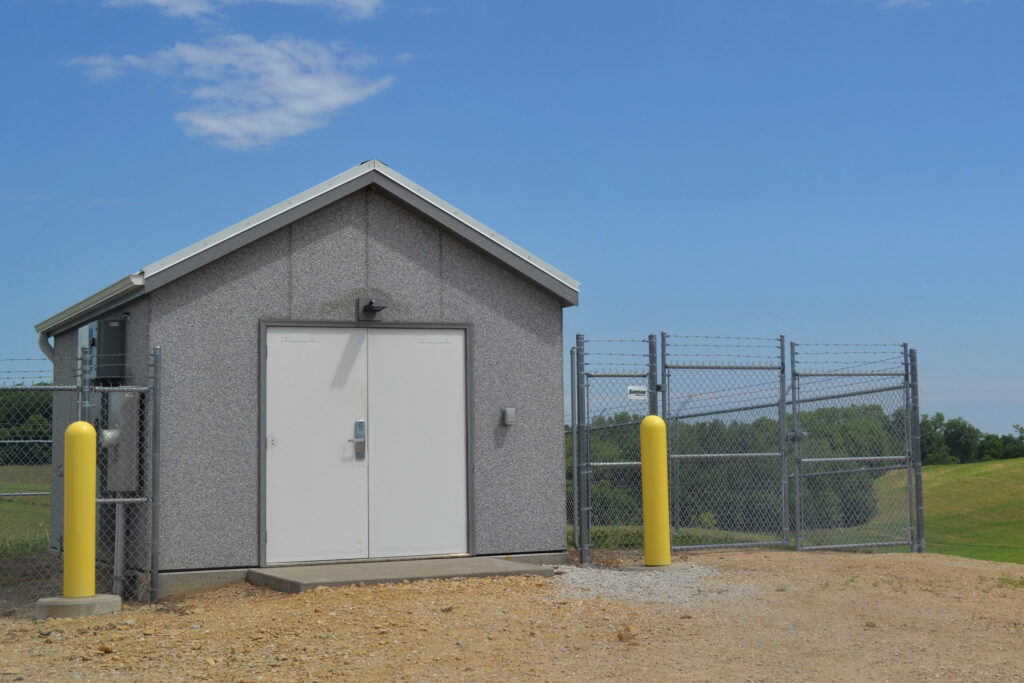
All three wells reach nearly 450 feet through clay and fractured limestone to draw water from the Silurian-Devonian aquifer that underlies much of Iowa.
While many of Iowa’s surface waters absorb nitrate runoff from fertilizer and manure on neighboring farmland and livestock confinements, such high nitrate levels are typically rare in deep, aquifer wells like those in Princeton.
In theory, those ancient aquifers should be unaffected by the chemical footprint of modern industrial agriculture, said Ryan Clark, associate state geologist at the Iowa Geological Survey. In practice, it becomes incredibly difficult to understand the interplay between surface pollution and water reserves deep underground.
That is evident in Princeton, where the city has taken an aggressive approach to limiting nitrogen fertilizer applied near the wellhead but seen scant results. At the recommendation of the Iowa Rural Water Association, a nonprofit offering technical and administrative support to water and wastewater systems across Iowa, the city has “leased” approximately 25 acres of farmland directly surrounding the nitrate-riddled well since spring 2025. Three landowners are paid $300 per acre, per year not to apply fertilizer to the land.
In total, it’s costing the city a little less than $8,000 a year, said Mayor Travis Volrath. None of the three landowners was happy with the arrangement, but all have obliged, he said.
“I didn’t put the well there, they didn’t put the well there, but the fact is, it’s there now,” said Volrath. “We have to deal with it, and, you know, I don’t think nobody wants to be blamed for the problem.”
Volrath fears that farmers across Iowa are facing disproportionate blame, as nitrate pollution in surface water and major drinking water sources raises questions about fertilizer use and manure management.
When the town’s first backup well was shuttered in 2009, Volrath admits he thought it plausible that infiltration from agricultural runoff was partly to blame. After all, a drainage ditch ran through acres of farmland before passing within feet of the well.
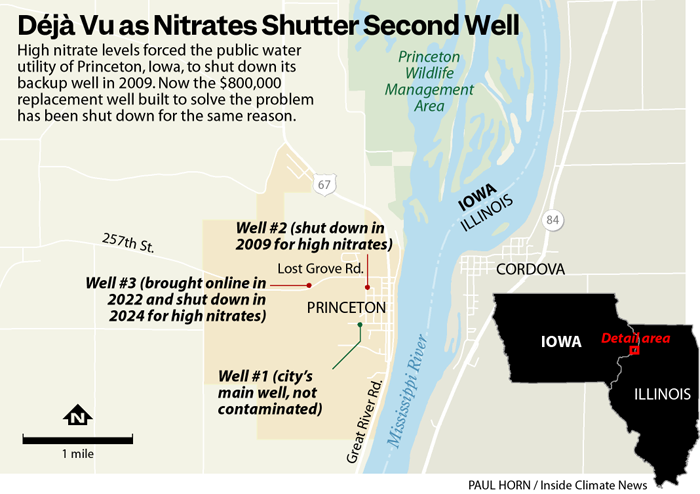
One year into limiting nitrogen application on the land surrounding its replacement well, Volrath isn’t so sure. Since the city gained control of the wellhead protection area, nitrate readings at the well have dropped by only 1 milligram per liter, Rindler estimates. The well is still averaging more than 5 milligrams above the legal limit.
“I would say the data shows that we haven’t moved the needle much. It has gently trended down, but not far enough to matter,” Volrath said.
Clark, of the Iowa Geological Survey, says this isn’t shocking. The issue of nitrate contamination extends beyond Princeton, and beyond 20 acres of farmland, he said.
In 1999, the U.S. Geological Survey warned that nitrate levels in Silurian water supply wells for Cedar Rapids, Eastern Iowa’s largest population center, were approaching the EPA’s maximum contaminant level. More recently, elevated nitrate levels have been measured in Silurian wells as far north as Green Bay, Wisconsin.
Almost all of the Silurian aquifer beneath Eastern Iowa is impacted by nitrate to some degree, Clark said. “It’s a much bigger picture,” he said.
While that’s welcome news for disgruntled landowners near the wellhead, it means the city of Princeton may be looking at much costlier solutions.
Before installing a reverse osmosis system, which would cost the small town at least a million dollars its budget can’t support, Rindler and Volrath are holding out hope that the nitrate contamination is coming from a crack in the well’s casing, a tube that extends several hundred feet and prevents groundwater infiltration above the Silurian aquifer.
A crack in the casing might allow surface-applied nitrogen, as well as “legacy nitrate” built up over years of row-cropping and aggressive fertilization, to leach into the water supply more rapidly, explained Clark.
The city wrapped up an application with the state DNR in May for a $10,000 grant that would fund an exploratory study to identify cracks in the well casing. If discovered, repairing such a crack would require another grant or loan.
Still, at this stage, a crack “would be the best possible case scenario,” a Princeton city council member said at a May meeting. A repair would be costly, but the town would at least have answers.
This story is funded by readers like you.
Our nonprofit newsroom provides award-winning climate coverage free of charge and advertising. We rely on donations from readers like you to keep going. Please donate now to support our work.
If no cracks are found in the backup well’s casing, nitrate contamination could also be coming from cracks in the aquifer itself. Dolostone and limestone aquifers, like the Silurian beneath Princeton, are prone to fractures, Clark said.
Those cracks in the bedrock make it difficult to predict how groundwater will move through the aquifer, he said, and could explain why some, but not all, of Princeton’s wells have experienced nitrate contamination.
Digging a deeper well also doesn’t guarantee a fix to the nitrate issue. In fact, drilling into a deeper aquifer could expose that water source to any contamination already affecting the Silurian.
To truly understand the situation in Princeton, Clark says he would want to expand a groundwater investigation area several miles north, where the Wapsipinicon River snakes its way to the Mississippi.
The Wapsipinicon, or “Wapsi,” used to be much wider before the river valley filled with sand and was eventually covered in farmland. Those sand deposits provide little water filtration, said Clark, which might allow surface water in the river to soak into the Silurian aquifer.
But, Clark caveats, hydrologists don’t actually know the direction in which groundwater flows in the region.
David Cwiertny, director of the Center for Health Effects of Environmental Contamination at the University of Iowa, noted that while Princeton’s still-functional primary well is testing well below the EPA limit, its nitrate levels also appear to be on the rise.
“It’s not an immediate risk, but there’s clearly nitrogen that’s getting into their waterways and into that aquifer,” Cwiertny said.
And even if the contamination is coming from farmland immediately around Princeton, it may take years for their wellhead protection program to yield meaningful results, he said.
Princeton’s water woes raise questions about the fate of many public water utilities across Iowa that are struggling to manage nitrates.
Failure to meet the nitrate water-quality standard was the top reason that public water supplies in Iowa received health-based violations in 2024, according to the Department of Natural Resources’ most recent annual compliance report.
And Princeton is not the first community to seek nitrate management advice from the Iowa Rural Water Association, Rindler said. “They’re here to help us. You know, we’re not the only community out here that has a problem,” he said.
Several towns have also approached the Iowa Geological Survey with similar issues in recent years, Clark said.
In general, it is cheaper for smaller municipalities to treat groundwater than surface water, as deep aquifers are less susceptible to certain contaminants. But those towns may face higher treatment costs either way if they have to install systems to scrub nitrates from increasingly contaminated groundwater sources, said Cwiertny.
One solution would be to consolidate small, struggling water systems into a larger utility with the infrastructure and tax base to support expensive treatment facilities, Cwiertny said. That typically means residents pay higher water rates.
Several towns neighboring Princeton already purchase their water from American Water, the largest regulated water utility in the nation.
In 2021, the Princeton city council declined a $2 million offer from the company’s local subsidiary to buy their municipal water system. At the time, the council turned it down because the company would have required Princeton to carry out expensive upgrades that outstripped the offered price.
In the wake of the second backup well’s disappointing launch, several Princeton residents proposed selling the city’s water utility to American Water.
Aaron Schroeder, a source water specialist with the Iowa Rural Water Association, is evaluating if nitrates in Princeton’s water are coming from organic sources, such as livestock manure, or synthetic sources.
“Initial tests are inconclusive or seem to indicate a mixing of both, but we’re waiting on more results,” Schroeder wrote in an email to Inside Climate News. Rindler hopes that the results will help the town narrow down the potential contamination sources
To build the backup well, Princeton received a nearly $400,000 loan from the U.S. Department of Agriculture, which they plan to pay off by 2040. Installing a reverse osmosis system to filter nitrates out of the groundwater would likely run upward of a million dollars, forcing the city to borrow more money.
“If it had to be done, it’s an option,” Volrath said. “But it’s going to be our very last option.”
About This Story
Perhaps you noticed: This story, like all the news we publish, is free to read. That’s because Inside Climate News is a 501c3 nonprofit organization. We do not charge a subscription fee, lock our news behind a paywall, or clutter our website with ads. We make our news on climate and the environment freely available to you and anyone who wants it.
That’s not all. We also share our news for free with scores of other media organizations around the country. Many of them can’t afford to do environmental journalism of their own. We’ve built bureaus from coast to coast to report local stories, collaborate with local newsrooms and co-publish articles so that this vital work is shared as widely as possible.
Two of us launched ICN in 2007. Six years later we earned a Pulitzer Prize for National Reporting, and now we run the oldest and largest dedicated climate newsroom in the nation. We tell the story in all its complexity. We hold polluters accountable. We expose environmental injustice. We debunk misinformation. We scrutinize solutions and inspire action.
Donations from readers like you fund every aspect of what we do. If you don’t already, will you support our ongoing work, our reporting on the biggest crisis facing our planet, and help us reach even more readers in more places?
Please take a moment to make a tax-deductible donation. Every one of them makes a difference.
Thank you,

Reporter, Iowa
Anika Jane Beamer covers the environment and climate change in Iowa, with a particular focus on water, soil and CAFOs. A lifelong Midwesterner, she writes about changing ecosystems from one of the most transformed landscapes on the continent. She holds a master’s degree in science writing from the Massachusetts Institute of Technology as well as a bachelor’s degree in biology and Spanish from Grinnell College. She is a former Outrider Fellow at Inside Climate News and was named a Taylor-Blakeslee Graduate Fellow by the Council for the Advancement of Science Writing.