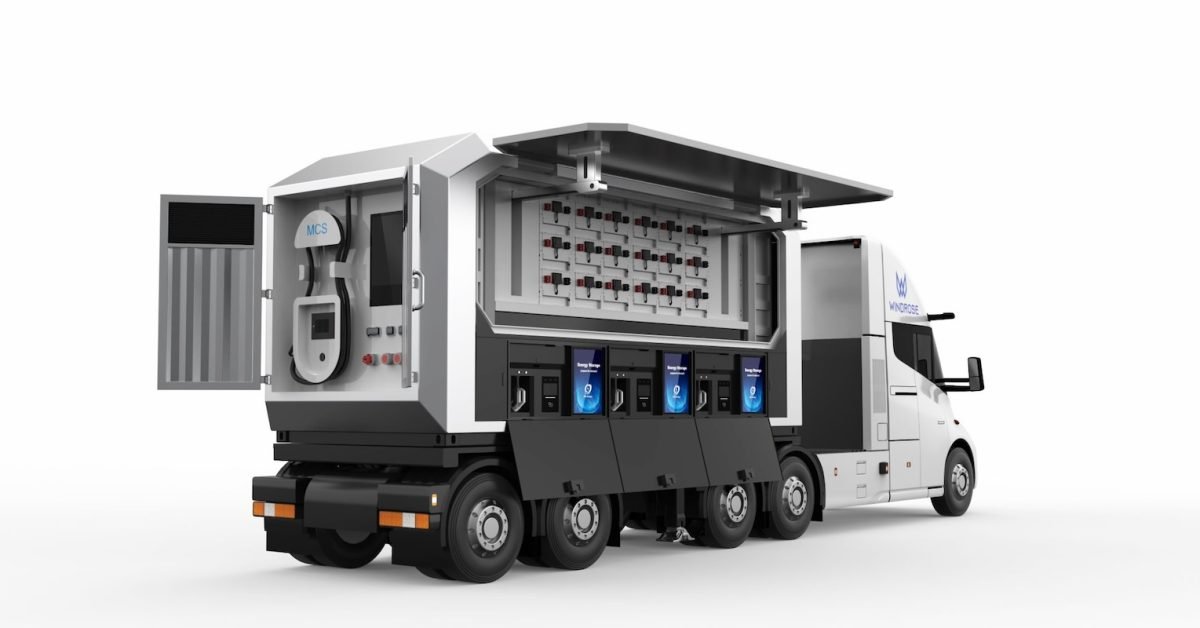
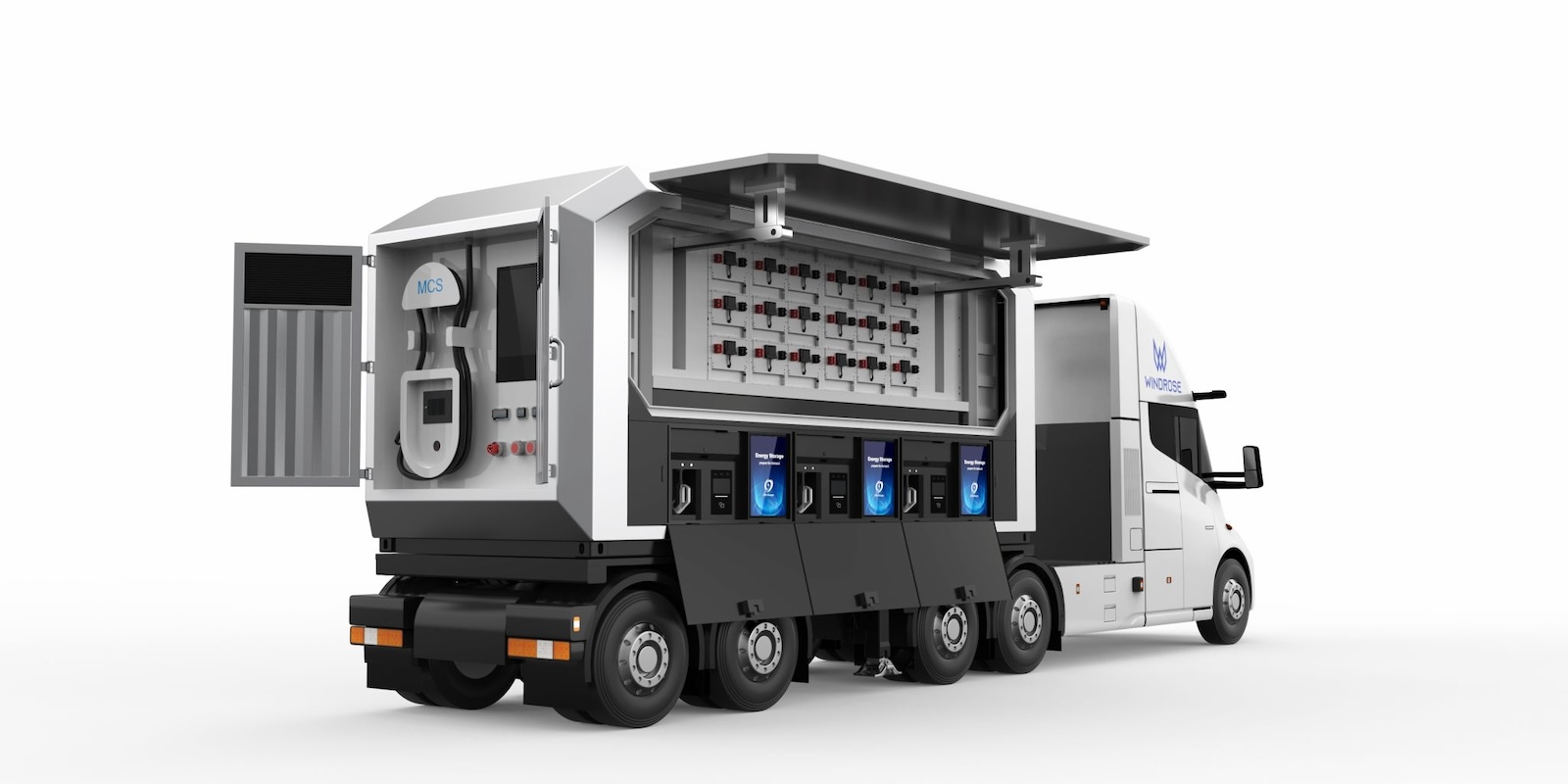
Windrose first published AI-generated drawings of its BESS-in-a-trailer and mobile AI data center concept back in February, but hand it to Windrose founder, Wen Han: he’s not leaving it at that – Han has signed a new strategic partnership with the mobile charging experts at LiFe-Younger to help turn his vision into reality.
LiFe-Younger is pairing its iMContainer HD trailer concept with Windrose’ R700 electric semi truck in this rendering (above) shared on LinkedIn, where Han claims that the, “container-sized unit contains 2 MWh of battery storage capacity and up to 2 MW of charging speed.” Specs on the LiFe-Younger site are a bit more conservative, meanwhile, citing up to 1 MWh of storage capacity with up to 500 kW of charging speed.
That said, the announcement is more forward-looking than it is about announcing a current product, so take that how you will.
You can check out the original post covering Windrose’ initial concept, below, then let us know what you think of packing large scale battery and charging solutions into standardized containers – something Volvo Penta and Range, at least, seem to think is a good idea – in the comments section at the bottom of the page.
ORIGINALLY PUBLISHED 09FEB2026

Windrose is making big, fast moves in the heavy-duty EV space with its electric semi truck business already expanding into four continents — but CEO Wen Han doesn’t want to stop there. He’s got an idea for a mobile data center and BESS solution packed into one, and he really wants us to know about it.
Windrose CEO Wen Han has been making headlines with his ultra-capable electric semi trucks, but herecently took to LinkedIn recently to promote a whole new idea that’s less about the trucks, and more about what they’re hauling.
Launched under the headline, “Windrose = AI = energy in a box.” The idea described two standard-sized shipping containers (pulled by a Windrose R700, of course) with one packed full of batteries and the other packed with server racks and cooling equipment.
What’s really wild, however, isn’t the idea — it’s the fact that Wen was in such a hurry to put the concept “out there” that he apparently used Google Gemini-rendered images (shown, above) to illustrate the concept.
Google Gemini adds the star watermark as a transparency and safety measure so that people can tell the image was created by AI, and isn’t either a photo or human-made artwork.
That said, I’ve only ever seen the Windrose R700 in 6×2 configurations, while these illustrations show it in 4×2. The other image, which shows how the BESS trailer can be deployed as a mobile charging solution, seems to drag the lines across an active highway.
The artwork leaves something to be desired, is what I’m saying. But the idea? It’s not too far removed from the containerized BESS Volvo showed off at Bauma last year. That system was designed to provide power to off-highway equipment and offices when grid power was unavailable, and be easily hauled off to reliable charging where grid was available. Combining that idea with a containerized data center would–
Actually, I’m not sure what it would do. You guys are smart, though. You have ideas. Take a look at Wen’s concept (as understood by Google Gemini, at least), then let us know what you think in the comments.
SOURCE: Windrose, via LinkedIn.

If you’re considering going solar, it’s always a good idea to get quotes from a few installers. To make sure you find a trusted, reliable solar installer near you that offers competitive pricing, check out EnergySage, a free service that makes it easy for you to go solar. It has hundreds of pre-vetted solar installers competing for your business, ensuring you get high-quality solutions and save 20-30% compared to going it alone. Plus, it’s free to use, and you won’t get sales calls until you select an installer and share your phone number with them.
Your personalized solar quotes are easy to compare online and you’ll get access to unbiased Energy Advisors to help you every step of the way. Get started here.


FTC: We use income earning auto affiliate links. More.