

Close Menu

    Subscribe to Updates

    Get the latest news information from worldwide businesses.

    What's Hot

    Elon Musk Highlights Alarming Drop in India’s Fertility Rate | India News

    June 7, 2026

    ‘Rosie the Riveters’ honored at National WWII Museum on D-Day anniversary

    June 7, 2026

    Earthquake at MSG confirmed”, “Kobe about to send a curse

    June 7, 2026
    Facebook Instagram YouTube LinkedIn X (Twitter)
    Trending
    • Elon Musk Highlights Alarming Drop in India’s Fertility Rate | India News
    • ‘Rosie the Riveters’ honored at National WWII Museum on D-Day anniversary
    • Earthquake at MSG confirmed”, “Kobe about to send a curse
    • Doctors declining NPA cannot later seek pay parity with juniors who opted for it: Rajasthan HC
    • Eli Lilly says next-gen obesity drug curbs sleep apnea, among other benefits
    • Ukraine war briefing: Kyiv unleashes hundreds of drones on Russia after Putin rejected Zelenskyy meeting | Ukraine
    • At nearly 50%, no. of deaths without medical care up sharply since 2020 | India News
    • ‘Chelsea Jane Doe’ identified as Pennsylvania teen 26 years after murder
    Newspublicly
    • About Us
    • Advertise & Partner with us
    • Pitch Your Story
    • Contact Us
    Facebook Instagram LinkedIn X (Twitter)
    Subscribe
    • Home
    • World News
      • Asia
      • India
      • USA
      • UK & Europe
      • Middle East
    • Economy & Business
      • Global Economy
      • Corporate & Industry
      • Finance & Markets
      • Policy & Trade
    • Technology
      • Gadgets & Devices
      • Software & Apps
      • AI & Machine Learning
      • Robotics & Automation
    • Health & Medicine
      • Fitness & Nutrition
      • Research & Innovation
      • Disease & Treatment
      • Doctors, Clinics & Patient Care
    • Travel & Tourism
    • Automobile
      • Electric & Hybrid Vehicles
      • Auto Industry Insights
    • Sports
    • More
      • Education
      • Real Estate
      • Environment & Climate
      • Space & Astronomy
      • War & Conflicts
    Newspublicly
    Home»Technology»Robotics & Automation»Stanford quantum computing breakthrough uses twisted light to work without extreme cooling
    Robotics & Automation

    Stanford quantum computing breakthrough uses twisted light to work without extreme cooling

    AdminBy AdminMay 30, 2026No Comments4 Mins Read0 Views
    Share
    Facebook Twitter LinkedIn Copy Link WhatsApp


    Quantum computers today are notoriously difficult and expensive to operate. Most require temperatures near absolute zero, about -459 degrees Fahrenheit, to maintain the fragile quantum states needed for computation and communication.

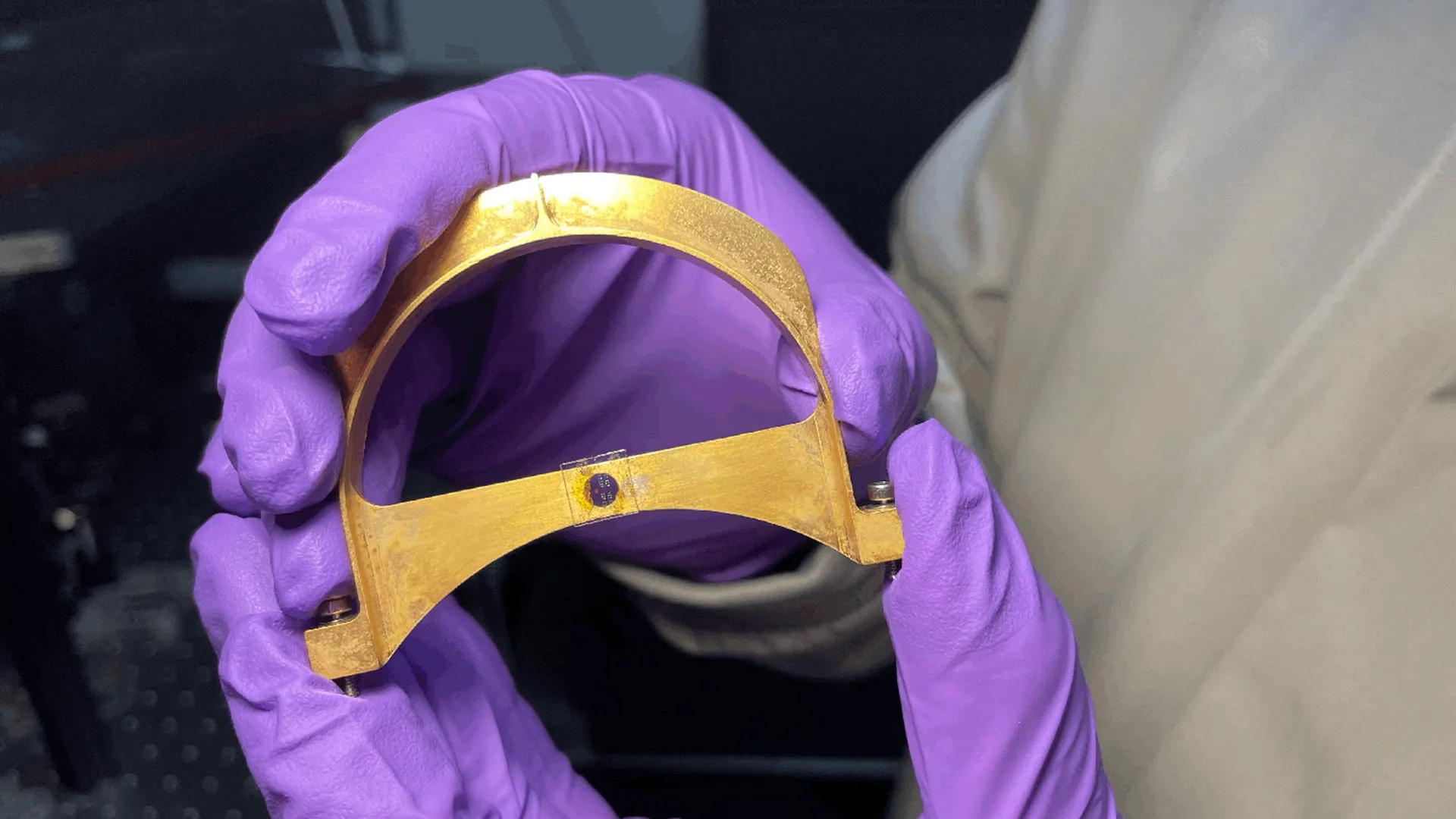
    Now, researchers at Stanford University have developed a nanoscale optical device that functions at room temperature while linking the quantum properties of light and electrons. The advance could help pave the way for smaller, lower-cost quantum technologies capable of transmitting information across long distances.

    The new device enables entanglement between photons, the particles that make up light, and electrons. This quantum connection is considered a fundamental requirement for future quantum communication systems.

    “The material in question is not really new, but the way we use it is,” says Jennifer Dionne, a professor of materials science and engineering at Stanford and senior author of the study published in Nature Communications. “It provides a very versatile, stable spin connection between electrons and photons that is the theoretical basis of quantum communication. Typically, however, the electrons lose their spin too quickly to be useful.”

    Twisted Light and Quantum Spin

    The device combines a thin patterned layer of molybdenum diselenide (MoSe2) with a nanopatterned silicon substrate. Molybdenum diselenide belongs to a family of materials known as transition metal dichalcogenides (TMDCs), which are valued for their unique optical and quantum properties.

    According to the researchers, the silicon nanostructures play a critical role by generating what they call “twisted light.”

    “The Silicon nanostructures enable what we call ‘twisted light,'” explains Feng Pan, a postdoctoral scholar in Dionne’s lab and the paper’s first author. “The photons spin in a corkscrew fashion, but more importantly, we can use these spinning photons to impart spin on electrons that are the heart of quantum computing.”

    Dionne notes that the patterned structures are incredibly small, roughly comparable in size to visible light wavelengths and impossible to see with the naked eye.

    “The patterned nanostructures are imperceptible to the human eye, about the size of the wavelength of visible light,” Dionne adds. “But they help us manipulate photons very precisely to make them spin — to twist them- in a specific direction, for example, up or down.”

    A Simpler Path to Quantum Communication

    Researchers can use this twisted light to become entangled with electron spins, creating qubits, the basic building blocks of quantum information systems.

    In conventional computing, information is represented by zeros and ones. In quantum technologies, qubits serve a similar purpose but can take advantage of quantum mechanical effects to process and transmit information in entirely new ways.

    One of the biggest challenges facing quantum technologies is maintaining stable quantum states. In many existing systems, extreme cooling is necessary to prevent a process known as decoherence, in which delicate quantum information is lost.

    Because the new device operates at room temperature, it avoids one of the major obstacles that has limited the widespread use of quantum technologies. The researchers say the compact design is also relatively inexpensive and practical compared with many current quantum systems.

    If further developed, the technology could contribute to advances in secure communications, advanced sensing, high-performance computing, artificial intelligence, and other emerging applications.

    Why the Material Matters

    The team selected TMDC materials because of their unusual quantum characteristics and collaborated with Stanford researchers Fang Liu and Tony Heinz, who specialize in these materials.

    “It all comes down to this material and our Silicon chip,” Pan says. “Together, they efficiently confine and enhance the twisting of light to create a strong coupling of spin between photons and electrons. This stabilizes the quantum state that makes quantum communication possible.”

    The combination allows light and matter to interact more strongly, helping preserve the quantum properties needed for communication and computing tasks.

    Toward Future Quantum Networks

    The researchers are continuing to improve the device and are exploring additional TMDC materials and material combinations that could deliver even better performance. They are also investigating whether these systems might reveal new quantum capabilities that are not currently possible at room temperature.

    A longer-term goal is integrating devices like this into larger quantum networks. Achieving that vision will require improvements in supporting technologies such as light sources, modulators, detectors, and interconnects.

    Ultimately, researchers hope quantum components can be miniaturized enough to be incorporated into everyday electronics. While that future remains many years away, the work represents a step toward making quantum technology more accessible and practical.

    “If we can do that, maybe someday we could do quantum computing in a cell phone,” Pan says with a smile. “But that’s a 10-plus-year plan.”


    Source link

    Author

    • Admin

      NewsPublicly.com is News & Articles Platform that creating SEO-focused articles on travel, lifestyle, and digital trends.

    Admin
    • Website

    NewsPublicly.com is News & Articles Platform that creating SEO-focused articles on travel, lifestyle, and digital trends.

    Related Posts

    The forgotten organ that could predict how long you live

    June 1, 2026

    AI-powered spectrometer chip shrinks lab technology to the size of a grain of sand

    May 26, 2026

    AI won’t replace you but someone using AI might

    May 25, 2026
    Leave A Reply Cancel Reply

    Demo
    Top Posts

    The Blue Moon rises on May 30— Where and when to see the second full moon of the month

    May 30, 202640 Views

    New SOCOM rifle allows barrel swapping and cartridge changes

    June 1, 202632 Views

    “Inside Gemini Robotics 1.5: How Robots Learn to Reason & Act

    November 22, 202525 Views

    525 pounds of cocaine seized after Nebraska K9 alerts troopers on I-80

    May 28, 202624 Views
    Don't Miss

    Elon Musk Highlights Alarming Drop in India’s Fertility Rate | India News

    June 7, 20262 Mins Read0 Views

    ‘Among those most educated … ’: Elon Musk flags India’s falling fertility rate (Image source:…

    ‘Rosie the Riveters’ honored at National WWII Museum on D-Day anniversary

    June 7, 2026

    Earthquake at MSG confirmed”, “Kobe about to send a curse

    June 7, 2026

    Doctors declining NPA cannot later seek pay parity with juniors who opted for it: Rajasthan HC

    June 7, 2026
    Stay In Touch
    • Facebook
    • Twitter
    • Instagram
    • YouTube
    • LinkedIn
    • WhatsApp

    Subscribe to Updates

    Get the latest creative news from SmartMag about art & design.

    Demo
    NEWSPUBLICLY
    Facebook X (Twitter) Instagram LinkedIn

    Home

    • About Us
    • Leadership
    • Advertise & Partner With Us
    • Pitch Your Story
    • Media Kit & Pricing
    • Career
    • FAQs

    Guidelines

    • Editorial & Submission
    • Partnership
    • Advertising & Sponsor
    • Intellectual Property Policy
    • Community & Comment
    • Security & Data Protection
    • Send Your Opinion

    Quick Links

    • Cookie Policy
    • Payment & Billing Terms
    • Refund & Cancellation
    • Copyright Policy
    • Complaint & Support
    • Sitemap
    • Contact Us

    Subscribe Us

    Get the latest news and updates!

    Copyright © 2026 Newspublicly (DIGITALIX COMMUNICATION). All Rights Reserved.
    • Privacy Policy
    • Terms of Use
    • Disclaimer