

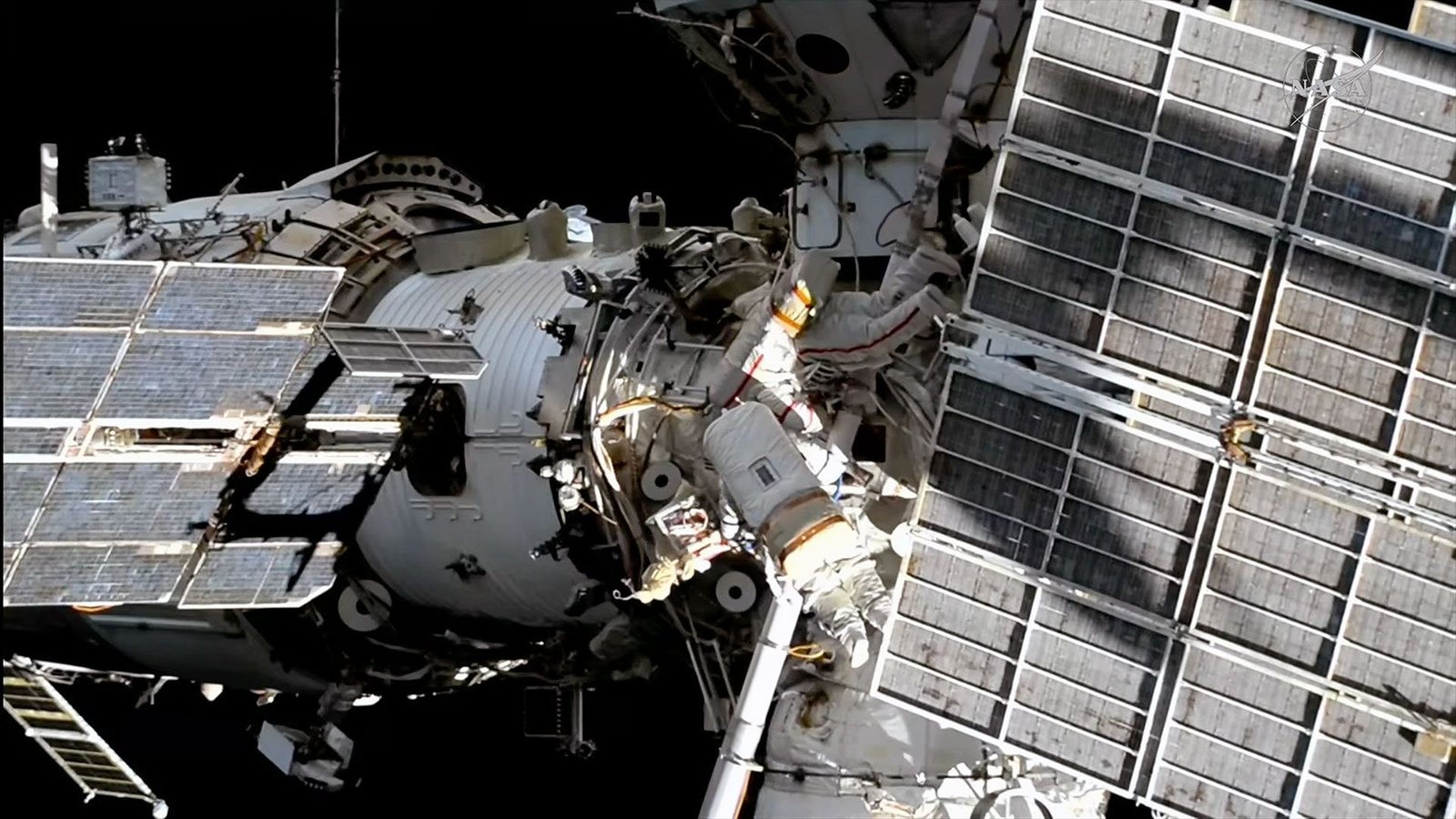
Two Russian cosmonauts worked to install and retrieve science experiments while on a spacewalk outside the International Space Station on Wednesday (May 27).
Expedition 74 commander Sergey Kud-Sverchkov and flight engineer Sergei Mikaev spent 6 hours and 5 minutes outside the space station, conducting an extravehicular activity (EVA) that ran from 10:18 a.m. to 4:23 p.m. EDT (1418 to 2023 GMT). The two spacewalkers installed a solar radiation experiment on the exterior of the Zvezda service module and removed science hardware from the Poisk and Nauka modules on the station’s Russian segment.
The Solntse-Teragerts telescope that the duo mounted outside Zvezda was designed to observe and collect data about strong solar flares emanating from the sun. The instrument will help scientists improve their prediction models and better understand solar flare activity at different frequencies. The device is expected to operate through 2028.
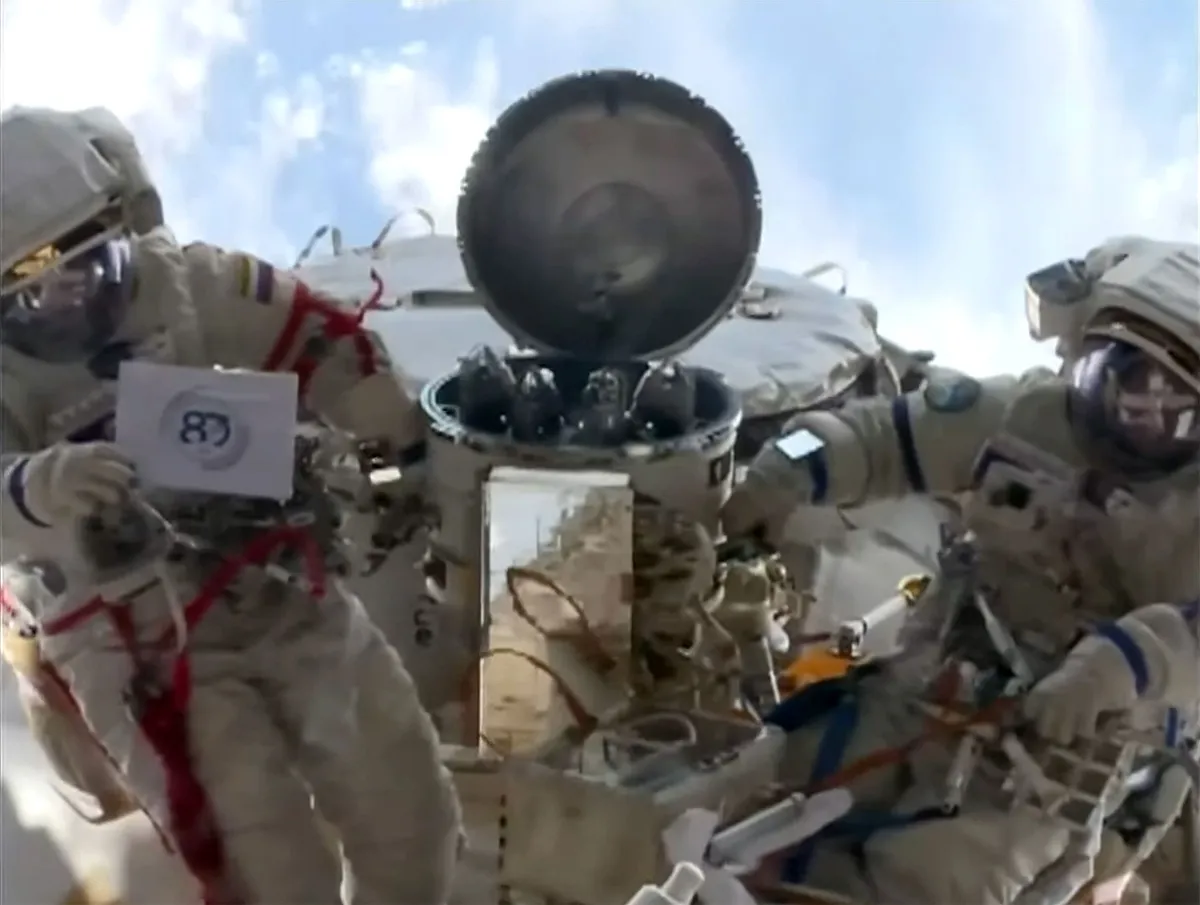
Kud-Sverchkov and Mikaev then rode at one end of the European Robotic Arm (ERA), a 40-foot-long (11.3-meter) remote manipulator, to retrieve a cassette holding semiconducting material produced by an experiment mounted outside the Nauka mini-research module. The Ekran-M molecular beam epitaxy (MBE) experiment uses gallium arsenide to form ultra-pure, ultra-thin films that can only be borne under the microgravity environment of space.
The cosmonauts ran into some difficulty retrieving the cassette, including losing a pair of pliers and commands sent from the ground failing to move the experiment’s interior mechanisms. However, with some workarounds, they were able to collect the sample for its return inside the station.
Before moving on with their other tasks, Kud-Sverchkov and Mikaev took a moment to recognize the 80th anniversary of RKK (RSC) Energia, Roscosmos‘ design bureau founded in August 1946. The spacewalkers held up a card printed with a commemorative logo and posed for photographs.
Not long after, Kud-Sverchkov asked Mikaev if he knew what day it was.
“The 27th,” replied the flight engineer.
“Today is the birthday of St. Petersburg,” said Kud-Sverchkov. “So, congratulations to all of the residents of St. Petersburg, on the day of the city. Our northern capital of Russia.”
The two cosmonauts then moved over to the Poisk module to inspect, photograph and secure one of the Kurs rendezvous antennas on the Progress MS-33 (ISS 94P) cargo spacecraft. The antenna failed to deploy when the vehicle launched to the space station in March, resulting in a manually controlled docking.
Wrapping up the EVA, Kud-Sverchkov and Mikaev retrieved a Biorisk science container holding samples of bacteria, seeds and other organisms and then jettisoned a bundle of used window cleaners before heading back inside the space station. All the activities planned for the outing were successfully completed.
The spacewalk on Wednesday was the second for Kud-Sverchkov and the first for Mikaev. Kud-Sverchkov now has logged 12 hours and 11 minutes working in the vacuum of space.
It was the 279th spacewalk in support of International Space Station assembly, maintenance and upgrades since 1998.