


Close Menu

    Subscribe to Updates

    Get the latest news information from worldwide businesses.

    What's Hot

    Hungarian MPs vote to remain member of ICC, overturning decision made by Orbán | Hungary

    May 27, 2026

    Enough buffer stocks to meet demand of thermal power plants: Coal India | India News

    May 27, 2026

    Minneapolis Police Chief Brian O’Hara resigns after probe interference

    May 27, 2026
    Facebook Instagram YouTube LinkedIn X (Twitter)
    Trending
    • Hungarian MPs vote to remain member of ICC, overturning decision made by Orbán | Hungary
    • Enough buffer stocks to meet demand of thermal power plants: Coal India | India News
    • Minneapolis Police Chief Brian O’Hara resigns after probe interference
    • DHSE announced SAY 2026 schedule, eligibility, and re-evaluation details | Education News
    • It’s been 340 years since Newton and scientists still haven’t solved the secret of gravity
    • Becka’s fate, Agnes’ truth and Daisy’s rebellion
    • Can eye drops replace reading glasses? Experts weigh in on newly approved VIZZ
    • Scientists create global treasure map pointing to hidden rare earth deposits
    Newspublicly
    • About Us
    • Advertise & Partner with us
    • Pitch Your Story
    • Contact Us
    Facebook Instagram LinkedIn X (Twitter)
    Subscribe
    • Home
    • World News
      • Asia
      • India
      • USA
      • UK & Europe
      • Middle East
    • Economy & Business
      • Global Economy
      • Corporate & Industry
      • Finance & Markets
      • Policy & Trade
    • Technology
      • Gadgets & Devices
      • Software & Apps
      • AI & Machine Learning
      • Robotics & Automation
    • Health & Medicine
      • Fitness & Nutrition
      • Research & Innovation
      • Disease & Treatment
      • Doctors, Clinics & Patient Care
    • Travel & Tourism
    • Automobile
      • Electric & Hybrid Vehicles
      • Auto Industry Insights
    • Sports
    • More
      • Education
      • Real Estate
      • Environment & Climate
      • Space & Astronomy
      • War & Conflicts
    Newspublicly
    Home»More»Space & Astronomy»The Milky Way may have devoured another galaxy named Loki, and astronomers think they’ve found its remains
    Space & Astronomy

    The Milky Way may have devoured another galaxy named Loki, and astronomers think they’ve found its remains

    AdminBy AdminMay 27, 2026No Comments5 Mins Read0 Views
    Share
    Facebook Twitter LinkedIn Copy Link WhatsApp


    Our home galaxy didn’t pop into existence all at once. The Milky Way was formed gradually, as smaller galaxies, or dwarf galaxies, were subsumed into our own galaxy over billions of years.

    It turns out that the stars leftover from these dwarf galaxies still share characteristics, and scientists are getting better at identifying them. By studying their similarities, scientists use these stars to determine their galaxies of origin. A team of astronomers say that they have identified a sample of these 20 stars that — due to their similar features — may have grown up together in a dwarf galaxy which the researchers have dubbed “Loki.”

    “We might have detected one of the various small systems that contributed to form our Milky Way,” astronomer Federico Sestito, a postdoctoral fellow at University of Hertfordshire and study coauthor, told Space.com via email.


    You may like

    The study, published in the Monthly Notices of the Royal Astronomical Society, builds on previous work from Sestitio. He had already identified the stars that they ended up surveying for the new study. But now, Sestitio and the team have new features that they can use to identify stars’ original galaxies.

    “This work can be thought of as a sort of follow-up of previous works,” Sestitio said. “In the past, we had to look at these old stars with peculiar motion; however, we lacked chemical information, which is now available with this work.”

    Growing up together

    Helium and hydrogen were main ingredients for the early stars that were formed in our universe. Once formed, the stars fused these two elements together, which created heavier elements that made later generations of stars. This process happened again and again over many generations.

    Those early stars are considered “metal-poor.” Because they formed so early, the stars only have traces of the heavier elements, like iron. Being metal-poor is one of the identifiers the scientists used to figure out which stars formed in the same dwarf galaxy.

    Space

    “We think these old and metal-poor stars were formed in one small galaxy that was ingested by the forming Milky Way,” Sestitio says.

    But it’s not just that these 20 stars are metal-poor; scientists have identified many stars in our galaxy that share this feature. The stars’ elemental makeup isn’t sufficient for determining the galaxy. To narrow it down, the team considered other features like location and orbit.

    “[The stars] orbital motion is peculiar as they are confined close to the Milky Way disc, which is usually populated by younger and metal-rich stars,” Sestitio says.


    What to read next

    The Milky Way disc is the circular flowing whirlpool-like structure, where most of our galaxy’s stars, including our own sun, are located. The 20 stars’ unique positioning was another indication that they might all be related.

    “This was possible thanks to precise orbital motion and chemical information of metal-poor and old stars,” Sestitio says.

    While the orbital motion of these stars has been previously identified and studied, the chemical information is new, and it gave the researchers a much stronger indication for the stars’ shared galaxy of origin.
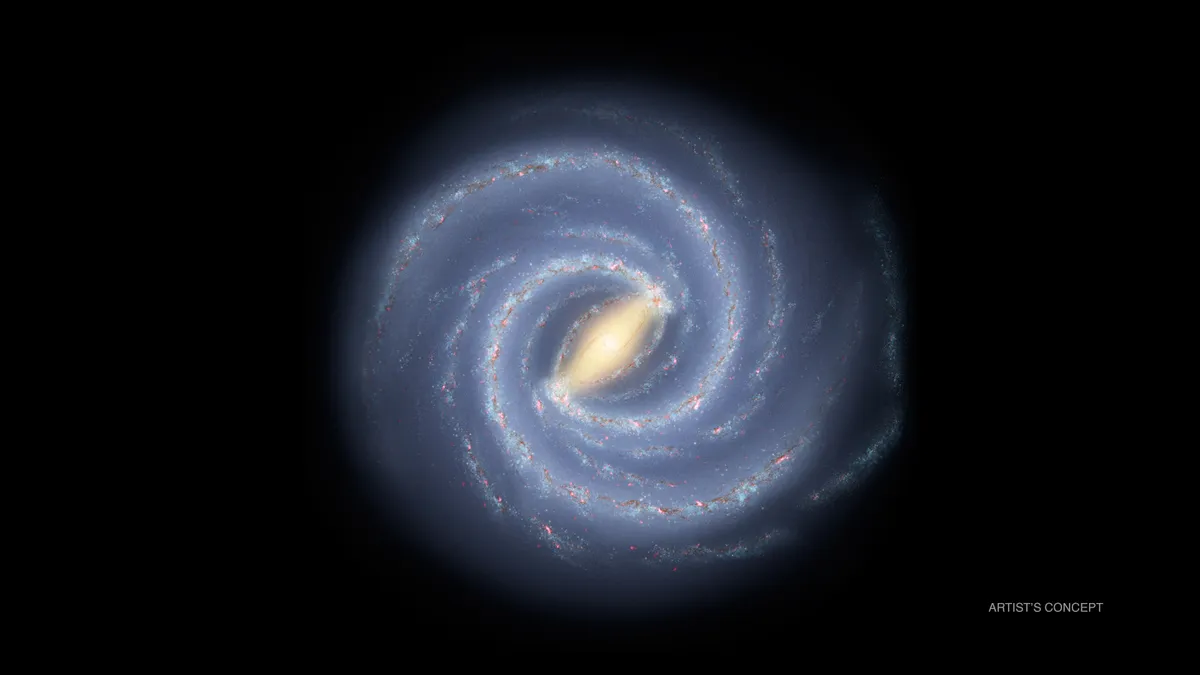
    a white-blue wispy spiral on a black background

    Artist’s conception of the Milky Way galaxy. (Image credit: NASA/JPL-Caltech/R. Hurt)

    Chemically unique

    The features that the team needed to study were diverse, so they used a patchwork of methods.

    “I think my favorite part of this research is having put together various techniques and methodologies to better understand the origin of these stars,” Sestitio said.

    The astronomers used high-resolution spectroscopy, orbital motion, and even theoretical simulations to interpret the stars’ chemical and orbital characteristics.

    “We are providing a complete picture, as much as we can, of the properties of these stars,” Sestitio said.

    The team compared the chemical properties in the stars to those of stars in the galactic halo, dwarf galaxies, as well as simulated populations. They found that the chemical signatures from the 20 stars indicated enrichment from high-energy supernovas, hypernovas, fast-rotating massive stars, and neutron star mergers.

    However, they found no indication of white dwarf explosions. The researchers say that this means the origin of stars was likely “short-lived, energetic dwarf galaxy.”
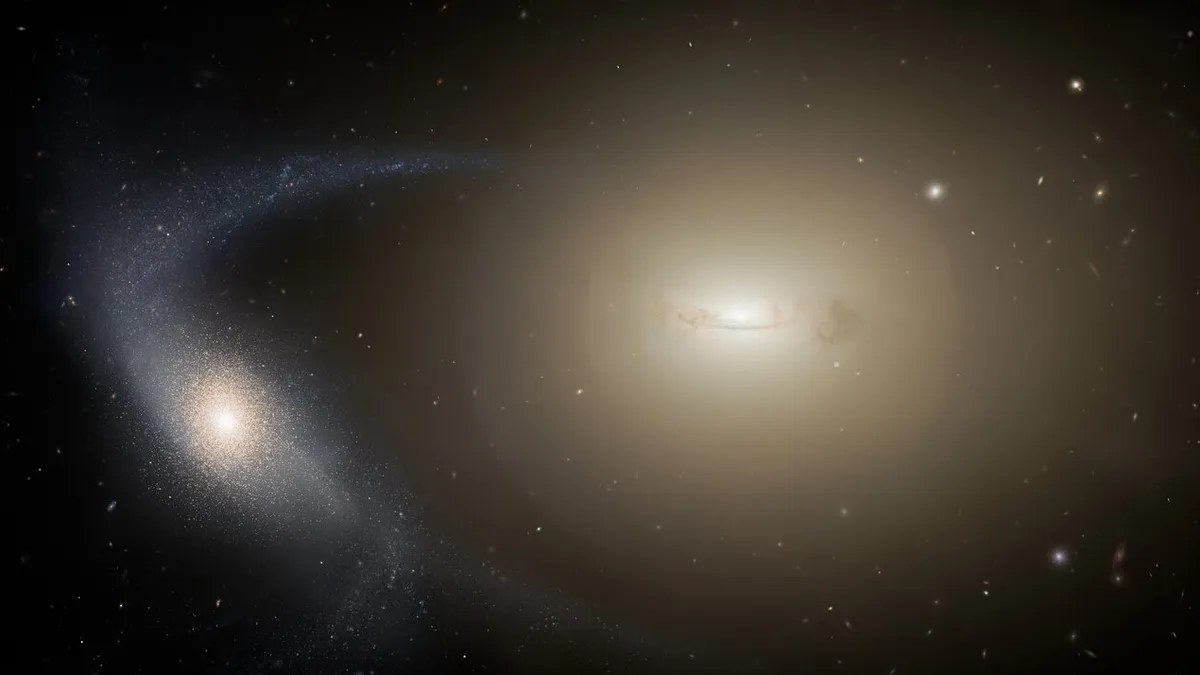
    two white spirals on a black, starry background converge into one

    Artist’s impression of a dwarf galaxy losing stars to a larger, more energetic galaxy. (Image credit: NOIRLab)

    Hidden galaxies

    Sestitio has been working on identifying these old galaxies, because understanding more about them helps us learn more about the Milky Way as a whole.

    “The most metal-poor stars in our galaxy, which are also among the oldest stars, are extremely important celestial objects,” Sestitio said. “They can open a window on the early processes related to the formation of the Milky Way (and galaxies in general), the origin of the elements, and the properties of the very first stars.”

    There could be many more of these ‘Loki’ galaxies hidden around the Milky Way. While it’s fairly easy to find small galaxies that are disrupted and accreted in the Milky Way’s periphery, Sestitio says, finding them in our galaxy’s disc is a much harder task.

    The disc is crowded with younger stars that are comparably metal-rich. So, surveying and picking out the right stars in the disc takes time. But Sestitio is looking forward to discovering new insights into the Milky Way’s formation.

    “While this work might be limited in the number of observed stars, the future is looking great,” he says. “We will have multi-object spectroscopic facilities that will obtain chemical information for thousands of stars.

    “At that point, we will be able to better understand the properties of many building blocks that formed our galaxy.”


    Source link

    Author

    • Admin

      NewsPublicly.com is News & Articles Platform that creating SEO-focused articles on travel, lifestyle, and digital trends.

    Admin
    • Website

    NewsPublicly.com is News & Articles Platform that creating SEO-focused articles on travel, lifestyle, and digital trends.

    Related Posts

    It’s been 340 years since Newton and scientists still haven’t solved the secret of gravity

    May 27, 2026

    Watch 2 Russian cosmonauts take 5-hour spacewalk outside the ISS today

    May 27, 2026

    Artemis moon base will cover ‘hundreds of square miles’ with hopping drones and new lunar rovers, NASA says

    May 26, 2026
    Leave A Reply Cancel Reply

    Demo
    Top Posts

    “Inside Gemini Robotics 1.5: How Robots Learn to Reason & Act

    November 22, 202525 Views

    How US Tariffs Are Reshaping the Global Growth Landscape?

    November 21, 202518 Views

    Pakistani Journalist Laughing at Tejas Fighter Jet Crash at Dubai Airshow Sparks Massive Outrage Worldwide

    November 23, 202517 Views

    Vibe-Coding Boom: How Non-Coders Build Apps With AI Agents

    November 22, 202515 Views
    Don't Miss

    Hungarian MPs vote to remain member of ICC, overturning decision made by Orbán | Hungary

    May 27, 20264 Mins Read0 Views

    Lawmakers in Hungary have voted overwhelmingly for the country to remain a member of the…

    Enough buffer stocks to meet demand of thermal power plants: Coal India | India News

    May 27, 2026

    Minneapolis Police Chief Brian O’Hara resigns after probe interference

    May 27, 2026

    DHSE announced SAY 2026 schedule, eligibility, and re-evaluation details | Education News

    May 27, 2026
    Stay In Touch
    • Facebook
    • Twitter
    • Instagram
    • YouTube
    • LinkedIn
    • WhatsApp

    Subscribe to Updates

    Get the latest creative news from SmartMag about art & design.

    Demo
    NEWSPUBLICLY
    Facebook X (Twitter) Instagram LinkedIn

    Home

    • About Us
    • Leadership
    • Advertise & Partner With Us
    • Pitch Your Story
    • Media Kit & Pricing
    • Career
    • FAQs

    Guidelines

    • Editorial & Submission
    • Partnership
    • Advertising & Sponsor
    • Intellectual Property Policy
    • Community & Comment
    • Security & Data Protection
    • Send Your Opinion

    Quick Links

    • Cookie Policy
    • Payment & Billing Terms
    • Refund & Cancellation
    • Copyright Policy
    • Complaint & Support
    • Sitemap
    • Contact Us

    Subscribe Us

    Get the latest news and updates!

    Copyright © 2026 Newspublicly (DIGITALIX COMMUNICATION). All Rights Reserved.
    • Privacy Policy
    • Terms of Use
    • Disclaimer