

Forecasters are calling for below-average activity this hurricane season, which begins Monday, June 1.
The National Weather Service is predicting eight to 14 named storms, including three to six hurricanes and one to three major hurricanes of category 3, 4 or 5 strength, packing winds of 111 mph or greater. By comparison, a typical season is characterized by 14 named storms, including seven hurricanes and three major hurricanes. The season ends Nov. 30.
“It just takes one,” said Ken Graham, director of the National Weather Service. “Now is the time to start thinking about your hurricane preparedness.”
The forecasters based their predictions on an expected El Niño that is likely to develop during the season. An El Niño is a naturally occurring climate phenomenon that begins with unusually warm waters in the central and eastern equatorial Pacific Ocean and can affect weather patterns worldwide.
In the Pacific an El Niño can trigger more hurricanes. But in the Atlantic Ocean the phenomenon can suppress activity, as it tends to cause more wind shear that can break apart the storms. Nonetheless, warm water temperatures in the Atlantic were expected to help the storms that do develop rapidly intensify, something that is becoming more common as climate change heats the planet’s oceans.
“When your ocean temperatures are warmer you get more intense hurricanes to develop. So if there is an opportunity and a location for low wind shear and warm ocean temperatures,” said Marc Alessi, science fellow at the Union for Concerned Scientists, an advocacy group, “that is when you can get a very strong hurricane to form.”
Haiyan Jiang, a meteorologist at Florida International University, said there was a high chance of a strong El Niño that could boost water temperatures in the Gulf of Mexico.
“We probably won’t have as many number of storms as previous years. However, some storms get lucky,” she said. “We see outliers all the time, especially with hurricanes. So I believe Floridians, we need to get prepared.”
2026 Atlantic Tropical Cyclone Names
| Arthur | Hanna | Omar |
| Bertha | Isaias | Paulette |
| Cristobal | Josephine | Rene |
| Dolly | Kyle | Sally |
| Edouard | Leah | Teddy |
| Fay | Marco | Vicky |
| Gonzalo | Nana | Wilfred |
The NWS outlook was for overall seasonal activity and did not include predictions for when or where hurricanes might make landfall, as that is determined by short-lived weather patterns, said the National Oceanic and Atmospheric Administration, which oversees the National Weather Service. NOAA said there was a 55 percent chance of a below-normal season, 35 percent chance of a near-normal season and 10 percent chance of an above-normal season.
Forecasters at Colorado State University similarly predicted a below-average season, with 13 named storms, including six hurricanes and two major hurricanes. The forecasters said waters in the western tropical Atlantic were warmer than normal but the eastern tropical and subtropical Atlantic were slightly cooler than normal. They said a warmer Atlantic also tends to lead to lower atmospheric pressure and a more unstable atmosphere, which can boost hurricane activity.
The Colorado State forecasters said the probability of a hurricane making landfall was 32 percent for the entire U.S. coastline, 15 percent for the U.S. East Coast including the Florida peninsula and 20 percent for the Gulf Coast from the Florida panhandle to Brownsville, Texas.
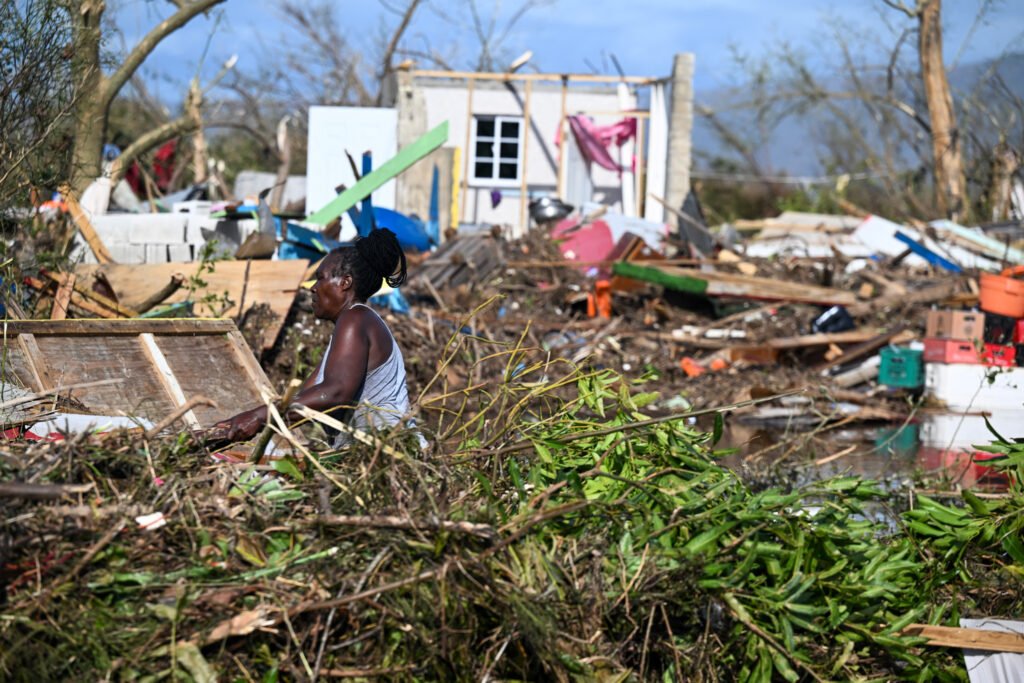
Alessi pointed out that although no hurricanes made landfall in the U.S. last year, Hurricane Melissa devastated Jamaica as a category 5 storm. Melissa caused nearly $9 billion in damage and 95 fatalities across the Caribbean.
“Just because it’s a below-average season doesn’t mean a very powerful hurricane won’t make landfall in the United States,” he said.
About This Story
Perhaps you noticed: This story, like all the news we publish, is free to read. That’s because Inside Climate News is a 501c3 nonprofit organization. We do not charge a subscription fee, lock our news behind a paywall, or clutter our website with ads. We make our news on climate and the environment freely available to you and anyone who wants it.
That’s not all. We also share our news for free with scores of other media organizations around the country. Many of them can’t afford to do environmental journalism of their own. We’ve built bureaus from coast to coast to report local stories, collaborate with local newsrooms and co-publish articles so that this vital work is shared as widely as possible.
Two of us launched ICN in 2007. Six years later we earned a Pulitzer Prize for National Reporting, and now we run the oldest and largest dedicated climate newsroom in the nation. We tell the story in all its complexity. We hold polluters accountable. We expose environmental injustice. We debunk misinformation. We scrutinize solutions and inspire action.
Donations from readers like you fund every aspect of what we do. If you don’t already, will you support our ongoing work, our reporting on the biggest crisis facing our planet, and help us reach even more readers in more places?
Please take a moment to make a tax-deductible donation. Every one of them makes a difference.
Thank you,

Reporter, Florida
Amy Green covers the environment and climate change from Orlando, Florida. She is a mid-career journalist and author whose extensive reporting on the Everglades is featured in the book MOVING WATER, published by Johns Hopkins University Press, and podcast DRAINED, available wherever you get your podcasts. Amy’s work has been recognized with many awards, including a prestigious Edward R. Murrow Award and Public Media Journalists Association award.