

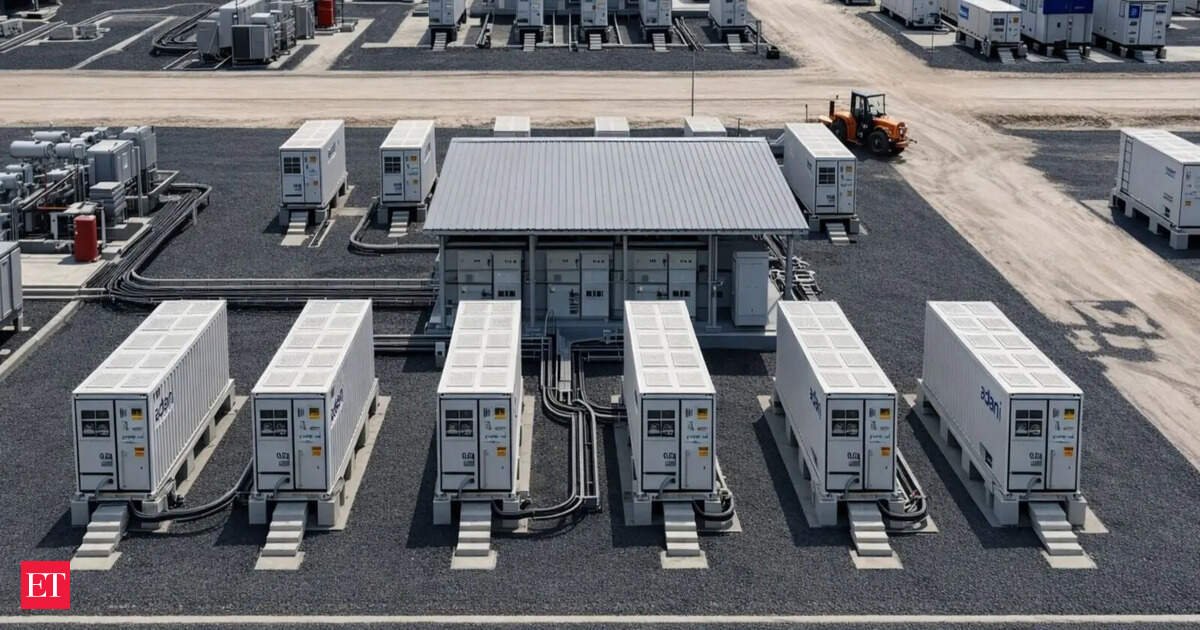
The company said the project was completed within 10 months of construction beginning, making it among the fastest utility-scale battery storage deployments globally.
The latest phase includes an additional 1.37 GWh commissioned in March 2026, taking the total operational battery storage capacity at Khavda to 3.37 GWh.
Also read: Adani, GMR among shortlisted bidders for $400 million IntelliSmart deal
The battery storage system is aimed at improving grid reliability and enabling round-the-clock renewable power supply by storing electricity generated from renewable sources and releasing it during peak demand periods.

According to the company, the 3.37 GWh system can store enough clean energy to power nearly 1 million homes for a day. It can also meet peak electricity demand of cities such as Indore and Chandigarh, or the entire state of Goa.
Sagar Adani, executive director at AGEL, said large-scale energy storage would play a key role in India’s clean energy transition as renewable energy capacity continues to expand rapidly. “With the commissioning of the 3.37 GWh BESS at Khavda, AGEL is strengthening the foundation for resilient, dispatchable and flexible energy systems,” he said.The company said it plans to add more than 10 GWh of battery storage capacity in FY27 and scale this up to 50 GWh over the next five years.
The Khavda project uses lithium-ion battery technology and advanced energy management systems to improve efficiency and grid responsiveness. The storage facility is part of AGEL’s broader renewable energy project at Khavda, where the company is developing a 30 GW renewable energy park by 2029. Of this, 9.9 GW is operational.