

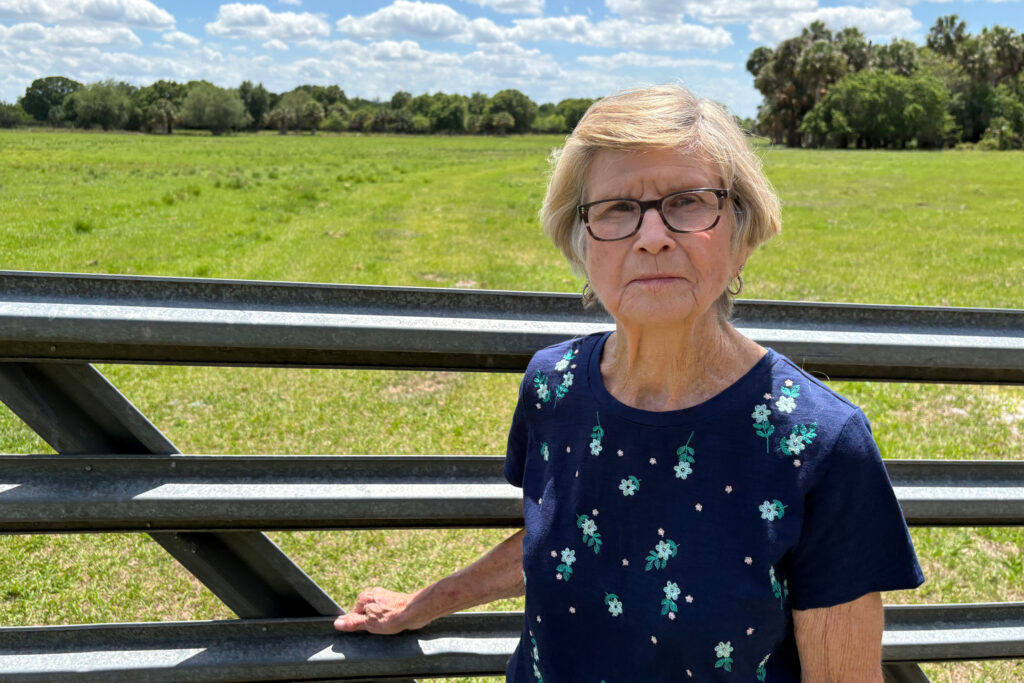
INDIANTOWN, Fla.—Carroll McAllister frets over the prospect of a hyperscale data center opening next to the grassy expanse where she grew up, in a shack her father built.
Now 87, McAllister is a tiny but sturdy woman with a bob of blonde hair. She fondly recalls running wild on the land in her youth with her three siblings, fishing and picking berries among the stands of oak and pine trees and cabbage palms. Her father raised watermelons, cantaloupes, strawberries, peas and beans and nurtured an orange grove. With no running water in the shack, the family members used an outhouse and drew their drinking water from an outdoor pump.
“Much of that land he actually cleared by hand. He didn’t have bulldozers,” said McAllister, gazing across the grassland where cattle now graze.
The old water pump is all that remains of her childhood home. “My life, my heritage. I have so much feeling in my heart. I’ve cried at night thinking about my parents and the sacrifices that they went through to accumulate what they did under such dire circumstances.”
For much of its existence, Indiantown has derived its identity from the land. The tiny community between Lake Okeechobee and Palm Beach is part of Florida’s heartland, a bountiful agricultural region encircling the state’s largest lake. Here, ranchers and farmers raise cattle, rice, sod, vegetables such as lettuce, celery, corn and, most notably, sugarcane. The region has remained relatively untouched by the explosive growth and development that has enveloped much of modern Florida.
Now, Indiantown is bracing for a new potential crop: hyperscale data centers.
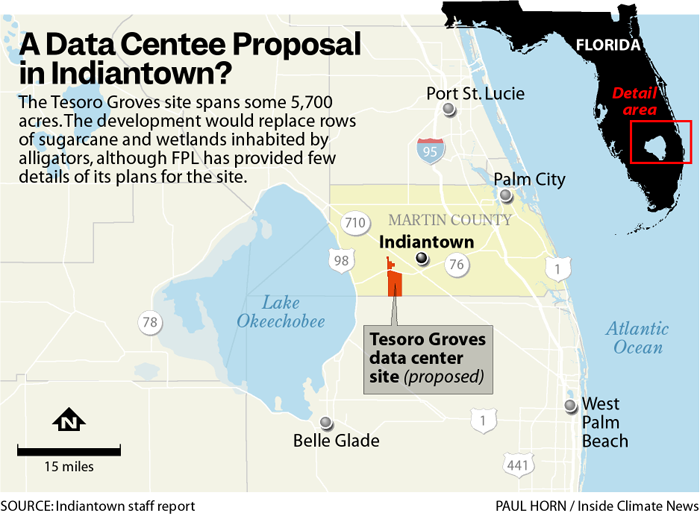
Next to the pastureland where McAllister and her siblings once played, Florida Power & Light (FPL) is considering constructing one of the massive facilities on a swath of some 5,700 acres. Called Tesoro Groves, the development would replace rows of sugarcane and wetlands inhabited by alligators, which are listed federally as threatened. Solar panels and a transmission line are currently on the property, although FPL has provided few details of its plans for the site.
Multiple such proposals are circulating in the town of 6,800 residents, many of whom are low-income people of color who work the region’s farmlands. Another one called Silver Fox, which would have involved some 2.2 million square feet of building space, was scrapped recently when the project’s backers withdrew it from consideration. That project would have included an electrical transmission system, with two independent electrical feeders, four customer-owned transformers and four dedicated transmission feeds, according to an Indiantown staff report. An environmental assessment noted a bald eagle nest on the site, along with evidence of gopher tortoises, which are listed in Florida as threatened.
Some in Indiantown see data centers as an economic opportunity that could help usher in a more modern future. They think the sites would generate jobs that could dissuade younger generations from abandoning the town for better prospects elsewhere.
“I love Indiantown, and it’s always been my home and I don’t want to leave. So I want there to be job opportunities here for me,” said Jacquelyn Rawls, 19, a nursing student at nearby Indian River State College who dreams of someday working in a hospital, although the closest hospital to Indiantown is some 25 miles away. “Maybe we can have a future for a hospital to be in Indiantown.”
Others worry the giant facilities would transform their bucolic community into something else entirely. They are concerned the sites could escalate energy costs for residents, as a single hyper-scale data center can consume as much power as 500,000 homes, enough to constitute a metro area the size of Orlando. The residents fear that data centers could deplete the fragile aquifer that supplies their drinking water, as the sites also produce a lot of heat and require enormous amounts of water to cool them.
People in Indiantown worry the noise generated by the continuously running facilities may affect their health and that the heat would drive up temperatures in a place where extreme heat is already an issue. They are also concerned that the promise of economic prosperity may not come to fruition, as the facilities tend to employ relatively few workers once built. A historically Black neighborhood called Booker Park closest to the Tesoro Groves site would be particularly affected.
“You trying to tell us the frog is not poisonous. You want us to take a chance, but if we take a chance and everybody is affected negatively, then what?” asked Village Council Member Vernestine Williams-Palmer, who represents Booker Park. “How are those people going to be compensated? Are you going to buy them a house somewhere else and pay for their medical bills?”
Few Details and Frustration
Hyperscale data centers are designed to store and process the data needed to sustain the technological conveniences of modern life, from streaming services to cloud storage to artificial intelligence applications. Such facilities can consist of millions of square feet of building space filled with servers and computers operating 24 hours a day. The sites require enormous amounts of energy and include banks of generators to serve as backup in the event of a power outage.
The data centers consume so much energy that utilities such as FPL may need to enhance their infrastructure and even build more power plants to accommodate the growing demand, which coincides with overwhelming scientific consensus about the need to conserve energy and stem the fossil fuel emissions warming the global climate and intensifying disasters such as hurricanes. The data centers can also guzzle up to 5 million gallons of water daily, about the same amount that is consumed by a town of up to 50,000 residents.
Like many in Indiantown, Williams-Palmer learned only recently of the data center proposals in her community, including the one supported by FPL. Since then, she and other residents have raced to find out everything they can about the massive facilities, to understand how they may affect their town.
“People are all up in arms because they don’t know what is going on,” she said. “So they are speculating, and they are reading any piece of information that they can get their hands on.”
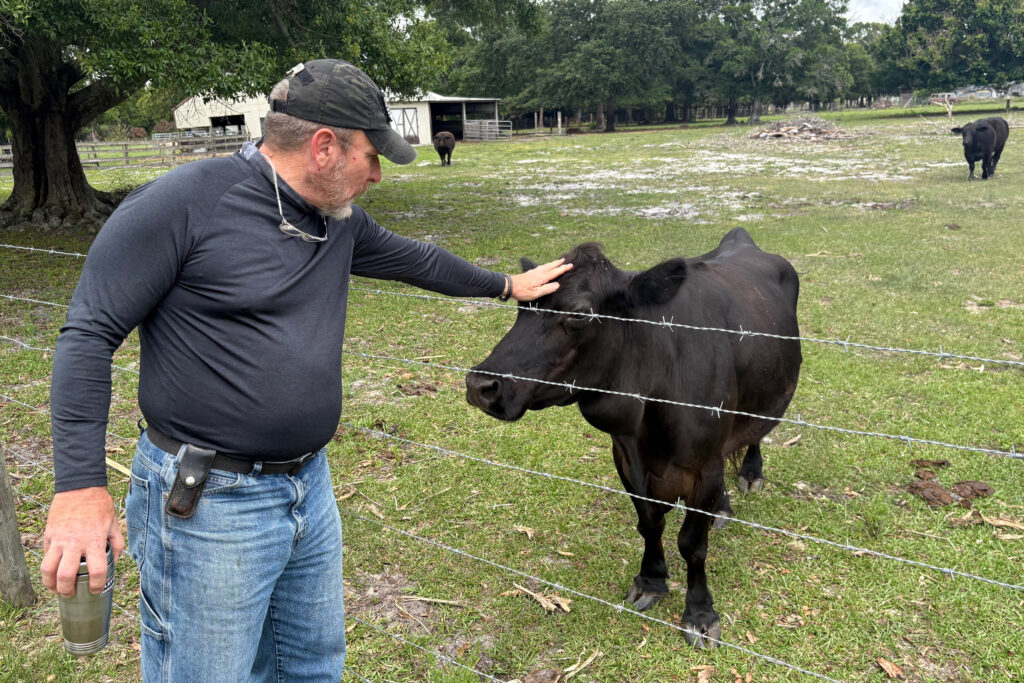
For Eric Miller, a retired technology entrepreneur and veteran who lives on five acres with his wife, six cows, a bull, three goats and more than 20 chickens, the issue has become like a full-time job. He said he spends 10 hours a day reading documents and trying to keep up with the proposals’ progress, while also attending council and community meetings and demonstrations. He doubts the facilities would boost the local economy and is concerned about how they could affect the environment and people’s health.
“These data centers don’t give back to the community. All they do is take away,” said Miller, 61. “Just slow down. Let’s talk about what we’re seeing and put it all on the table.”
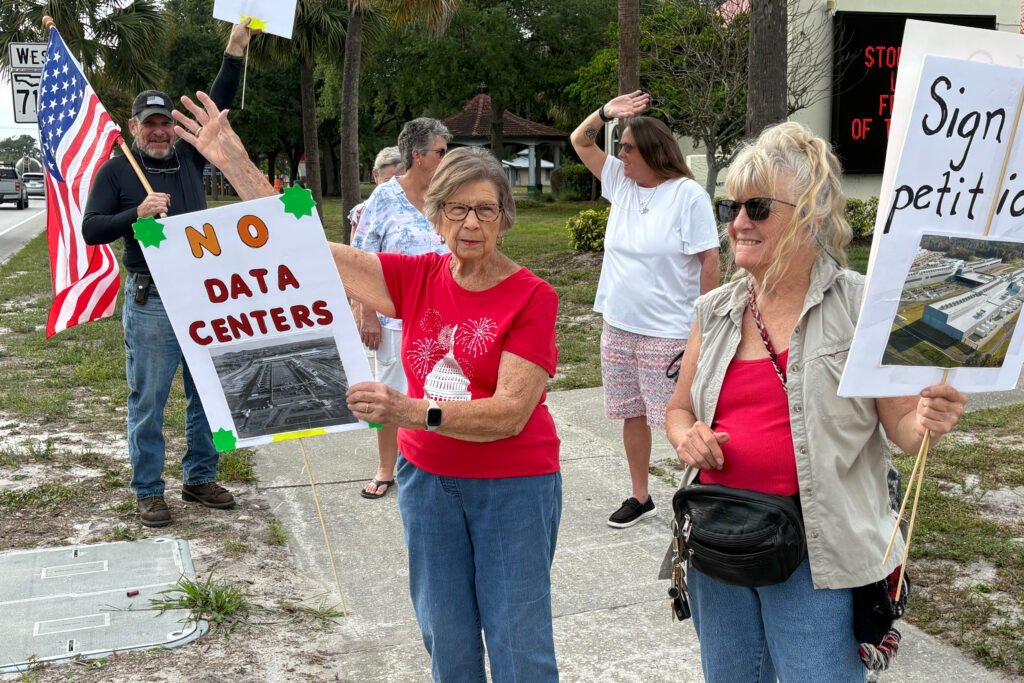
Many Indiantown residents opposed to data centers express frustration over what they characterize as a lack of transparency regarding the proposals. Most local leaders have not discussed them publicly outside of council meetings. No information has been distributed in languages such as Spanish, and very little has been disseminated at all, they said. Linda Byczko, who lives on the outskirts of town on five secluded acres with her husband and adult son, feels the proposals’ backers are eyeing Indiantown because of its dearth of resources.
“Sixty-six percent of the incorporated Indiantown is Hispanic. A lot of them don’t speak English, and so they’re doing things behind the scenes that a lot of residents don’t know what they’re doing. They have no way of knowing because nothing is done in Spanish in the council,” said Byczko, 64, a retired school district administrator. “I’m not against people making money. That’s the way of the world. But they prey on a town that they know can’t defend themselves. It’s influencing the people that make the decisions here to push something that people don’t want.”
In May, the council voted to rezone the Tesoro Groves site from agricultural to planned unit development and also approved a zoning agreement and master site plan for the property. The action enabled the data center proposal to move forward, although the project faces several more steps before construction could begin. Williams-Palmer said she voted in support of the proposal because she felt the project’s backers had addressed her concerns about the environment and wanted to prevent hundreds of houses from sprouting on the property, which would bring congestion and sprawl.
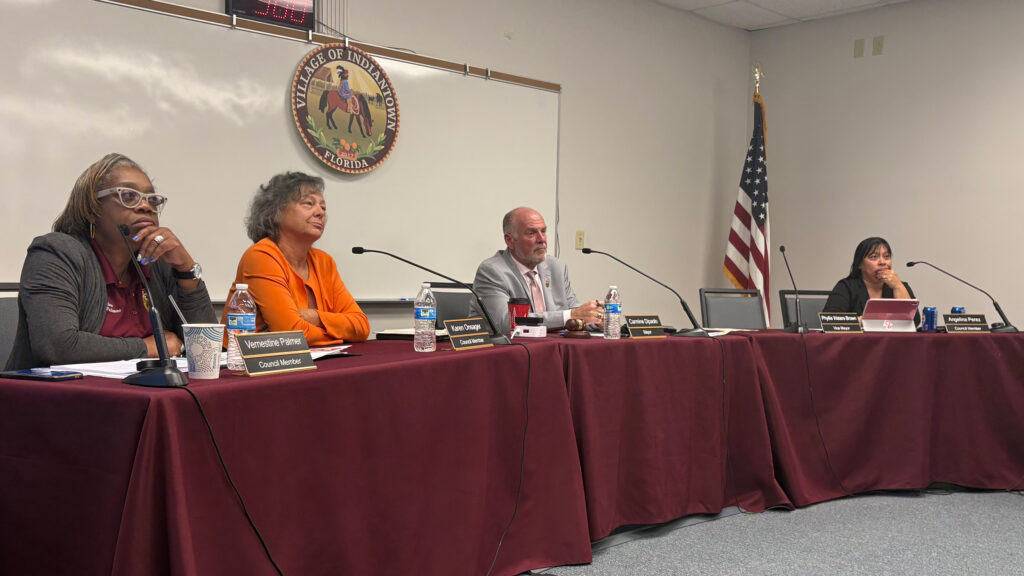
In a statement FPL provided to Inside Climate News, the utility emphasized that no data center has been approved.
“No project was greenlit through this process,” the statement reads. “Potential projects that could be developed on the site include electrical infrastructure, research and IT as well as a data center. In accordance with Florida’s consumer protection statute, if a data center were to locate on the site, FPL’s large load rate structure would require the data center to fund 100% of the cost of new power generation needed to serve their project – ensuring data centers bear their own electric costs and Florida’s families and businesses are not footing the bill.”
In Florida’s Heartland
Across the country, hyperscale data centers stand to reshape rural communities. Their number is projected to grow substantially in the coming years by 50 percent, to some 4,500, based on sites currently in development, according to a Pew Research Center analysis of data from Data Center Map. As many as 67 percent of the planned facilities are in rural areas, and 39 percent are in counties that do not already have any. Most are in the South and Midwest, with the South accounting for nearly half of the projects. Data centers tend to be constructed in clusters. Nine in 10 are within five miles of another one, although many proposals never get built.
In Florida, multiple hyperscale data centers have been proposed within the state’s heartland. In Fort Meade, 110 miles northwest of Indiantown, a planned 4.4 million-square-foot data center is moving forward after city commissioners gave their blessing in April, despite concerns about environmental impacts and whether the facility could overwhelm the area’s utility and wastewater infrastructure. Supporters say the project would boost the local economy, but detractors argue the proposal does not align with local planning laws. The administration of Gov. Ron DeSantis, a Republican, opposes the project.
In western Palm Beach County, just south of Indiantown, commissioners agreed in April to postpone a vote on a proposal called Project Tango until July, after it faced strong pushback, in part because the data center would be near a protected area of the fragile Everglades. In nearby Fort Pierce, a project called Sentinel Grove Technology Park, which would involve up to 15 million square feet of building space, stalled recently after the project’s backers withdrew the proposal, as state lawmakers contemplated new data center regulations.
In Okeechobee, a community on the north side of the lake, a planned data center was scrapped recently after pushback from residents who voiced concerns similar to those raised in Indiantown. The facility would have been on the property of the now-closed Florida School for Boys at Okeechobee, an infamous reform school where students were brutally abused.
This story is funded by readers like you.
Our nonprofit newsroom provides award-winning climate coverage free of charge and advertising. We rely on donations from readers like you to keep going. Please donate now to support our work.
One reason the proposals are concentrated in this region is that state regulators approved a $7 billion rate hike for FPL last November, said Christina Reichert, senior attorney at Earthjustice. Consumer groups characterized the settlement as the largest in U.S. history. As part of the settlement, which faces a legal challenge in state court, FPL established a lower rate for data centers built near existing infrastructure. Transmission lines extend through this region. Meanwhile, advocates say the rate hike is poised to increase energy costs for consumers.
“Basically, FPL looked at their existing infrastructure and said, ‘If you build near where we already have infrastructure, we’ll give you a sweetheart deal,’” Reichert said. “Once you have one, you’re likely to have more. The infrastructure is already there.”
FPL said in a statement the arrangement minimizes the need for infrastructure upgrades. “Florida’s consumer protection statute is clear: Large load projects like data centers must pay their own costs. FPL’s large load rate structure aligns with Florida’s statute and is one of the strictest and most consumer-protective in America,” a representative wrote. “In fact, because these large customers are required to pay their own way in Florida they actually stand to create downward pressure on rates for everyone else by helping cover fixed system costs.”
In May, DeSantis signed into law the state’s first regulations on hyperscale data centers. The legislation is aimed at ensuring the facilities bear the full financial burden of powering their own sites and that costs do not fall to average Floridians. The measure is also designed to safeguard the state’s fragile water resources by prohibiting the state Department of Environmental Protection and water management districts from issuing consumptive use permits where the water use would be harmful. A provision that would have prohibited government agencies from entering into non-disclosure agreements involving data centers was removed. The legislation takes effect July 1.
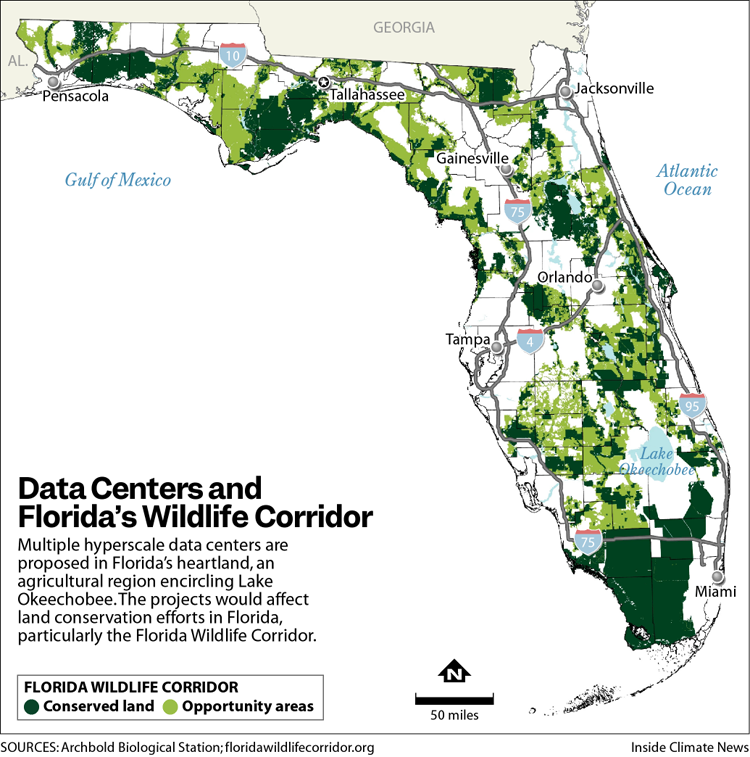
The data centers would affect land conservation efforts in Florida, particularly the Florida Wildlife Corridor, said Paul Owens, president of 1000 Friends of Florida, a conservation group focused on smart growth. More than three-quarters of the unprotected lands within the wildlife corridor are agricultural lands, he said.
“The whole point of the Florida Wildlife Corridor is connection. It allows the survival of key species to migrate to maintain their health and viability,” he said. “If you break the wildlife corridor up into disconnected pieces you lose the function and the value of the wildlife corridor.”
From Citrus Groves to Data Centers
If hyperscale data centers come to Indiantown there would be nothing like them in this community. The main thoroughfare extends only a few blocks and features eateries such as the El Rancho Restaurant and stores such as the Tractor Supply Company. The closest major supermarket is 23 miles away in Port St. Lucie. FPL, the town’s largest taxpayer, has also supported local organizations such as the Boys & Girls Club and YMCA, Williams-Palmer said.
FPL has been effective at acquiring land in the area once occupied by sprawling citrus groves that have since fallen fallow because of citrus greening, a disease that has decimated Florida’s iconic crop, said Greg Braun, executive director of the Guardians of Martin County, a conservation group focused on growth management. The utility operates solar arrays, several substations and transmission lines here. Northwest of town, there is a large power plant and a cooling reservoir, all relevant infrastructure for hyperscale data centers.
Braun thought the facilities may be a good fit because he said many of the old groves were planted before modern Environmental Protection Agency regulations took effect. The groves now offer little habitat value, and their demise has contributed to the economic hardship of communities such as Indiantown. He characterized the groves as “brownfield sites waiting to be developed.”
“If there is fallow land now that has been taken off the tax rolls, how could it not be an economic benefit from a tax perspective?” Braun said. “I would hope that the Village [of Indiantown] could be selective enough to not jump on every opportunity that comes along but rather look at the big picture and select those sites that will be least negatively impactive to the community.”
For Carroll McAllister, the issue is existential. Her family roots in Indiantown trace back more than a century. Driving among the fields and pasturelands, she can point to where her nephew is building a house, where her sister owns land and where her parents lived before they died. She raised a son and daughter here and now, as a widow, lives on 10 acres not far from where she grew up in the shack. She has a few cows, including one named Mr. Mac.
“I just think we’re going to have all these buildings. We’re not going to have farms,” McAllister said, wistfully. “The life that I knew and loved, the country simple life will be gone.”
About This Story
Perhaps you noticed: This story, like all the news we publish, is free to read. That’s because Inside Climate News is a 501c3 nonprofit organization. We do not charge a subscription fee, lock our news behind a paywall, or clutter our website with ads. We make our news on climate and the environment freely available to you and anyone who wants it.
That’s not all. We also share our news for free with scores of other media organizations around the country. Many of them can’t afford to do environmental journalism of their own. We’ve built bureaus from coast to coast to report local stories, collaborate with local newsrooms and co-publish articles so that this vital work is shared as widely as possible.
Two of us launched ICN in 2007. Six years later we earned a Pulitzer Prize for National Reporting, and now we run the oldest and largest dedicated climate newsroom in the nation. We tell the story in all its complexity. We hold polluters accountable. We expose environmental injustice. We debunk misinformation. We scrutinize solutions and inspire action.
Donations from readers like you fund every aspect of what we do. If you don’t already, will you support our ongoing work, our reporting on the biggest crisis facing our planet, and help us reach even more readers in more places?
Please take a moment to make a tax-deductible donation. Every one of them makes a difference.
Thank you,

Reporter, Florida
Amy Green covers the environment and climate change from Orlando, Florida. She is a mid-career journalist and author whose extensive reporting on the Everglades is featured in the book MOVING WATER, published by Johns Hopkins University Press, and podcast DRAINED, available wherever you get your podcasts. Amy’s work has been recognized with many awards, including a prestigious Edward R. Murrow Award and Public Media Journalists Association award.