

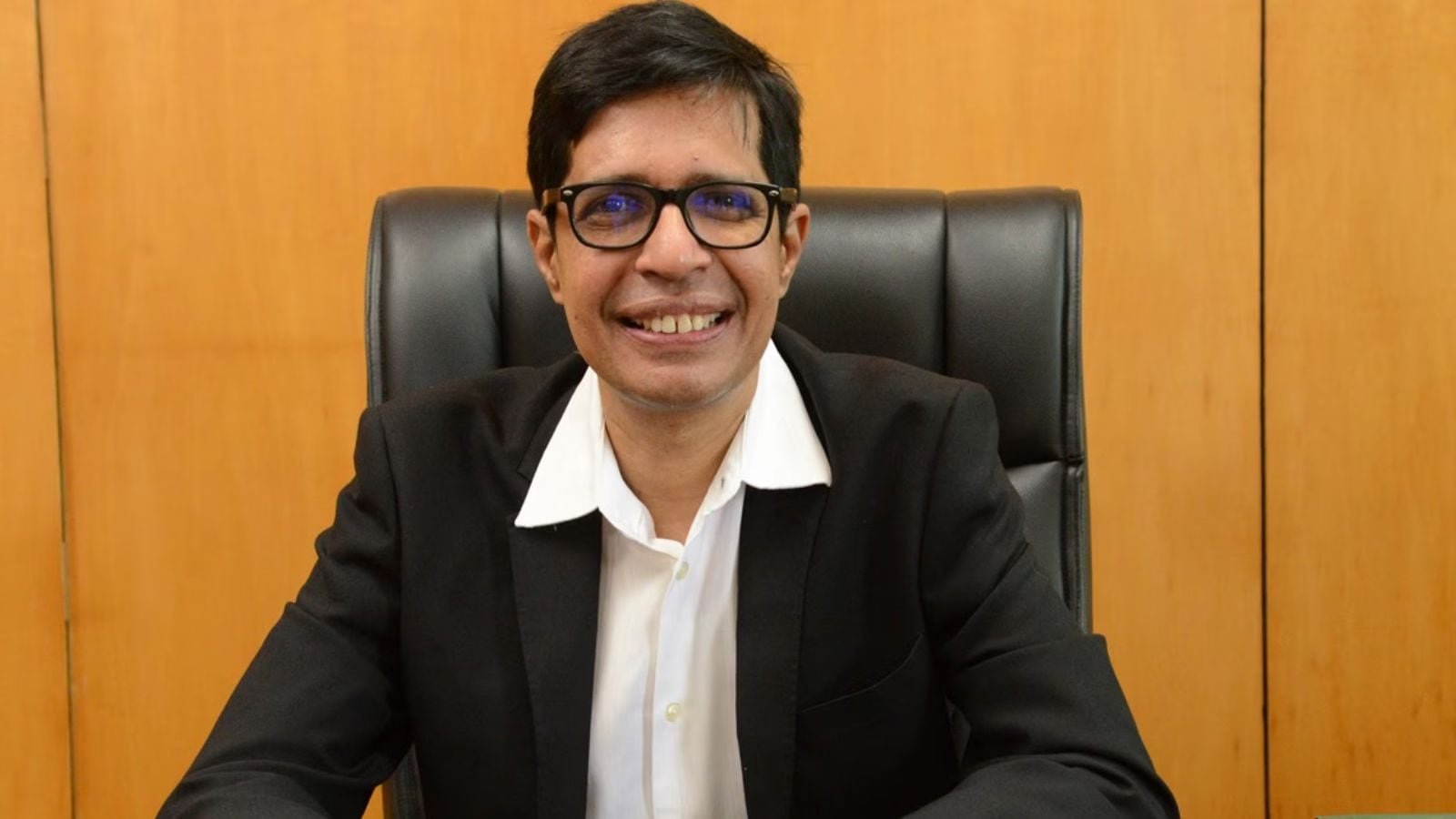
A day after Union Education Minister Dharmendra Pradhan announced that teams from IITs would help the Central Board of Secondary Education (CBSE) navigate mounting complaints over its new digital evaluation system, Indian Institute of Technology (IIT) Madras Director V Kamakoti said the institute has dispatched a technical team to Delhi to investigate what went wrong with the Board’s re-evaluation portal and to conduct what he described as a “complete health check-up” of the system.
“Today, there was a glitch in the payment. People were able to apply, but they were not able to pay,” Kamakoti told The Indian Express on Monday, referring to technical failures students faced while applying for post-result services.

Explaining the nature of the intervention, Kamakoti said the IIT team would examine whether the failures stemmed from infrastructure problems, software deployment issues, or even a potential cyberattack.
“We just go and do a complete health check-up of the website, and also find the root cause analysis, what went wrong, so that in future… they would be careful,” he said. “We will give them certain guidelines of how to deploy, what sort of tests could have been done, was it a problem with the internet at that point of time, was it some other issue.”
Kamakoti added that IIT-Madras was also looking into whether the portal may have faced a denial-of-service attack. “Maybe it’s a cyber attack also. Some person on that day could have launched a lot of packets, like what you call denial of service,” he said. “We’d like to see the logs. If there is a denial of service, then we need to put certain web application firewalls and some routers which will detect this and divert the traffic.”
According to Kamakoti, IIT-Madras has sent “one faculty and one project staff” member to work from the CBSE headquarters in Delhi. The project staff member, he said, would help with “data analytics and analysing logs” and a faculty member who he described as “very senior people” who had handled “a lot of work in this direction”.
“Technologies are changing and unfortunately there is always an assault on the education system,” he added.
Story continues below this ad
Behind the move
The intervention comes amid one of the most turbulent result seasons the CBSE has faced in recent years after the Board introduced a sweeping overhaul of its Class 12 evaluation system.
For the first time, CBSE shifted entirely to an On-Screen Marking (OSM) system for the 2026 examination cycle, replacing traditional paper-based evaluation with digital assessment. Under the new model, nearly 98.6 lakh physical answer sheets were scanned and uploaded onto a secure digital platform, where more than 77,000 trained teachers evaluated them remotely.
CBSE had projected the move as a major technological reform aimed at improving transparency, reducing human error, speeding up evaluation, and eliminating mistakes in totalling and mark uploads. Controller of Examinations Dr Sanyam Bhardwaj had described the transition as part of the Board’s “continuous effort to enhance efficiency and transparency”.
But concerns over the rollout had surfaced months before the results were declared.
Story continues below this ad
Teachers across several states complained that training sessions lasted barely a week and that the shift from manual to digital evaluation had increased stress rather than reducing it. During evaluation, many evaluators described struggling with blurred scans, repeated server crashes, and answer books disappearing from the system after evaluation. Some said they could initially check only “four or five sheets a day”.
The controversy escalated after results were declared. Students, including several who had qualified for JEE Main, began reporting low theory marks in subjects such as Physics, Chemistry, Mathematics, Accountancy and Economics.
When scanned answer books became accessible, complaints flooded social media. Students alleged unchecked answers, missing step marking in multi-page responses, mismatches between page-wise marks and final totals, blurry or unreadable scans, and repeated payment failures on the re-evaluation portal.
The Class 12 results, too, saw a marked change from previous years. This year’s overall pass percentage dropped to 85.20 per cent — down from 88.39 per cent in 2025 and 87.98 per cent in 2024 — making it the lowest pass percentage recorded in the post-pandemic period.
Story continues below this ad
As criticism mounted, CBSE issued a nine-page circular strongly defending the OSM system, insisting that it ensured “error-free evaluation”, “complete assessment”, and reduced human intervention. The Board maintained that the system “eliminates totalling, posting, and uploading errors” and “ensures every answer is evaluated as per marking scheme”.
Amid growing pressure, Pradhan Saturday sought a detailed report from CBSE over technical glitches in the post-result services portal and directed that expert teams from IIT-Madras and IIT-Kanpur assist the Board in stabilising the system.