

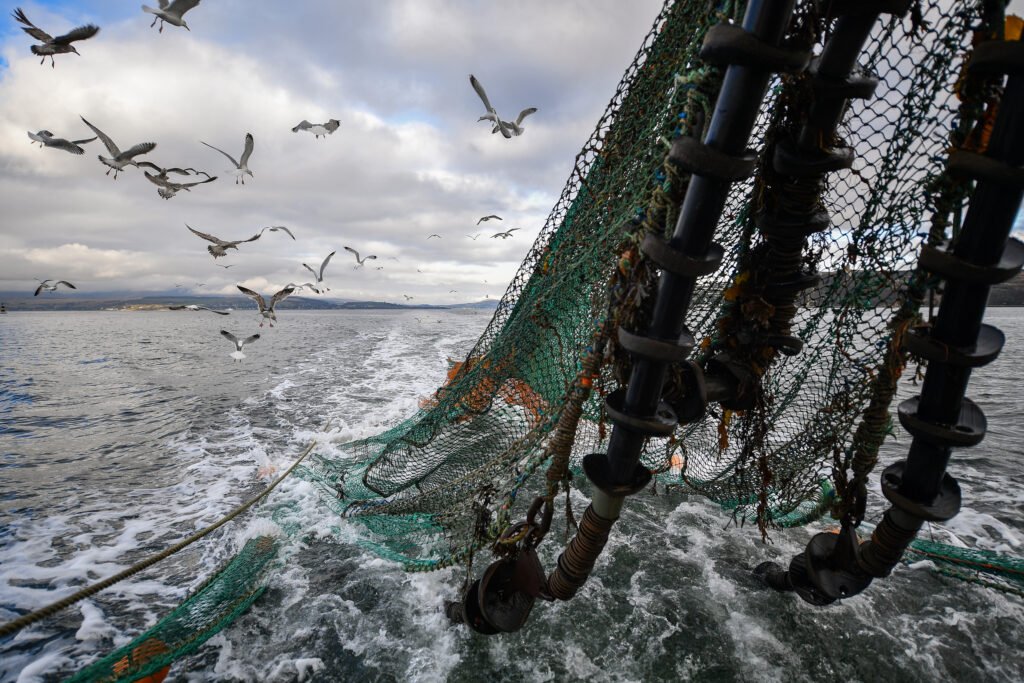
Environmental groups on Thursday sued the United States government to ensure internationally sourced seafood doesn’t threaten whales or dolphins that become entangled or drown due to sometimes lethal fishing techniques.
The U.S., the world’s largest seafood importer, has long had laws ensuring that fishers in its waters don’t ensnare marine mammals as incidental “bycatch.” But the federal government has never enforced those laws, which require the nation to ban seafood imports from countries that don’t have similarly protective rules.
On Thursday, Earthjustice filed suit on behalf of the Natural Resources Defense Council, the Animal Welfare Institute and the Center for Biological Diversity in the U.S. Court of International Trade, challenging seafood sales from eight countries that import to U.S. consumers. The suit alleges that commercial fisheries in these countries kill thousands of marine mammals in part by using lethal fishing gear, including gillnets, longlines and trawlers.
“The absolute biggest threat to marine mammals—whales, dolphins, porpoises—is bycatch,” said Sarah Uhlemann, a staff attorney with the Center for Biological Diversity, who has long pressured the government to enforce its existing laws. “It’s not intentional, but it still kills 650,000 marine mammals a year,” she said.
The 1972 Marine Mammal Protection Act requires foreign fishers to meet U.S. standards, which require certain measures to protect marine mammals, including seasonal closures and robust reporting on marine mammal populations.
“Congress realized it’s not just U.S. marine mammals that are threatened by fishing, so it required that for any seafood to be imported into the United States, foreign fishers have to essentially meet the same standards that U.S. fishers do,” Uhlemann added. “But for the most part, the National Marine Fisheries Service, which is the U.S. agency that implements this requirement, just ignored the law.”
The fisheries service began banning imports from some countries only recently. The lawsuits challenge imports from Argentina, Ecuador, India, Norway, Taiwan, Tunisia, the United Kingdom and Vanuatu, saying the service failed to acknowledge that these countries lack adequate protective measures.
The National Marine Fisheries Service did not immediately respond to a request for comment Friday.
“We’re really trying to focus on countries that don’t know how many marine mammals are in their waters, or didn’t set limits or didn’t do monitoring,” Uhlemann noted. “Those are the key components to a really good marine mammal bycatch program. These countries—they all lack at least one of those components.”
The U.S. imports billions of dollars worth of seafood from 140 nations and about 80 percent of the seafood consumed is imported.
“We have domestic fishers that invest an incredible amount of time and resources to do right by the law,” said Zak Smith, an attorney with the Natural Resources Defense Council. “They’re at a competitive disadvantage against the countries that aren’t being held accountable. It really makes you wonder, who are these agencies working for—are they working for foreign fisheries and people who make money off of foreign fisheries, or are they working for the American consumer and marine mammals?”
Earlier this month, the Center for Biological Diversity also filed a formal petition requesting the U.S. government potentially sanction China for failing to meet American shark conservation standards. Shark populations have declined by more than 70 percent since 1970, with more than one-third of all shark and ray species now threatened with extinction. Yet each year, Chinese-flagged vessels catch thousands of sharks, brutally remove their fins and then discard the wounded sharks back in the ocean to die. Thousands.
Should the National Marine Fisheries Service identify China as having violated the U.S. Moratorium Protection Act, then President Donald rump could be expected to ban the import of all $1.5 billion of Chinese seafood.
About This Story
Perhaps you noticed: This story, like all the news we publish, is free to read. That’s because Inside Climate News is a 501c3 nonprofit organization. We do not charge a subscription fee, lock our news behind a paywall, or clutter our website with ads. We make our news on climate and the environment freely available to you and anyone who wants it.
That’s not all. We also share our news for free with scores of other media organizations around the country. Many of them can’t afford to do environmental journalism of their own. We’ve built bureaus from coast to coast to report local stories, collaborate with local newsrooms and co-publish articles so that this vital work is shared as widely as possible.
Two of us launched ICN in 2007. Six years later we earned a Pulitzer Prize for National Reporting, and now we run the oldest and largest dedicated climate newsroom in the nation. We tell the story in all its complexity. We hold polluters accountable. We expose environmental injustice. We debunk misinformation. We scrutinize solutions and inspire action.
Donations from readers like you fund every aspect of what we do. If you don’t already, will you support our ongoing work, our reporting on the biggest crisis facing our planet, and help us reach even more readers in more places?
Please take a moment to make a tax-deductible donation. Every one of them makes a difference.
Thank you,
