

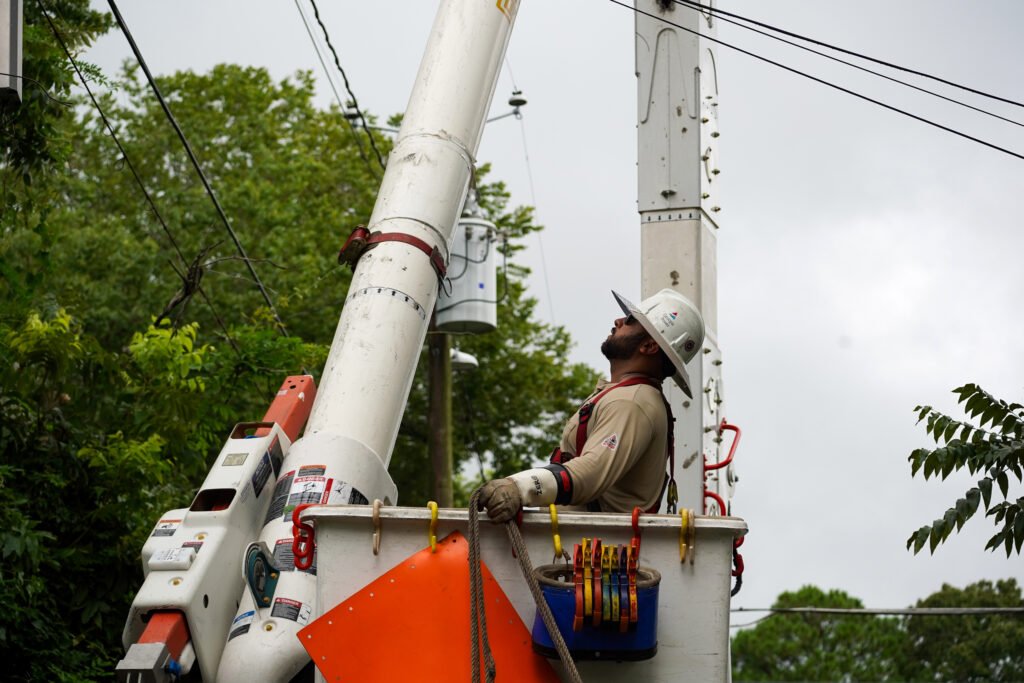
Georgia Public Service Commission elections historically received limited public attention and turnout. That changed last year, when voters, frustrated by rising electric bills, ousted two GOP members of the utility regulator, previously made up entirely of Republicans. This year, Democrats have a chance to flip control of the five-member commission.
The Georgia Public Service Commission regulates utilities across the state, most notably Georgia Power, which supplies electricity to roughly 2.7 million customers. The commission approves rate hikes, oversees long-term energy planning and decides how utilities recover costs from customers. Republicans have controlled the body for decades, but with two of the five seats on the ballot this year, that grip on power may be slipping.
Last year, Alicia M. Johnson and Peter Hubbard became the first Democrats elected to statewide office in Georgia since 2006. Johnson won a full six-year term, while Hubbard won a temporary one-year term and is now running for reelection to a full term.
The second seat up for grabs belongs to Republican Tricia Pridemore, who is not seeking reelection as she runs for Georgia’s 11th Congressional District seat. Democrat Shelia Edwards secured her party’s nomination Tuesday night. Her Republican opponent will be decided in a runoff because no candidate won a majority of the primary vote, a requirement under Georgia election law.
The seat represents PSC District 5, which includes counties in northwest Georgia. Candidates must live within the district, but voters statewide cast ballots in each PSC race.
Edwards thanked voters “for the opportunity to bring ‘service’ back to the heart of the Public Service Commission,” she wrote on Facebook Wednesday morning.
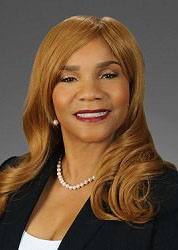
Edwards previously won the Democratic PSC primary in 2022 before the general election was canceled amid voting-rights litigation over how commissioners are elected. She previously served as executive director of the Georgia House Democratic Caucus and as district director for former U.S. Rep. David Scott.
Her campaign has centered on affordability and utility oversight. Since her first run in 2022, Georgia Power customers have seen rates rise by more than 40 percent through a series of PSC-approved increases tied to higher fuel costs, storm recovery, grid investments and the completion of the Vogtle nuclear plant expansion.
As bills climbed, disconnections also surged. According to Georgia Power’s 2025 Bad Debt Report, nearly 280,000 customers experienced shutoffs for nonpayment—around ten times the industry average.
“I’m running to be the third vote on the PSC and to work with Peter Hubbard and Alicia Johnson,” Edwards said during an April debate. “Georgians deserve better in terms of constant rate increases.”
A third Democratic commissioner would give Democrats a 3-2 majority on the commission, whose decisions are made by majority vote. To gain control, Edwards would need to win in November and Hubbard would need to win his race against former commissioner Fitz Johnson, a Republican.

Hubbard, founder of the Georgia Center for Energy Solutions, said he is running to continue work he began during his short time on the commission. Earlier this year, Hubbard voted to reconsider Georgia Power’s proposal to expand its generating capacity by roughly 10 gigawatts, much of it fueled by natural gas and driven by projected demand growth from data centers.
Hubbard argued the commission should scale back portions of the proposed gas expansion.
“Georgians voted for affordability and accountability,” Hubbard said. “Instead, the PSC voted for a massive grid expansion including brand-new, expensive resources to serve data center load growth.”
He has also called for an independent audit of Georgia Power’s profit margins.
Both Hubbard and Edwards have argued for stronger oversight of data centers and have criticized tax incentives offered to the industry. Their criticism comes as Georgia faces a surge in planned data center construction, raising questions about how the industry’s growing electricity demand could shape future power bills and long-term energy planning.
This story is funded by readers like you.
Our nonprofit newsroom provides award-winning climate coverage free of charge and advertising. We rely on donations from readers like you to keep going. Please donate now to support our work.
An Atlanta Journal-Constitution poll found 76 percent of Democrats said they would somewhat or strongly oppose data centers being built in their communities, compared to 53 percent of Republicans.
On the Republican side, candidate Bobby Mehan, who received 31 percent of the primary vote, has pledged not to raise utility rates if elected. Critics have questioned how feasible that promise would be, particularly with Georgia Power’s current base rate agreement, which is set to expire in 2028.
His runoff opponent, Joshua Tolbert, who earned 47 percent of the vote, has centered his campaign on technical expertise and the possibility of becoming the only engineer on the commission.
If Democrats gain a majority, they say they want to pursue renewable energy development and stronger community protections. Through votes on utility resource plans and rate cases, commissioners can influence how much solar, battery storage, energy efficiency and fossil fuel generation utilities like Georgia Power build—and how the costs of those projects are passed on to customers. Republican candidate Mehan supports an “all of the above” energy approach.
The general election will be held in November, with winning candidates set to take office Jan. 1.
About This Story
Perhaps you noticed: This story, like all the news we publish, is free to read. That’s because Inside Climate News is a 501c3 nonprofit organization. We do not charge a subscription fee, lock our news behind a paywall, or clutter our website with ads. We make our news on climate and the environment freely available to you and anyone who wants it.
That’s not all. We also share our news for free with scores of other media organizations around the country. Many of them can’t afford to do environmental journalism of their own. We’ve built bureaus from coast to coast to report local stories, collaborate with local newsrooms and co-publish articles so that this vital work is shared as widely as possible.
Two of us launched ICN in 2007. Six years later we earned a Pulitzer Prize for National Reporting, and now we run the oldest and largest dedicated climate newsroom in the nation. We tell the story in all its complexity. We hold polluters accountable. We expose environmental injustice. We debunk misinformation. We scrutinize solutions and inspire action.
Donations from readers like you fund every aspect of what we do. If you don’t already, will you support our ongoing work, our reporting on the biggest crisis facing our planet, and help us reach even more readers in more places?
Please take a moment to make a tax-deductible donation. Every one of them makes a difference.
Thank you,

Contributor
Ryan Krugman is a recent graduate of Columbia University’s Climate School focusing on climate change reporting and communications. He also holds a Bachelor’s degree from St. Lawrence University where he studied Environmental Science and Sociology. As a former Inside Climate News fellow, he is now reporting on climate and environmental issues in New England and Georgia.