

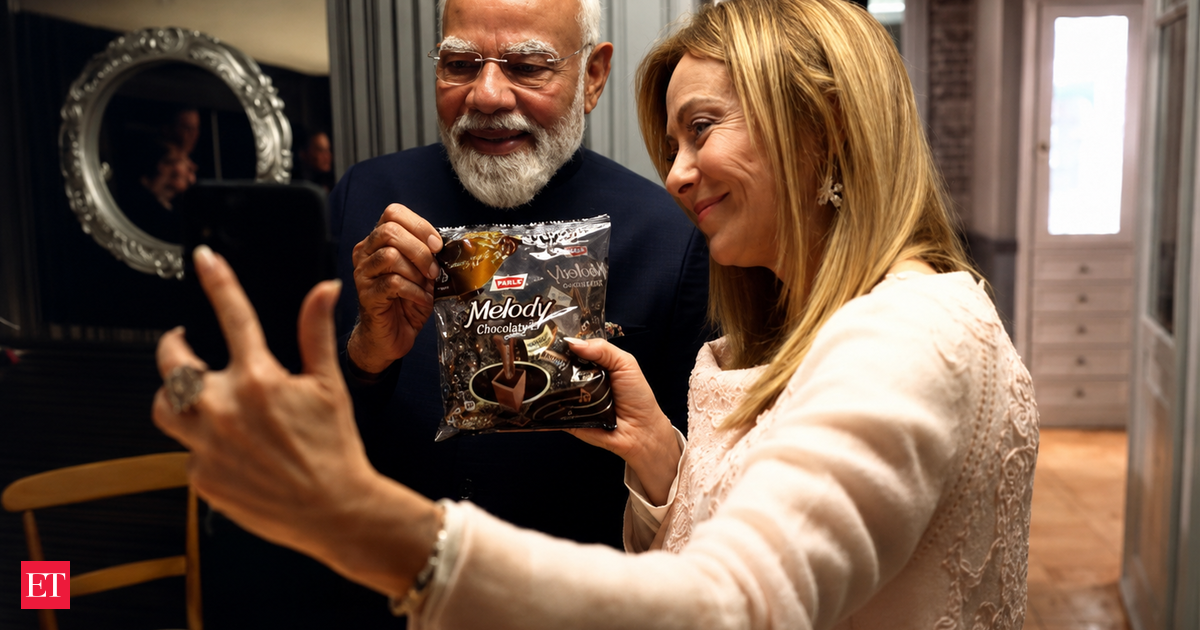
The “Melodi” meme, born from a combination of the two leaders’ surnames, has been amplified online since the G20 summit in 2023. Meloni laughed on camera and called it a “very, very good toffee” as the clip spread rapidly across platforms.
But beneath lies a larger business and economic story of India, even as India’s opposition party leader Rahul Gandhi called it a gimmick and not leadership.
Also Read: PM Modi’s Melody gift to Meloni boosts Parle buzz
Countries once exchanged luxury watches, rare artefacts and expensive wines to project national identity. India’s prime minister instead chose a caramel toffee sold in neighbourhood shops for around ₹1, a product recognised by generations of Indians across cities, villages and citizens from all income groups. For many Indians, Melody is not merely confectionery, but it’s a memory wrapped in golden packaging. That says something about modern India’s confidence in its own mass-market culture.

From Mumbai factory floors to India’s memory bank
Parle Products, maker of Melody, is one of India’s oldest and most recognisable consumer goods companies. Founded in 1929, the Mumbai-based group built its empire not through premium branding but through affordability and scale.
Parle also gave India its most loved biscuit, Parle-G. A swadeshi biscuit of independent India, It has accompanied the nation on its journey since then.Its products travelled through India long before organised retail chains arrived or quick-commerce players delivered to you in 10 minutes. Melody, Parle-G, Poppins and Mango Bite adorn the kirana stores, railway stations and school canteens.
Indians across generations immediately understood the cultural reference when Modi gave Meloni a Melody toffee, even as Indian consumers are also tasting imported chocolates such as Ferrero Rocher. Perhaps, that is the larger shift underway. India is beginning to project not only its elite heritage to the world, but also its everyday consumer identity while the Make in India and make for the world ambitions gain more strength.
The Melody moment was such that shares of Parle Industries, an unrelated small-cap company with no connection to Parle Products, hit the upper circuit on the BSE following the viral episode. It was not clear what drove the move.
Also Read: Parle Industries shares hit 5% upper circuit after PM Modi’s ‘Melody’ gift to Meloni
The moment also spilled into corporate branding campaigns, with Air India posting on X: “Some places don’t need introductions, just the right melody,” underscoring how the Modi-Meloni Melody exchange quickly evolved from a diplomatic gesture into a marketing moment for Indian brands.
The rise of India’s ₹1 soft-power economy
For decades, countries exported influence through luxury or premium products. France had luxury fashion and champagne. Switzerland built symbolic power through watches. Japan turned electronics, anime and convenience-store culture into global industries. South Korea transformed K-pop and beauty products into economic weapons.
India’s soft power traditionally travelled through yoga, spirituality, classical arts and later Bollywood.
Now the symbols are changing.
 ET Online
From yoga to UPI and now a ₹1 caramel toffee, India’s global identity is increasingly being shaped by mass-market culture rather than elite luxury.
The change mirrors India’s economic transformation. The country is no longer presenting itself only as a civilisation-state or an IT outsourcing hub. It is increasingly positioning itself as a vast consumer economy whose desi products can travel beyond the country’s borders.
Reacting to the #Melody trend after Modi gifted Meloni the toffee, India’s Trade Minister Piyush Goyal wrote on X that “India’s TOFFEE TALE would surely be melody to the ears!” He said India’s toffee exports have soared 166% in 12 years to Rs 132 crore in 2025-26.
According to PIB, the food processing sector’s gross value added rose from ₹1.34 lakh crore in 2014-15 to ₹2.24 lakh crore in 2023-24, while processed food’s share in India’s agricultural exports climbed from 13.7% to 20.4% during the same period. The sector has also attracted $7.33 billion in foreign direct investment between 2014-15 and 2024-25, underscoring how Indian consumer and food brands are increasingly finding relevance beyond domestic markets.
Indian snacks, biscuits and confectionery products are now widely available across the Gulf, Africa, Britain, Southeast Asia and North America, powered by diaspora demand as well as growing global interest in regional food brands.
Indian snack maker Haldiram’s valuation was reported at $10 billion when it was selling minority stake to global players last year.
After the Modi-Meloni moment, Parle itself acknowledged the global reach.
In an interview with CNBC-TV18, the company said Melody is already exported and available in 100 countries. Parle said it is a nice way of pushing Indian products and giving a global stage.
The Melody moment also came at a time when there are speculations that Parle Products is in early-stage talks for a potential initial public offering. Modi’s Melody gift to Meloni could have been a great global roadshow before aiming for D-Street entry.
However, Parle told the local TV channel that it is not considering listing on exchanges right now.
India’s biggest brands often stay domestic
To be sure, many Indian FMCG giants remain overwhelmingly domestic despite massive distribution networks and huge consumer bases.
But global consumption patterns are changing.
Walk into Indian grocery stores in London, Dubai, Singapore or New Jersey and shelves increasingly resemble nostalgia corridors for the diaspora.
India’s overseas diaspora now exceeds 34 million people, according to the Ministry of External Affairs, creating one of the largest global consumer bases for Indian-origin products.
That opens a new possibility. Indian legacy FMCG brands could evolve into global cultural exports much like Korean noodles or Japanese candy did over the past two decades.
Diplomacy speaks the language of the Internet
The Melody episode also reveals how diplomacy itself is changing.
A ₹1 toffee generated huge global engagement online without it being a carefully drafted diplomatic statement.
The symbolism also arrived at a time when India is trying to deepen trade, defence and infrastructure ties with Italy and Europe.
India and Italy are aiming to raise bilateral trade to €20 billion by 2029 from €14.25 billion in 2025, with India exporting goods worth €8.55 billion and maintaining a trade surplus of €2.85 billion. Italy is also increasingly viewing India as a strategic economic partner, identifying the country as one of its priority markets under its global trade strategy, while India has emerged as Italy’s 14th-largest import source.
Against that backdrop, the Melody packet became a statement about how India increasingly wants to be seen and what it produces that can be tasted or bought by Italy.
From toffees to technology and missiles
India is no longer exporting only software services and pharmaceuticals. India is increasingly pushing outward across automobiles, electronics, defence equipment and digital infrastructure.
India’s passenger vehicle exports rose to a record-breaking 905,200 units in FY26, according to SIAM data, as automakers benefited from strong demand across emerging markets in the Middle East, Latin America and Africa. Meanwhile, defence exports surged 62% on year to hit a record ₹38,424 crore in FY26, helped by rising international interest in systems such as the BrahMos missile platform.
That matters because countries project influence not only through military or economic power, but also through products. Sometimes those symbols are fighter jets. Sometimes they are digital payment systems.
And sometimes, unexpectedly, they arrive as a ₹1 caramel toffee gifted to the top minister of an European country in Rome.