

Close Menu

    Subscribe to Updates

    Get the latest news information from worldwide businesses.

    What's Hot

    The moon shines with a swarm of stars on May 21 as Jupiter, Venus and Mercury line-up nearby

    May 20, 2026

    Cameron Green strikes twice in his first over to dismiss Ryan Rickelton and Naman Dhir in KKR vs MI IPL 2026 match [Watch]

    May 20, 2026

    BYD EV conquers 2,700-mile trip with new battery and 5-min charging

    May 20, 2026
    Facebook Instagram YouTube LinkedIn X (Twitter)
    Trending
    • The moon shines with a swarm of stars on May 21 as Jupiter, Venus and Mercury line-up nearby
    • Cameron Green strikes twice in his first over to dismiss Ryan Rickelton and Naman Dhir in KKR vs MI IPL 2026 match [Watch]
    • BYD EV conquers 2,700-mile trip with new battery and 5-min charging
    • Can perimenopause start in your 30s?
    • Scientists discover massive natural hydrogen source beneath Canada
    • Fosfomycin Not Found Effective for Febrile Neutropenia Prevention, Suggests Research
    • Anker’s travel-friendly Laptop Power Bank has returned to its best price of the year
    • Customers say Trump Mobile is leaking their personal information
    Newspublicly
    • About Us
    • Advertise & Partner with us
    • Pitch Your Story
    • Contact Us
    Facebook Instagram LinkedIn X (Twitter)
    Subscribe
    • Home
    • World News
      • Asia
      • India
      • USA
      • UK & Europe
      • Middle East
    • Economy & Business
      • Global Economy
      • Corporate & Industry
      • Finance & Markets
      • Policy & Trade
    • Technology
      • Gadgets & Devices
      • Software & Apps
      • AI & Machine Learning
      • Robotics & Automation
    • Health & Medicine
      • Fitness & Nutrition
      • Research & Innovation
      • Disease & Treatment
      • Doctors, Clinics & Patient Care
    • Travel & Tourism
    • Automobile
      • Electric & Hybrid Vehicles
      • Auto Industry Insights
    • Sports
    • More
      • Education
      • Real Estate
      • Environment & Climate
      • Space & Astronomy
      • War & Conflicts
    Newspublicly
    Home»More»Space & Astronomy»NASA’s Psyche probe takes awesome images of Mars on way to (possibly) precious asteroid
    Space & Astronomy

    NASA’s Psyche probe takes awesome images of Mars on way to (possibly) precious asteroid

    AdminBy AdminMay 20, 2026No Comments6 Mins Read0 Views
    Share
    Facebook Twitter LinkedIn Copy Link WhatsApp


    Right now, a spacecraft named Psyche is headed to its namesake asteroid, 16 Psyche. The theory is that 16 Psyche, which lies in the asteroid belt between Mars and Jupiter, may be made of precious metals that, on Earth, would be worth more than the entire world economy. However, we’ll only know for sure once this probe gets there in 2029. So, we’ll have to wait.

    But in the mean time, this spacecraft has been keeping us entertained. On its way to that tremendously exciting asteroid, Psyche just made a memorable pit stop: It flew by Mars, getting within 2,864 miles (4,609 kilometers) of the planet’s surface. That’s very, very close — indeed, close enough to bring us some marvelous imagery of our neighbor, the Red Planet.

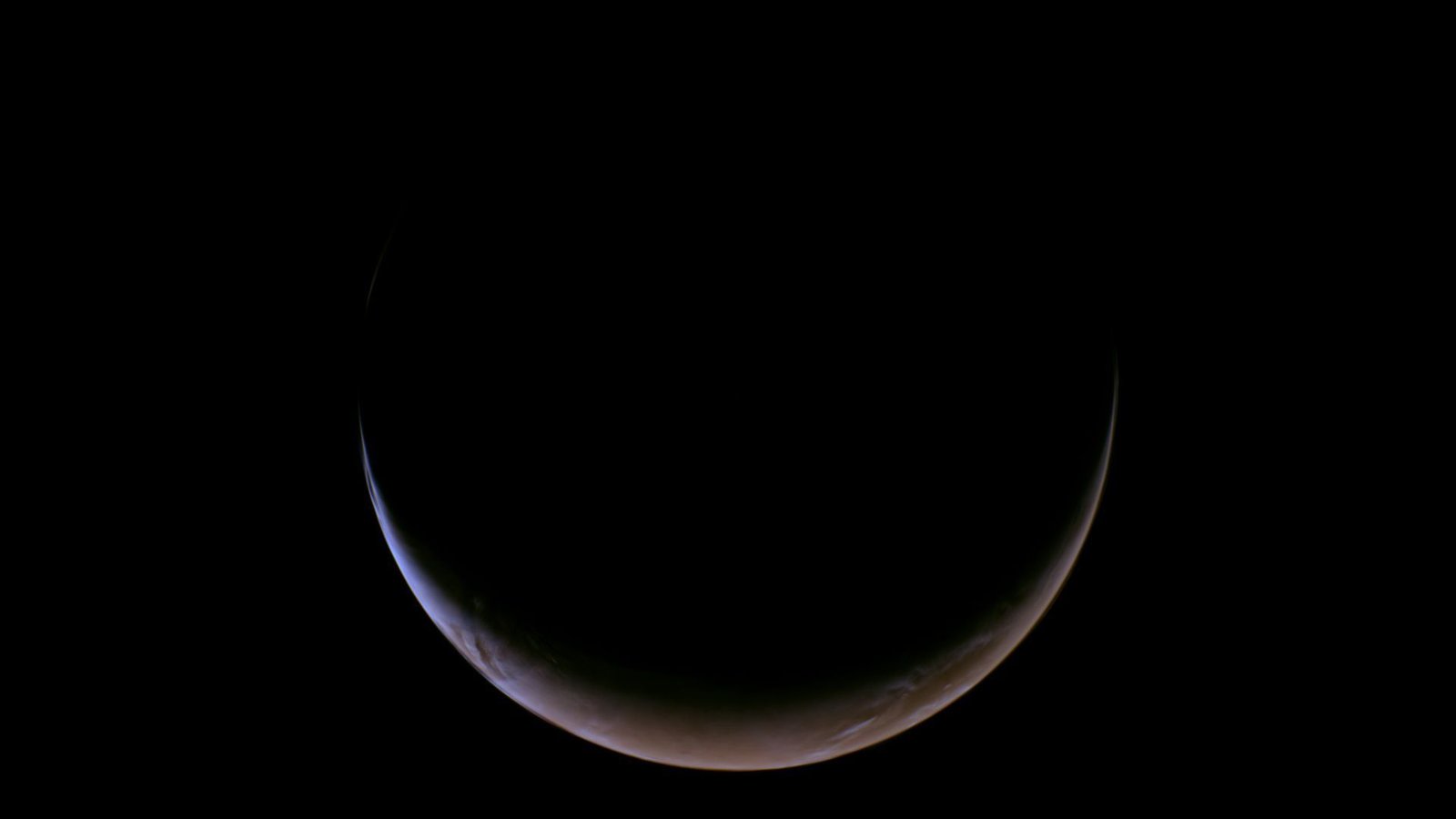
    The image of Mars above was taken at about 8:03 a.m. EDT (1203 GMT) on May 15 during the flyby. The planet’s crescent shape is due to Psyche approaching Mars from what’s known as a “high phase angle,” in reference to the angle formed between the sun, the target being imaged (Mars, in this case), and the spacecraft itself.


    You may like

    NASA also explains that one of Psyche’s instruments, the multispectral imager, saw the crescent appearing brighter and extending farther than expected due to the dusty Mars atmosphere scattering light. The multispectral imager is special because it can take images in both visible light (light we can see as humans) and near-infrared light (the kind of invisible light the James Webb Space Telescope famously specializes in).

    That kind of imaging will be important once Psyche gets to 16 Psyche, because it’ll reveal better detail about the asteroid’s surface features. In fact, it would appear that a lot of asteroid-specific gear meant to help NASA decode the true composition of 16 Psyche and let us know whether or not it lives up to its proposed price tag of many (many) quadrillions of dollars was turned on during the Mars flyby. This includes instruments like the magnetometers that may have found a “bow shock” on Mars, which relates to solar wind dynamics near the planet.

    But to keep our eyes on Mars for a minute: As breathtaking as that crescent is, it isn’t the only image Psyche’s operators managed to process during the probe’s close approach to the planet.

    “We’ve captured thousands of images of the approach to Mars and of the planet’s surface and atmosphere at close approach. This dataset provides unique and important opportunities for us to calibrate and characterize the performance of the cameras, as well as test the early versions of our image-processing tools being developed for use at the asteroid Psyche,” Jim Bell, the Psyche imager instrument lead at Arizona State University, said in a statement.

    Space

    For instance, NASA also released the flyby images below. And agency officials say we can expect further analysis of Psyche’s Martian views in the coming days as more opportunities arise.

    “As the spacecraft continues its journey after the flyby, we’ll continue calibration imaging of Mars for the rest of the month as it recedes into the distance,” Bell said.

    A black and white view of a planet. A white blob is on the left.

    A view of Mars, captured by the Psyche probe. (Image credit: NASA/JPL-Caltech/ASU)

    A close up of the black and white image.

    A closer look at the Martian southern polar cap. (Image credit: NASA/JPL-Caltech/ASU)

    This image just above showcases Psyche’s view of a nearly “full Mars.” The white blob toward the left is actually the planet’s south pole, depicting a high-resolution view of the water-ice-rich area in this region on Mars. That cap is over 430 miles (700 kilometers) in width, NASA says.


    What to read next

    The first image below shows wind streaks over craters on the Red Planet, with the streaks extending to about 30 miles (50 km) in length. The craters average around 30 miles (50 km) in diameter as well.

    Meanwhile, the second image below is blue because it’s an enhanced color view of Mars, showing Huygens crater, which is about 290 miles (470 km) in width.

    A reddish planet's surface with craters and streaks that make it almost look blurry.

    This view of the Martian surface shows streaks that have formed due to wind blowing over impact craters in the Syrtis Major region. (Image credit: NASA/JPL-Caltech/ASU)

    a colorful image of a deep crater surrounded by lots of smaller craters

    This is an enhanced-color view of the large double-ring Mars crater Huygens and the surrounding area. (Image credit: NASA/JPL-Caltech/ASU)

    As to why Psyche made this little detour on its way to its final target? It’s because of something called a “gravity assist,” which is a popular maneuver taken by spacecraft headed into the depths of our solar system.

    Basically, a gravity assist allows a probe to harness the gravitational influence of different objects in space (usually planets) and slingshot onto a planned trajectory that brings it toward an ultimate target. According to NASA, it would appear this gravity assist of Psyche was as effective as hoped for.

    “We’ve confirmed that Mars gave the spacecraft a 1,000 mile‑per‑hour boost and shifted its orbital plane by about 1 degree relative to the sun. We are now on course for arrival at the asteroid Psyche in summer 2029,” Don Han, Psyche’s navigation lead at NASA’s Jet Propulsion Laboratory, said in the statement.

    Han also explained that the Psyche flight team came to this conclusion by taking advantage of the Doppler Shift effect. The Doppler Shift has to do with the way wavelengths from an object moving away from you stretch out while those from an object moving toward you compress.

    NASA’s Deep Space Network, which the agency uses to communicate with far-flung spacecraft, is able to tap into this effect and thus figure out the locations of spacecraft. It’s also worth noting that Psyche is testing out a cool new form of spacecraft communications that involves laser-beaming information back to Earth with its Deep Space Optical Communications (DSOC) software. That has, so far, been knocking it out of the park — even transmitting an image of a cat named Taters across 19 million miles (30 million km) of space.

    “We’ve been anticipating the Mars flyby for years, but now it’s complete. We can thank the Red Planet for giving our spacecraft a critical gravitational slingshot farther into the solar system,” Lindy Elkins-Tanton, principal investigator for Psyche at the University of California, Berkeley, said in the statement.

    “Onward to the asteroid Psyche!”


    Source link

    Author

    • Admin

      NewsPublicly.com is News & Articles Platform that creating SEO-focused articles on travel, lifestyle, and digital trends.

    Admin
    • Website

    NewsPublicly.com is News & Articles Platform that creating SEO-focused articles on travel, lifestyle, and digital trends.

    Related Posts

    The moon shines with a swarm of stars on May 21 as Jupiter, Venus and Mercury line-up nearby

    May 20, 2026

    An astronaut’s view of Argentina’s snow-capped mountains photo of the day for May 20, 2026

    May 20, 2026

    The universe’s ‘most relaxed’ galaxy cluster was shaped by cosmic violence, new study finds

    May 20, 2026
    Leave A Reply Cancel Reply

    Demo
    Top Posts

    “Inside Gemini Robotics 1.5: How Robots Learn to Reason & Act

    November 22, 202525 Views

    How US Tariffs Are Reshaping the Global Growth Landscape?

    November 21, 202518 Views

    Pakistani Journalist Laughing at Tejas Fighter Jet Crash at Dubai Airshow Sparks Massive Outrage Worldwide

    November 23, 202517 Views

    Vibe-Coding Boom: How Non-Coders Build Apps With AI Agents

    November 22, 202515 Views
    Don't Miss

    The moon shines with a swarm of stars on May 21 as Jupiter, Venus and Mercury line-up nearby

    May 20, 20263 Mins Read0 Views

    Look west after sunset on May 21 to see the crescent moon shining alongside the…

    Cameron Green strikes twice in his first over to dismiss Ryan Rickelton and Naman Dhir in KKR vs MI IPL 2026 match [Watch]

    May 20, 2026

    BYD EV conquers 2,700-mile trip with new battery and 5-min charging

    May 20, 2026

    Can perimenopause start in your 30s?

    May 20, 2026
    Stay In Touch
    • Facebook
    • Twitter
    • Instagram
    • YouTube
    • LinkedIn
    • WhatsApp

    Subscribe to Updates

    Get the latest creative news from SmartMag about art & design.

    Demo
    NEWSPUBLICLY
    Facebook X (Twitter) Instagram LinkedIn

    Home

    • About Us
    • Leadership
    • Advertise & Partner With Us
    • Pitch Your Story
    • Media Kit & Pricing
    • Career
    • FAQs

    Guidelines

    • Editorial & Submission
    • Partnership
    • Advertising & Sponsor
    • Intellectual Property Policy
    • Community & Comment
    • Security & Data Protection
    • Send Your Opinion

    Quick Links

    • Cookie Policy
    • Payment & Billing Terms
    • Refund & Cancellation
    • Copyright Policy
    • Complaint & Support
    • Sitemap
    • Contact Us

    Subscribe Us

    Get the latest news and updates!

    Copyright © 2026 Newspublicly (DIGITALIX COMMUNICATION). All Rights Reserved.
    • Privacy Policy
    • Terms of Use
    • Disclaimer