

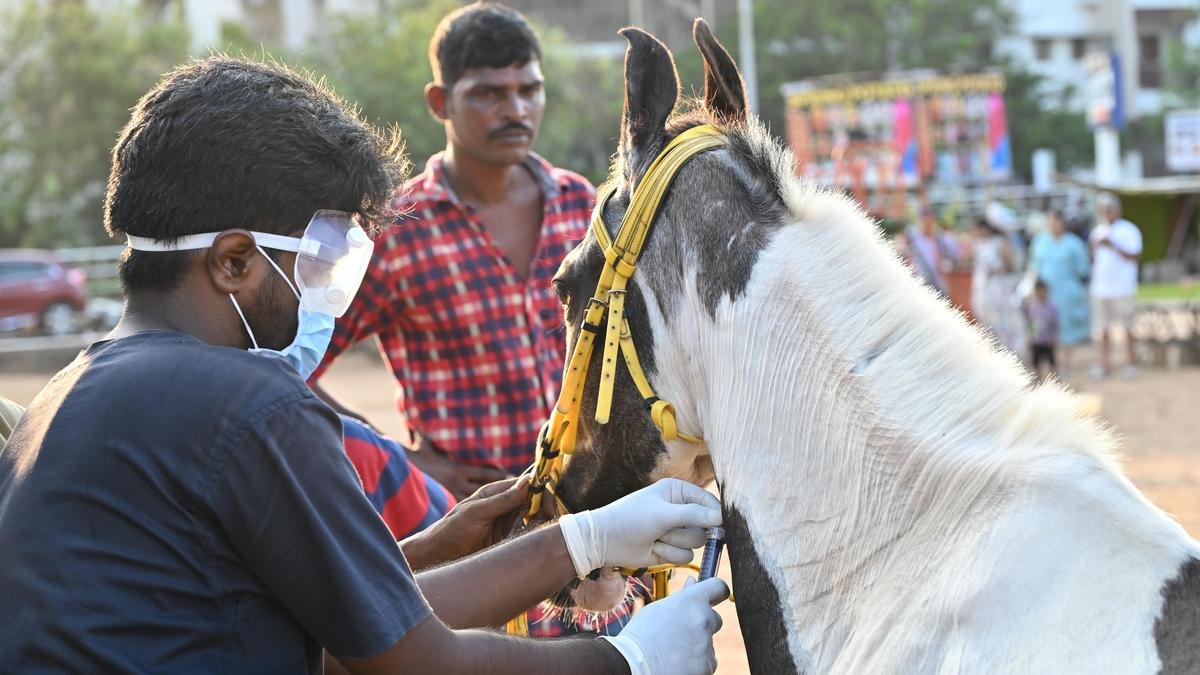
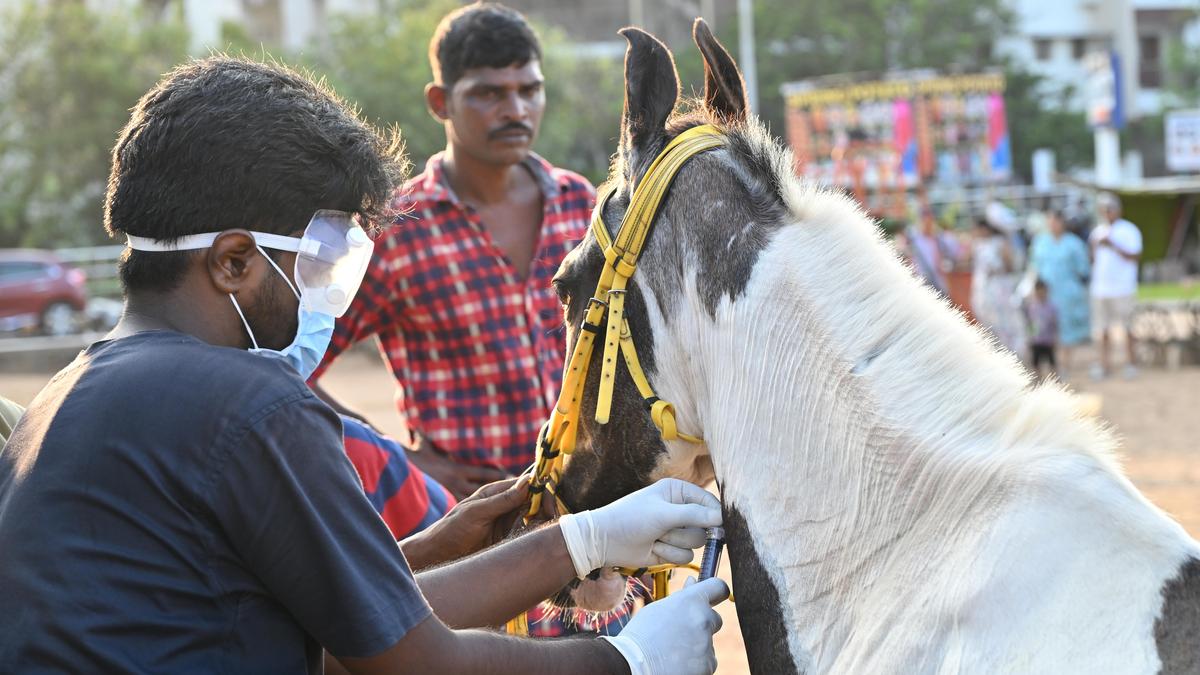
A staff of the Animal Husbandry Department collecting a sample from a horse at Besant Nagar beach on May 19, 2026
| Photo Credit: B. Velankanni Raj
Nearly 200 samples from horses used for joyrides, along with samples from handlers, have been sent to the ICAR–National Research Centre on Equines (NRCE), Haryana, for testing after a horse used for joyrides in Chennai city died of glanders, a highly contagious and notifiable bacterial disease that affects equines.
There are over 200 horses used for joyrides at the Marina, Elliot’s, and Kovalam-Mahabalipuram beaches, many of them housed in temporary shelters in Triplicane and Ice House, and under the Sivananda Salai MRTS station. These horses are often kept in poor conditions, as their upkeep is expensive, and handlers and owners earn too little to maintain them adequately. While the State mandates licences, registration, screening tests, fitness certificates, and vaccination records for equines, enforcement remains poor.
S.P. Amrith, Director of Animal Husbandry and Veterinary Services, Tamil Nadu, said authorities were acting in accordance with the prescribed action plan. “Samples are being collected daily since Saturday [May 16] and sent to the ICAR-NRCE every day. As of Monday, 126 samples were sent. Around 40 to 50 more will be sent tomorrow. In addition, samples from handlers have also been collected and sent by the Directorate of Public Health,” he said on Monday. On Tuesday, samples were collected at Besant Nagar beach, the Besant Memorial Animal Dispensary in Adyar, and in Kovalam.
In August 2025, the Department of Animal Husbandry and Dairying (DAHD), under the Ministry of Fisheries, Animal Husbandry and Dairying, issued the Revised National Action Plan on Glanders, aimed at strengthening surveillance, prevention, control, and eradication of the contagious and often fatal disease across the country. The plan, however, reduced the surveillance and restriction areas. Major revisions include reducing the infected zone from 5 km to 2 km, redefining the surveillance area from 5-25 km to 2-10 km, and aligning restrictions accordingly, which will now apply only up to a 10-km radius.
As per the guidelines, animals that test positive must be humanely euthanised in accordance with prescribed Standard Operating Procedures (SOPs), followed by disinfection of the premises.
‘No cause for concern’
Mr. Amrith said although glanders is zoonotic, which means it can be transmitted to other animals and humans, there was no major cause for concern. Referring to his tenure as Collector of the Nilgiris, he said joyride horses in such districts were routinely screened for diseases. “For glanders, there is a protocol, and it is being followed. There is no reason for alarm,” he said, adding that the ICAR-NRCE would issue confirmation only if samples tested positive.
Published – May 19, 2026 09:33 pm IST