

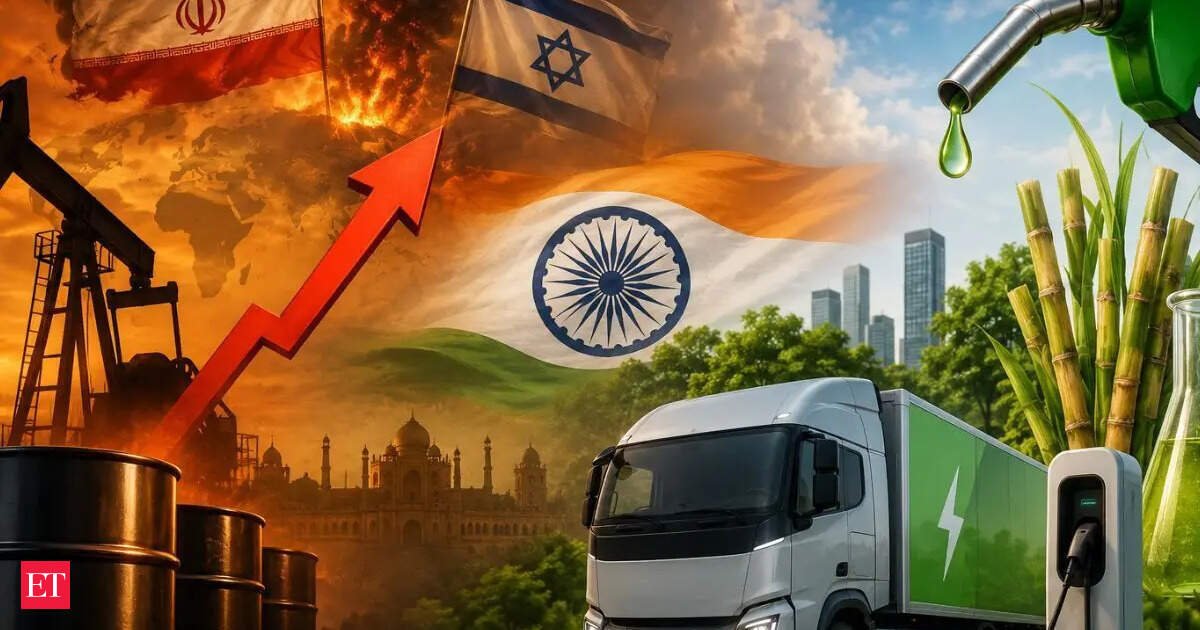
Two separate reports emerging today reveal a highly proactive administration fast-tracking aggressive plans for both absolute ethanol adoption and commercial vehicle electrification. By targeting the country’s most stubborn fossil fuel consumers, these dual initiatives aim to protect the economy from geopolitical volatility while preserving foreign exchange reserves, thus bolstering the rupee which has slid past 96. This strategic shift marks a critical turning point where energy security transitions from a long-term environmental goal to an immediate macroeconomic necessity.
ALSO READ | Ready to flex ethanol muscle, E100 gets road map to cut oil imports
Macro vulnerabilities
The ongoing conflict in the Middle East has laid bare the systemic risks embedded in India’s energy architecture. Importing nearly 90 percent of its crude oil requirements means that any localised geopolitical friction immediately translates into domestic economic stress. Supply disruptions linked to the Middle East crisis have revived intense concerns regarding energy security and imported inflation.
When global oil prices spike due to regional wars, the shockwaves are felt across the entire Indian economy, driving up the cost of logistics, manufacturing and daily commodities. This imported inflation exerts downward pressure on the Indian rupee, widens the current account deficit and forces monetary authorities to maintain tighter policies. By accelerating the transition away from fossil fuels, the government is trying to decouple the domestic economy from international crude volatility, ensuring that local growth is not held hostage by overseas geopolitical conflicts.

The fast-track biofuel roadmap
According to an ET report based on government sources, the Ministry of Petroleum and Natural Gas has outlined an aggressive strategy to establish 5,000 dispensing stations for E100 fuel within the next two years. The initial phase of this plan will see 150 retail outlets becoming operational over the next month across key urban hubs including Delhi, Mumbai, Pune and Nagpur. Over the following six to twelve months, the infrastructure will expand deeper into the Delhi-NCR and Maharashtra regions while also entering Bengaluru, Chennai, Kolkata and Hyderabad with a target of 500 outlets.
This rapid expansion is designed to provide the necessary framework for flex fuel vehicles, which give consumers the ability to switch between available fuel types and significantly reduce dependence on imported crude. The concentration on major metropolitan zones in the primary phase is a deliberate tactical move to build immediate density, tap into high-volume consumer markets and demonstrate logistical viability before scaling nationally.
Addressing the structural roadblocks
While the infrastructure roadmap is ambitious, the transition to 100 percent ethanol faces significant consumer and manufacturing challenges that require deep structural adjustments. The ET report highlights that major automakers like Maruti Suzuki, Hyundai, Tata Motors, Mahindra & Mahindra, Hero MotoCorp and TVS Motor Company have already developed prototypes but are holding back on commercial launches due to a lack of fuel stations and pricing clarity. This creates a classic chicken-and-egg dilemma where manufacturers hesitate to mass-produce vehicles without a guaranteed fuel network, and fuel retailers are reluctant to allocate pumps without a substantial fleet on the road.
Furthermore, a senior official at Indian Oil Corporation revealed to ET that a previous pilot across nearly 400 outlets yielded negligible offtake because of the limited vehicle base and lower fuel efficiency of E100 compared to regular petrol. The official noted that the core issue is structural since India has an extremely limited base of flex-fuel vehicles and E100 also delivers lower fuel efficiency compared to regular petrol, making it unattractive for consumers. Currently, E100 accounts for less than 0.5 percent of retail fuel sales, emphasising the massive scale of transformation required to make it a mainstream alternative to the current 20 percent ethanol blending standard.
Incentivising flex fuel
To bridge the gap between consumer reluctance and national energy targets, the government must address the financial viability of alternative fuels. To overcome the efficiency deficit of ethanol, the Society of Indian Automobile Manufacturers has suggested pricing E100 at least 30 percent lower than normal petrol. This price differential is essential to compensate users for the reduced mileage and to stimulate demand in a highly price-sensitive consumer market.
Additionally, fiscal policy will play a foundational role in de-risking the automotive sector’s transition. Deepak Ballani, the director general of the Indian Sugar & Bioenergy Manufacturing Association, emphasised that tax incentives such as lower GST will be vital for mass adoption. He noted that while India imports up to 90 percent of its crude oil, ethanol is entirely homegrown and supports up to 80 million local stakeholders. Redirecting capital from foreign oil producers to domestic farmers creates a self-sustaining economic loop that strengthens rural economies, insulates agrarian incomes from local market gluts and retains wealth within national borders.
Financial catalyst
In tandem with the biofuel push, the government is tackling the massive diesel consumption of the commercial transport sector, which represents the heaviest burden on India’s fuel bill. A Bloomberg report today indicates that India is considering a massive incentive programme exceeding $1 billion to spur private sector adoption of electric buses and trucks. This decade-long initiative primarily targets inter-city bus operators and private logistics, with the Prime Minister’s Office and industry stakeholders scheduled to refine the plan this month, Bloomberg reported based on sources.
Electrifying this segment is critical because out of the more than 2 million buses currently operating on Indian roads, the government controls a mere 5 percent of the fleet. The remaining 95 percent of buses and virtually all heavy trucks are privately operated, representing the single largest source of diesel consumption in the country. Targeting public transport alone is no longer sufficient. The state must influence the purchasing decisions of thousands of independent commercial operators if it hopes to make a meaningful dent in fossil fuel demand.
Overcoming barriers
The high upfront costs of electric commercial vehicles have historically deterred smaller fleet operators who operate on razor-thin margins. The proposed policy reported by Bloomberg aims to directly alleviate these financial bottlenecks by introducing interest subvention benefits worth up to 1.5 million rupees per vehicle over its lifetime. This subsidy structure will taper over time as technology matures and production scales up, ensuring efficient use of state funds.
Furthermore, the government is evaluating a partial credit guarantee mechanism to encourage cautious commercial lenders to extend credit to private companies purchasing electric trucks and buses. Early discussions centre on support that could cover 10,000 buses initially, with plans to eventually scale up to 50,000 vehicles. This financial de-risking is a necessity for small operators who lack the deep capital reserves to absorb the premium cost of electric fleets, transforming a high-risk capital expenditure into a manageable operational expense.
Catching up
Beyond the economic relief from imported inflation, this shift addresses an urgent environmental and public health crisis. As reported by Bloomberg, vehicular emissions contribute up to 40 percent of fine particulate matter pollution annually in cities like New Delhi. The environmental damage inflicts hidden but massive costs on the economy through healthcare burdens and lost productivity.
While global peers like China already operate hundreds of thousands of electric trucks and buses, and the United States and Europe are moving rapidly to electrify their urban logistics, India has lagged due to unique operating conditions and financial constraints. By exploring industry demands for dedicated charging parks, toll waivers, tax cuts and electricity concessions, the government is attempting to build a comprehensive ecosystem.
The Iran war fuel shock has effectively forced India to compress a decade-long evolutionary timeline into an immediate, aggressive deployment strategy, aligning economic survival with environmental sustainability.