

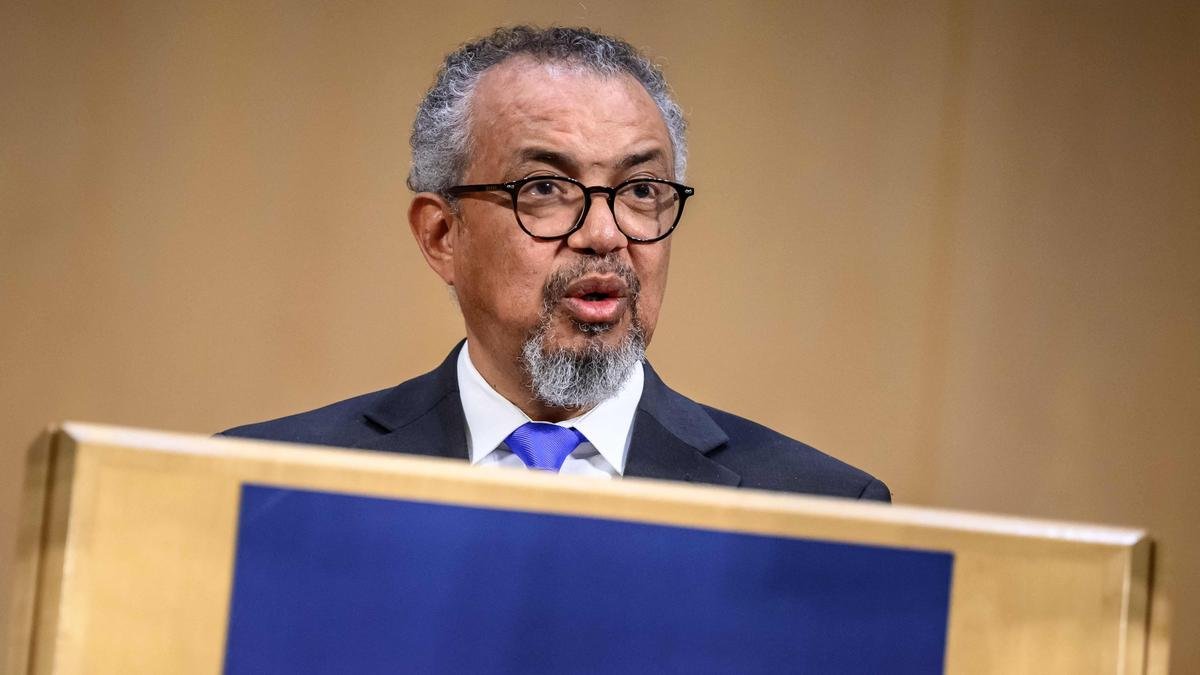
WHO chief Tedros Adhanom Ghebreyesus said Tuesday he was “deeply concerned about the scale and speed of the epidemic”, and would convene an emergency meeting on the crisis later in the day |Image used for representational purpose only
| Photo Credit: AFP
The WHO said Tuesday it was examining whether any candidate vaccines or treatments could be used to rein in what it warned could be a lengthy Ebola outbreak in the Democratic Republic of Congo.
The WHO has declared the surge of the highly contagious haemorrhagic fever, suspected to have killed 131 people and infected more than 500, an international health emergency.
“At the international level, (we are) looking at what candidate vaccines or treatment are available and if any could be of use in this outbreak,” Anne Ancia, the WHO’s DRC representative, told reporters in Geneva, speaking from Bunia in the Ituri region.
The WHO has declared the surge of the highly contagious haemorrhagic fever, suspected to have killed 131 people and infected more than 500, an international health emergency.
WHO chief Tedros Adhanom Ghebreyesus said Tuesday he was “deeply concerned about the scale and speed of the epidemic”, and would convene an emergency meeting on the crisis later in the day.
No vaccine or therapeutic treatment exists for the Bundibugyo strain of Ebola responsible for the latest outbreak of the disease, which has killed more than 15,000 people in Africa in the past half century.
Vaccines are only available for the Zaire strain, which was identified in 1976.
Ancia said that for the time being, international experts say prequalified vaccines for the Zaire strain “cannot be used in the current response”.
“Of course, a lot more studies need to be done on this,” she said.

Could be lengthy
She added that the WHO’s technical advisory group would meet Tuesday “to provide further recommendations… on which potential vaccines should be prioritised”.
There are a number of vaccine candidates.
Ancia said one called Ervebo was among those being looked at “for eventually being able to come and bring additional prevention and protection among the communities here”.
But, she warned, it was likely to take at least “two months for it to be available”.
It could still be useful, she stressed, since “I don’t think that in two months we will be done with this outbreak”, pointing to a recent Ebola outbreak that “took two years” to end.
The outbreak declared last Friday is the 17th outbreak of Ebola to hit the DRC and officials have warned of a high risk of spread.
Nearly 2,300 people died between 2018 and 2020 in the deadliest outbreak in the DRC to date.
Ancia said the WHO was rushing to address the current crisis and had deployed more than 40 experts to the field, alongside national responders.
The United Nations health agency had also sent 12 tonnes of supplies, she said, including personal protective equipment (PPE) for frontline health workers, from the Congolese capital Kinshasa and Nairobi in Kenya.
It was also working with partners, including medical charity Doctors Without Borders, to set up treatment centres, and was striving to scale up laboratory capacity.
Published – May 19, 2026 06:33 pm IST