

Close Menu

    Subscribe to Updates

    Get the latest news information from worldwide businesses.

    What's Hot

    PepsiCo India to invest Rs 5,700 crore by 2030 on capacity expansion

    May 19, 2026

    AI in focus as Standard Chartered Bank replaces ‘lower value human capital’, slashing back office workers by 15%

    May 19, 2026

    India soymeal exports to fall to four-year low on rising prices

    May 19, 2026
    Facebook Instagram YouTube LinkedIn X (Twitter)
    Trending
    • PepsiCo India to invest Rs 5,700 crore by 2030 on capacity expansion
    • AI in focus as Standard Chartered Bank replaces ‘lower value human capital’, slashing back office workers by 15%
    • India soymeal exports to fall to four-year low on rising prices
    • Polish officials vent worries over scrapped US troop deployment
    • TMC candidate Jahangir Khan withdraws from Falta repoll 2 days ahead of voting
    • Apply before June 8 at sbi.bank.in
    • Corpus Christi Leaders Believe Data Center Plans May Be Behind Delays to Emergency Water Supply
    • 5 vehicles that should get HSW upgrades in GTA Online in 2026
    Newspublicly
    • About Us
    • Advertise & Partner with us
    • Pitch Your Story
    • Contact Us
    Facebook Instagram LinkedIn X (Twitter)
    Subscribe
    • Home
    • World News
      • Asia
      • India
      • USA
      • UK & Europe
      • Middle East
    • Economy & Business
      • Global Economy
      • Corporate & Industry
      • Finance & Markets
      • Policy & Trade
    • Technology
      • Gadgets & Devices
      • Software & Apps
      • AI & Machine Learning
      • Robotics & Automation
    • Health & Medicine
      • Fitness & Nutrition
      • Research & Innovation
      • Disease & Treatment
      • Doctors, Clinics & Patient Care
    • Travel & Tourism
    • Automobile
      • Electric & Hybrid Vehicles
      • Auto Industry Insights
    • Sports
    • More
      • Education
      • Real Estate
      • Environment & Climate
      • Space & Astronomy
      • War & Conflicts
    Newspublicly
    Home»Technology»Robotics & Automation»Forget electrons, this breakthrough uses light-matter particles to power AI
    Robotics & Automation

    Forget electrons, this breakthrough uses light-matter particles to power AI

    AdminBy AdminMay 19, 2026No Comments3 Mins Read0 Views
    Share
    Facebook Twitter LinkedIn Copy Link WhatsApp


    Eighty years after the creation of ENIAC, the world’s first general-purpose electronic computer, researchers at the University of Pennsylvania are exploring a new way to power the future of computing. Instead of relying entirely on electrons, which have formed the backbone of computers since the 1940s, scientists are now turning to light.

    ENIAC, developed by Penn researchers J. Presper Eckert and John Mauchly, helped launch the modern computing era by using streams of electrons to solve complex mathematical problems. That same electronic approach still powers today’s computers, smartphones, and AI systems. But as artificial intelligence grows more demanding, the limits of electron-based hardware are becoming harder to ignore.

    Why Electrons Are Reaching Their Limits

    Electrons carry an electrical charge, which creates several challenges inside modern computer chips. As they move through materials, they generate heat and face resistance that wastes energy. Those problems become even more difficult as chips grow more complex and process enormous amounts of data for AI applications.

    Researchers led by Penn physicist Bo Zhen in the School of Arts & Sciences believe photons, the particles that make up light, could help solve some of these issues.

    “Because they are charge-neutral and have zero rest mass, photons can carry information quickly over long distances with minimal loss, dominating communications technology,” explains Li He, co-first author of a paper published in Physical Review Letters and a former postdoctoral researcher in the Zhen Lab. “But that neutrality means they barely interact with their environment, making them bad at the sort of signal-switching logic that computers depend on.”

    In other words, light is excellent for carrying information quickly and efficiently, but it struggles with the switching operations needed for computing.

    Combining Light and Matter for AI Computing

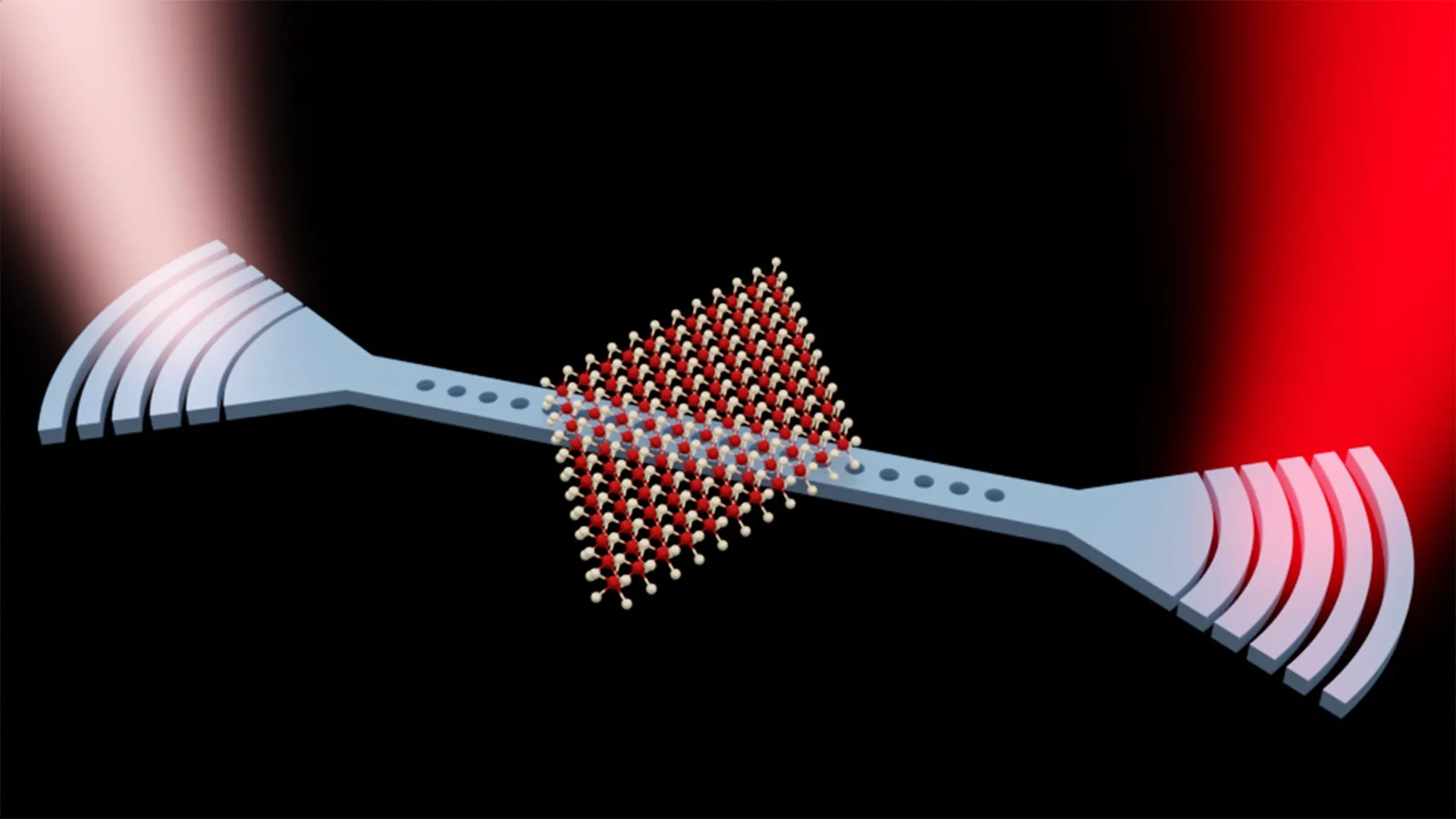
    To overcome that problem, Zhen’s team developed a special quasiparticle called an exciton-polariton. The particle forms when photons are strongly linked with electrons inside an atomically thin semiconductor material. This combination allows light to interact much more effectively, making it capable of performing the signal switching required for computing tasks.

    The breakthrough could be especially important for artificial intelligence systems, which consume enormous amounts of power.

    Many experimental photonic AI chips already use light to handle certain calculations at high speed. However, when these systems need to perform nonlinear activation steps, such as decision-making operations, they usually must convert light signals back into electronic ones. That conversion slows the process and increases energy use, reducing the benefits of photonic computing.

    Using exciton-polaritons, the Penn researchers demonstrated all-light switching while using only about 4 quadrillionths of a joule of energy. That amount is extraordinarily small, far below the energy needed to briefly power a tiny LED light.

    Toward Faster and More Efficient AI Chips

    If the technology can be successfully scaled, it could lead to photonic chips capable of processing information directly from cameras without repeated conversions between light and electricity. The approach could also lower the massive energy demands of large AI systems and potentially support basic quantum computing functions on future chips.

    Bo Zhen is the Jin K. Lee Presidential Associate Professor in the Department of Physics and Astronomy in the School of Arts & Sciences at the University of Pennsylvania.

    Li He was a postdoctoral researcher in the Zhen Lab in Penn Arts & Sciences. He is currently an assistant professor at Montana State University.

    Additional authors on the study include Zhi Wang and Bumho Kim from the University of Pennsylvania’s School of Arts & Sciences.

    The research was supported by the US Office of Naval Research (N00014-20-1-2325 and N00014-21-1-2703) and the Sloan Foundation.


    Source link

    Author

    • Admin

      NewsPublicly.com is News & Articles Platform that creating SEO-focused articles on travel, lifestyle, and digital trends.

    Admin
    • Website

    NewsPublicly.com is News & Articles Platform that creating SEO-focused articles on travel, lifestyle, and digital trends.

    Related Posts

    AI reveals the invisible magnetic chaos wasting energy inside electric motors

    May 18, 2026

    NASA’s new AI space chip could let spacecraft think for themselves

    May 15, 2026

    Breakthrough optical processor lets AI compute at the speed of light

    May 14, 2026
    Leave A Reply Cancel Reply

    Demo
    Top Posts

    “Inside Gemini Robotics 1.5: How Robots Learn to Reason & Act

    November 22, 202524 Views

    How US Tariffs Are Reshaping the Global Growth Landscape?

    November 21, 202518 Views

    Pakistani Journalist Laughing at Tejas Fighter Jet Crash at Dubai Airshow Sparks Massive Outrage Worldwide

    November 23, 202517 Views

    Vibe-Coding Boom: How Non-Coders Build Apps With AI Agents

    November 22, 202515 Views
    Don't Miss

    PepsiCo India to invest Rs 5,700 crore by 2030 on capacity expansion

    May 19, 20262 Mins Read0 Views

    New Delhi, Food and beverages major PepsiCo will invest up to Rs 5,700 crore in…

    AI in focus as Standard Chartered Bank replaces ‘lower value human capital’, slashing back office workers by 15%

    May 19, 2026

    India soymeal exports to fall to four-year low on rising prices

    May 19, 2026

    Polish officials vent worries over scrapped US troop deployment

    May 19, 2026
    Stay In Touch
    • Facebook
    • Twitter
    • Instagram
    • YouTube
    • LinkedIn
    • WhatsApp

    Subscribe to Updates

    Get the latest creative news from SmartMag about art & design.

    Demo
    NEWSPUBLICLY
    Facebook X (Twitter) Instagram LinkedIn

    Home

    • About Us
    • Leadership
    • Advertise & Partner With Us
    • Pitch Your Story
    • Media Kit & Pricing
    • Career
    • FAQs

    Guidelines

    • Editorial & Submission
    • Partnership
    • Advertising & Sponsor
    • Intellectual Property Policy
    • Community & Comment
    • Security & Data Protection
    • Send Your Opinion

    Quick Links

    • Cookie Policy
    • Payment & Billing Terms
    • Refund & Cancellation
    • Copyright Policy
    • Complaint & Support
    • Sitemap
    • Contact Us

    Subscribe Us

    Get the latest news and updates!

    Copyright © 2026 Newspublicly (DIGITALIX COMMUNICATION). All Rights Reserved.
    • Privacy Policy
    • Terms of Use
    • Disclaimer