

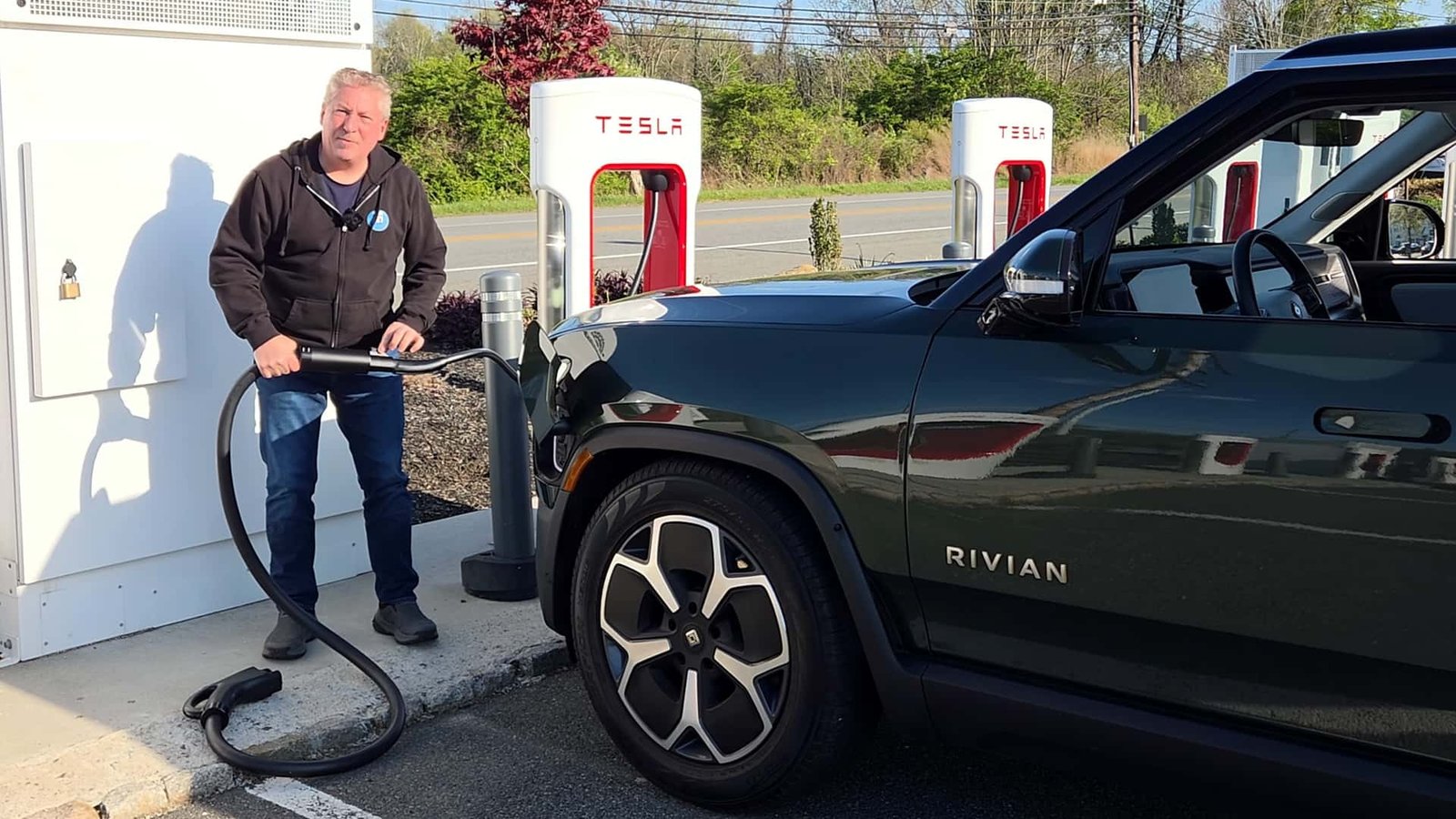
- InsideEVs contributor and charging expert Tom Moloughney put Hansshow’s latest Tesla Supercharger extension cable to the test.
- In real-world testing, the 8-foot NACS to CCS1 DC fast-charging extension cable fell short of expectations.
- The cable is aimed at non-Tesla EV owners who often need to double park when using V3 Tesla Superchargers
Tens of thousands of Tesla Superchargers are now open to non-Tesla EVs in the United States, which can make life a lot easier for everybody, especially on long road trips. However, Superchargers were designed for Teslas, which have the charge port on the left rear of the car, whereas other EVs might have it somewhere else.
It’s not the end of the world, but some EV owners are forced to double park at Superchargers because Tesla’s third-generation stalls have a pretty short cable designed exclusively for Teslas.
To fix the issue, a company called Hansshow is selling an extension cable that also doubles as a DC fast charging adapter, promising to make life a lot easier for some EV owners. The second-generation version of the product was put to the test by Tom Moloughney, charging expert and InsideEVs contributor.

Tom put the first-generation product through its paces and found that it was a safety disaster waiting to happen,. He also tested the prototype for the second-gen model, which fixed all of its predecessor’s problems. Recently, he got his hands on the final version, but after a testing session that was unexpectedly cut short, he discovered that the prototype worked better than the finished product.
The cable is available in 5-foot and 8-foot lengths, and is rated for 1,000 volts and 350 amps. To really put it to the test, Tom wanted to keep the 8-foot version under stress for an hour straight, charging his Rivian R1S and Ford F-150 Lightning from a low state of charge, where both EVs ask for 500 amps at the beginning of the session.
However, that plan didn’t work out. The Rivian stopped charging after 17 minutes while using the extension cable, despite the surface temperature of the cable never going over 100 degrees. A second attempt did not work, either.
The cable was plugged into the F-150 Lightning, and after eight minutes of charging, the session automatically stopped again.
Moving over to another Tesla Supercharger stall didn’t help, either. Weirdly enough, the pre-production version of the cable, which looks exactly like the finished product, worked flawlessly in Tom’s charging sessions multiple times. It’s not clear why this latest product has missed the mark.
What’s more, there’s the price to consider, with the 8-foot version retailing for $729. That’s a lot of money, especially if you can’t rely on it. Additionally, owners who use something like this need to know that they’re doing it at their own risk, as all EV makers advise against using extension cables or charging adapters that are not manufacturer-approved. In case something goes wrong during a charging session, your warranty will likely not cover damages.