

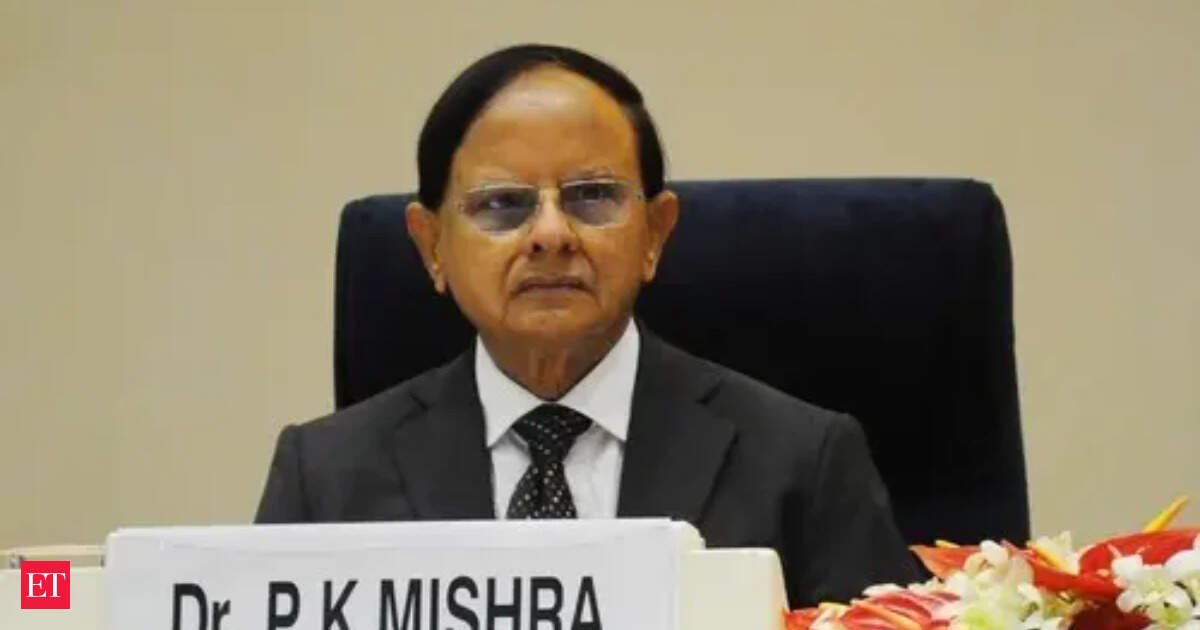
“A digital payment system is not merely technology,” said Mishra. “It is a bridge between informality and formal economic participation, between exclusion and opportunity, and between invisibility and economic identity,” he said, addressing the annual convocation of the National Institute of Bank Management (NIBM) on Saturday.
Mishra said the Unified Payments Interface (UPI) is a prime example of democratisation and that this mass interoperable system generates vital data trails, allowing those without traditional collateral to build credit histories.

Technology is fundamentally changing who can access financial services, he said, adding that credit is an important element of economic activity, livelihood generation, and the wellbeing of citizens. Mishra further noted that integrating finance with digital identity and mobile connectivity has dismantled long-standing barriers to reaching the population at scale.

The JAM Trinity or Jan Dhan, Aadhaar, and Mobile, and the Direct Benefit Transfer (DBT) architecture have transferred more than ₹50 lakh crore while saving ₹4 lakh crore in systemic governance, he said.
Mishra emphasised that financial inclusion must translate into productive economic opportunities and schemes like the Pradhan Mantri Mudra Yojana, which has sanctioned over ₹40 lakh crore so far, and PM SVANidhi and PM Vishwakarma have ensured tailored growth for marginalised artisans, freeing them from exploitative informal credit. “These multifaceted initiatives, firmly anchored by foundational elements like Jan Dhan and Aadhaar, owe their existence to sound policymaking and the exceptionally strong political will of the Prime Minister,” he said.
Mishra further warned that modern financial systems must remain anchored in the real economy to reliably serve MSMEs, farmers, and women-led enterprises, and cautioned that in an era of AI and cyber threats, technological innovation must be balanced with ethical responsibility and public trust.