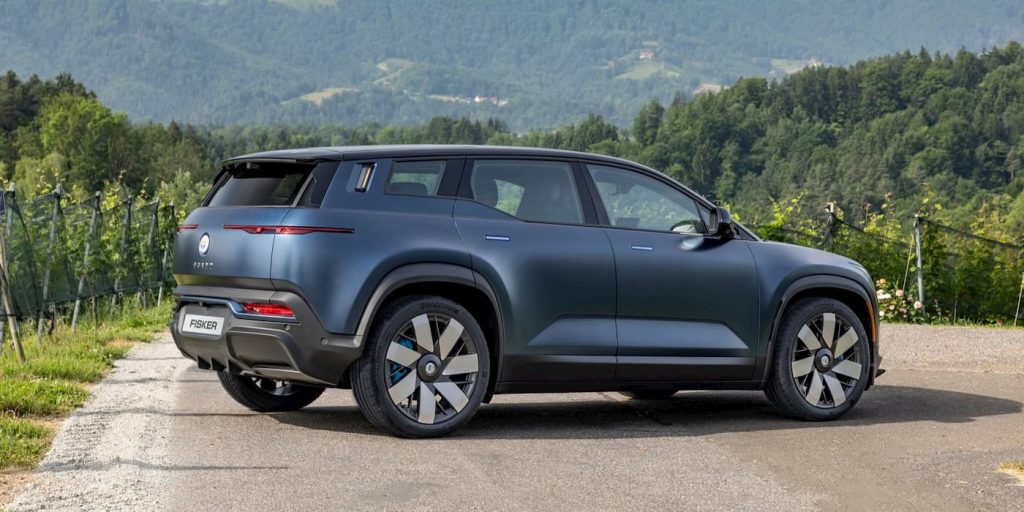
When Fisker Inc. filed for Chapter 11 bankruptcy in June 2024, it left roughly 11,000 Ocean SUV owners holding the keys to vehicles that cost them anywhere from $40,000 to $70,000 — and that were rapidly losing the software brains that made them work. No more over-the-air updates. No more connected services. No more warranty. The manufacturer was dead.
What happened next is one of the most remarkable stories in the history of the electric vehicle industry. Instead of accepting that their cars would become rolling paperweights, Fisker Ocean owners organized, reverse-engineered their vehicles’ proprietary software, hacked into CAN bus networks, built open-source tools on GitHub, and effectively stood up a volunteer-run open-sourced car company from the ashes of Fisker.
From $70,000 SUVs to orphans overnight
The speed of Fisker’s collapse was staggering. The company, once touted as a Tesla rival that had secured over 31,000 Ocean reservations totaling $1.7 billion in potential revenue, produced just 11,000 vehicles before the money ran out. Bankruptcy filings revealed more than $1 billion in debts.
We had reviewed the Ocean in late 2023 and found the hardware genuinely attractive — but the software was simply not ready for prime time. The irony of that headline — “Coming soon, in a future software update” — now reads like an epitaph. Those future updates never came from Fisker. They came from the owners themselves.
The core problem was architectural. Fisker had built what Cory Doctorow, the digital rights author and activist, pointedly called a “software-based car.” Virtually every subsystem in the Ocean — brakes, airbags, shifting, battery management, door locks — needed to periodically connect with Fisker’s cloud servers for diagnostics or regular operations. When those servers went dark, the cars didn’t just lose their infotainment screens. They lost critical functionality.
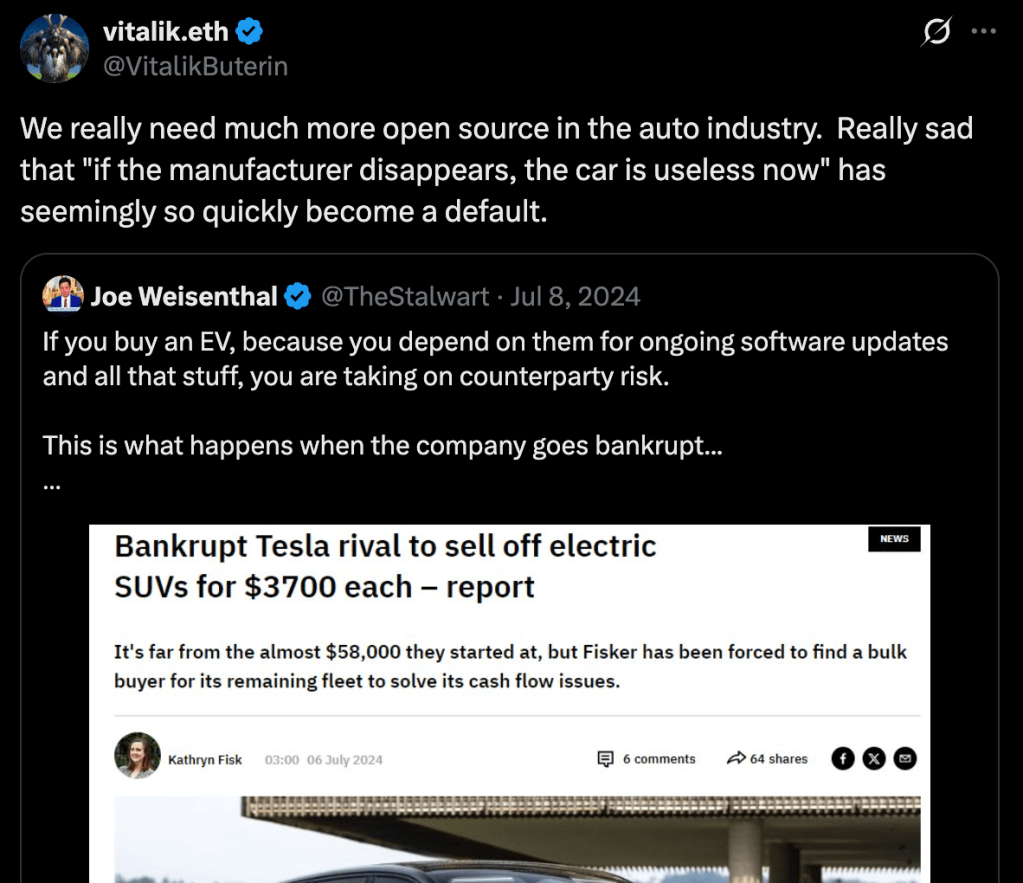
Ethereum co-founder Vitalik Buterin captured the mood on X in July 2024, writing: “We really need much more open source in the auto industry. Really sad that ‘if the manufacturer disappears, the car is useless now’ has seemingly so quickly become a default.”
He was right. But what neither Buterin nor Doctorow could have predicted was what the owners would do about it.
4,000 strangers build a car company
Within months of the bankruptcy filing, thousands of Ocean owners formed the Fisker Owners Association (FOA) — a nonprofit that quickly grew to 4,000 members and began operating as something between a car club, a tech startup, and an independent automaker.
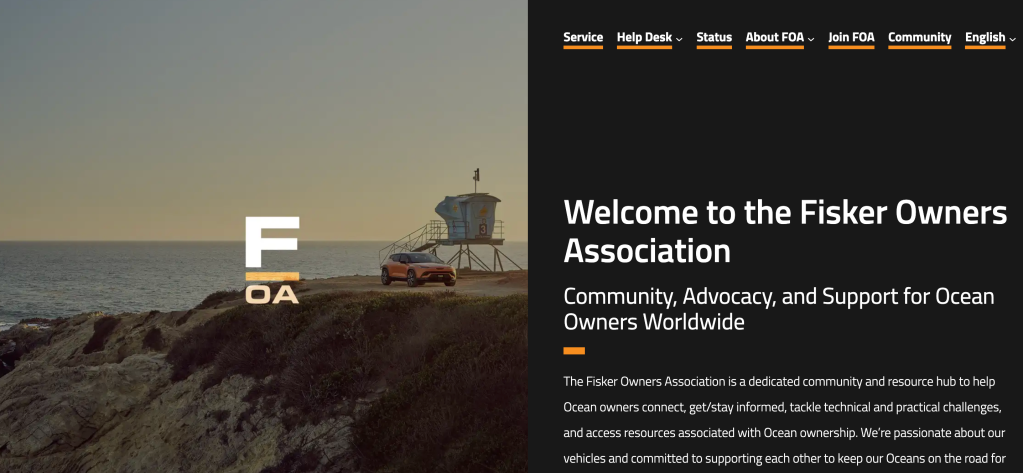
The FOA hired independent tech experts who began reverse-engineering Fisker’s proprietary software patches. Members taught each other how to flash firmware. They organized bulk purchases of replacement parts — negotiating the price of key fobs down from roughly $1,000 each to a fraction of that through coordinated group buys. They hosted free global key fob pairing events, saving each owner $100 to $250.
In Europe, they created what they call the “Flying Doctors” program — a mobile repair network where technically skilled members travel to help other owners keep their vehicles running. In the U.S., the FOA pushed to ensure that safety recalls were included in the bankruptcy proceedings, secured parts supply channels through companies like Tsunami/Tidal Wave, and convinced several insurers to maintain coverage for a vehicle whose manufacturer no longer existed.
As Auto Connected Car News reported in September 2025, the FOA had accomplished something remarkable in just six months: court representation for recalls, new parts pipelines, insurance preservation, and the beginnings of an independent software support ecosystem.
In other words, they were doing the work that Fisker left undone.
The open-source arsenal
The technical work happening beneath the surface is where this story gets truly fascinating. What started as desperate troubleshooting has evolved into a genuine open-source ecosystem around the Fisker Ocean.
On GitHub, a developer named MichaelOE reverse-engineered the API behind Fisker’s official “My Fisker” mobile app and built a Home Assistant integration that exposes every cloud API value as a sensor — with all the app’s buttons available as Home Assistant controls. The project has 135 commits, 20 releases, and is licensed under Apache 2.0. It’s a small but functioning example of what an open-source vehicle interface looks like.
Separately, CAN bus files for the Fisker Ocean have been published on GitHub, including DBC files for CAN viewer filtering and processing. The Ocean runs multiple CAN buses — CCAN, PTCAN, Inverter CAN, and BCAN, all at 500kbps — and community members have been systematically mapping them.
One of the more impressive individual efforts comes from Majd Srour, who published a multi-part series on Medium documenting how to sniff CAN traffic and decode Diagnostic Trouble Codes on the Ocean. The goal: put diagnostic capabilities into mobile apps so owners can run their own DTC scans, instead of relying on dealer tools that no longer exist for a company that no longer exists.
On community forums like CH4RGE and Ocean Forums, there are active discussions about whether it’s even feasible to fully open-source Ocean OS. The consensus is mixed — the core automotive software was developed by Magna and other suppliers, which means safety-critical systems can’t simply be forked like a web application. But the infotainment layer, connectivity stack, and diagnostics are all fair game, and that’s where the community has focused its energy.
The $2.5 million handshake that fell apart
The community’s path hasn’t been smooth. In October 2024, when Fisker’s remaining inventory was sold to a company called American Lease, the deal included access to Fisker’s proprietary source code and cloud services. American Lease spent an extra $2.5 million to acquire that software access and agreed to extend connected services to private Ocean owners through a deal with the FOA.
There was just one problem: the deal was never formally signed. It was based on a handshake.
The relationship collapsed when American Lease asked the FOA to cover 58% of all operational costs — LTE connectivity, Microsoft Cloud services, and software tools. The FOA wanted itemized invoices so members would know exactly what they were paying for. American Lease refused. The result was devastating: Ocean owners had their remote connectivity revoked, cloud features were cut, and a pending software recall was blocked.
Why this will happen again
The Fisker Ocean saga is not an isolated incident. Nikola also filed for bankruptcy, leaving its owners in a similar bind. Canoo and Arrival are headed for liquidation auctions. Analysts expect more EV startups to follow as the industry consolidates and investor enthusiasm for capital-intensive manufacturing cools.
Consumer advocates are now pushing for structural changes: mandatory software escrow funds that would keep vehicle software running even if the manufacturer disappears, open-source mandates in bankruptcy proceedings, and shared repair data requirements. Oregon’s Right to Repair bill already bans the “parts pairing” that makes independent repair of vehicles like the Ocean so difficult. European automakers, meanwhile, are moving in a different direction entirely — Volkswagen, BMW, Mercedes-Benz, and eight suppliers signed a memorandum in 2025 to develop a shared open-source automotive software platform.
The question isn’t whether more EV companies will fail. They will. It’s inevitable. The question is whether we’ll have systems in place to prevent tens of thousands of functional vehicles from becoming e-waste when they do.
Electrek’s Take
There’s something deeply admirable about what Fisker Ocean owners have accomplished — and something deeply broken about the system that forced them to do it.
We watched Fisker’s trajectory from the beginning, from the impressive reservations to the bankruptcy filing to the slow realization that these cars might simply stop working. The fact that 4,000 owners organized themselves into what amounts to a volunteer car company — reverse-engineering firmware, mapping CAN buses, building Home Assistant integrations, running mobile repair programs across Europe — is both inspiring and a damning indictment of how the modern auto industry treats software.
Vitalik Buterin and Cory Doctorow are right that the auto industry needs more open-source thinking. But the Fisker story shows something more specific: the industry needs mandatory software escrow and open-source fallback provisions for any vehicle that depends on cloud connectivity to function. If a manufacturer dies, the software should be released to the public. Period.
The Fisker Owners Association has proven that a dedicated community can keep orphaned EVs on the road. But they shouldn’t have had to. The next time an EV startup goes under — and there will be a next time — the owners shouldn’t need to become hackers and parts brokers and quasi-manufacturers just to keep driving the cars they already paid for.


FTC: We use income earning auto affiliate links. More.