

The most mysterious and yet ubiquitous stuff in the cosmos, dark matter is effectively invisible. This is simply because it doesn’t interact with light. But what if instead of trying to see dark matter, scientists attempted to hear it instead?
New research suggests dark matter could leave a tiny but discernible imprint in the cacophony of ripples in spacetime called “gravitational waves” that ring through the cosmos when two black holes slam together and merge. However, this is only if spinning black holes can “churn” dark matter like cosmic butter. (We’ll get to that shortly.)
Fortunately, when it comes to detecting gravitational waves from colliding black holes, humanity’s instruments, such as LIGO (Laser Interferometer Gravitational-Wave Observatory), are getting more and more sensitive all the time. And in preparation for a time when such imprints could become even more easily logged in gravitational wave data, this team developed a method that predicts just what shape a gravitational wave should take when moving through dark matter, rather than empty space.
“Using black holes to look for dark matter would be fantastic,” team member Rodrigo Vicente, a researcher at GRAPPA (Gravitation Astroparticle Physics Amsterdam), said in a statement. “We would be able to probe dark matter at scales much smaller than ever before.”
I can’t believe it’s not butter
Dark matter represents such a puzzle because, despite being invisible to us, it still “outweighs” ordinary matter by a ratio of about five to one.
Its lack of interaction with light means it can’t be composed of protons, neutrons and electrons — the particles that compose atoms. That’s because atoms compose all the “ordinary matter” we see around us, from stars and planets to the device you’re reading this article on and our own bodies. In other words, atoms do interact with light (more technically, electromagnetic radiation). In fact, the only way astronomers know dark matter exists is via its interaction with gravity and the way this interaction curves spacetime, indirectly influencing ordinary matter and light.
With this knowledge, scientists have been hunting for particles outside the Standard Model of particle physics that could account for dark matter. These particles have a wide range of potential masses and properties, with one hypothetical particle being the “light scalar” proposed to have a mass much smaller than that of an electron. One characteristic of the light scalar would be the fact that dark matter composed of these particles would act like coordinated waves around black holes.
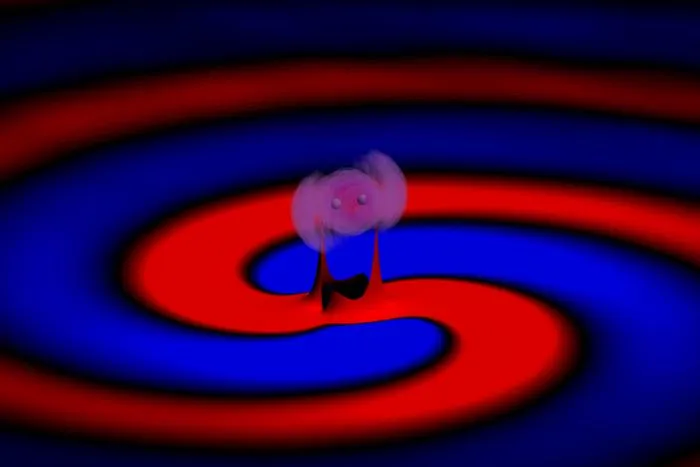
Around a spinning black hole, rotational energy would be transferred to light scalar dark matter, amplifying its density, almost like a paddle churning cream into butter. If this dark matter “butter” gets dense enough, it could affect gravitational waves from merging black holes, leaving a telltale imprint.
After determining what this signature would look like, Vicente and colleagues searched through data gathered by LIGO and its fellow gravitational wave detectors, KAGRA (Kamioka Gravitational Wave Detector) and Virgo, focusing on 28 of the clearest signals from merging black holes. Of these, 27 appeared to have come from mergers that occurred in the relative vacuum of space. One signal, however, GW190728, first heard on July 19, 2019, and the result of merging binary black holes with a combined mass of 20 times that of the sun and located an estimated 8 billion light-years away, seemed to carry the telltale trace of this merger occurring in a region of dense, “buttery” dark matter.
The team behind this research is quick to point out that this can’t be considered a positive detection of dark matter, but does say it gives us a hint at what to look for and thus where to direct follow-up investigations — something that could be increasingly useful as dark matter detectors on Earth continue into their fifth operating run with boosted sensitivity.
“We know that dark matter is around us. It just has to be dense enough for us to see its effects,” said team leader Josu Aurrekoetxea, of the Massachusetts Institute of Technology (MIT) Department of Physics. “Black holes provide a mechanism to enhance this density, which we can now search for by analyzing the gravitational waves emitted when they merge.”
The team’s results were published on Tuesday (May 12) in the journal Physical Review Letters.