

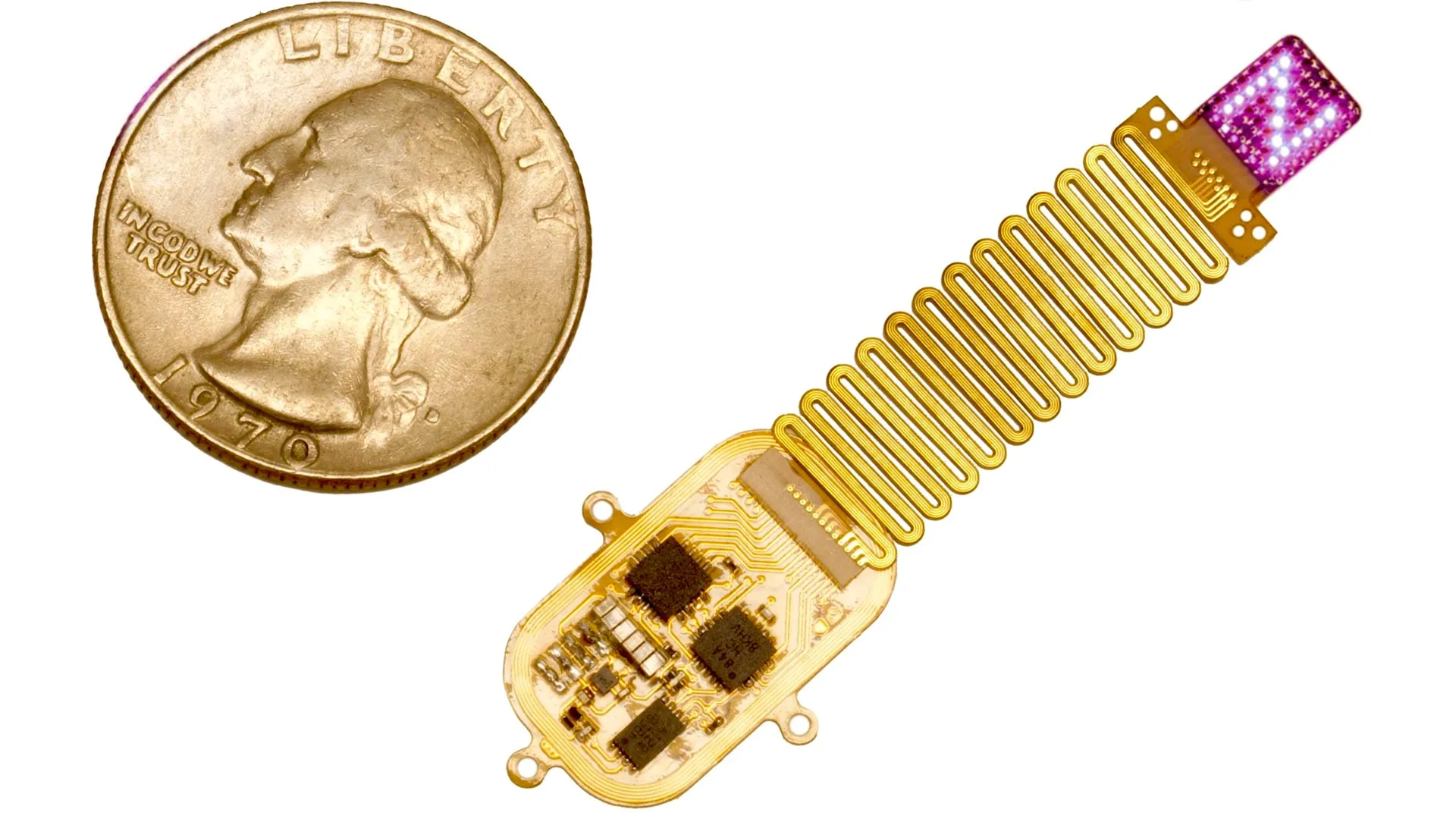
In a major step forward for neurobiology and bioelectronics, scientists at Northwestern University have created a wireless device that uses light to transmit information directly into the brain. The technology bypasses traditional sensory routes in the body and instead delivers signals straight to neurons.
The device is soft and flexible, fitting beneath the scalp while resting on the skull. From this position, it sends carefully controlled light patterns through the bone to activate specific groups of neurons across the cortex.
Light-Based Brain Signals in Animal Models
During testing, researchers used tiny, precisely timed bursts of light to stimulate targeted populations of neurons deep in the brains of mouse models. (These neurons are genetically modified to respond to light.) The mice quickly learned to interpret certain patterns as meaningful cues. Even without sound, sight or touch, the animals used the incoming information to make decisions and complete behavioral tasks accurately.
This technology could one day support a wide range of medical applications. Potential uses include providing sensory feedback for prosthetic limbs, delivering artificial inputs for future hearing or vision prostheses, controlling robotic limbs, improving rehabilitation after injury or stroke, and modifying pain perception without medications.
The work will appear Monday (Dec. 8) in Nature Neuroscience.
Creating New Brain Signals With Micro-LED Technology
“Our brains are constantly turning electrical activity into experiences, and this technology gives us a way to tap into that process directly,” said Northwestern neurobiologist Yevgenia Kozorovitskiy, who led the experimental portion of the study. “This platform lets us create entirely new signals and see how the brain learns to use them. It brings us just a little bit closer to restoring lost senses after injuries or disease while offering a window into the basic principles that allow us to perceive the world.”
John A. Rogers, a leading figure in bioelectronics and head of the technology development, said, “Developing this device required rethinking how to deliver patterned stimulation to the brain in a format that is both minimally invasive and fully implantable. By integrating a soft, conformable array of micro-LEDs — each as small as a single strand of human hair — with a wirelessly powered control module, we created a system that can be programmed in real time while remaining completely beneath the skin, without any measurable effect on natural behaviors of the animals. It represents a significant step forward in building devices that can interface with the brain without the need for burdensome wires or bulky external hardware. It’s valuable both in the immediate term for basic neuroscience research and in the longer term for addressing health challenges in humans.”
Kozorovitskiy is the Irving M. Klotz Professor of Neurobiology in Northwestern’s Weinberg College of Arts and Sciences and a member of the Chemistry of Life Processes Institute. Rogers holds appointments in materials science and engineering, biomedical engineering and neurological surgery, and directs the Querrey Simpson Institute for Bioelectronics. The study’s first author is postdoctoral researcher Mingzheng Wu.
Advancing Earlier Optogenetics Breakthroughs
The research builds on earlier work from the same team. In 2021, they reported the first fully implantable, programmable, wireless and battery-free device that could control neurons with light. That system used a single micro-LED probe to influence social behavior in mice. Unlike traditional optogenetics, which relied on fiberoptic wires that restricted movement, the wireless design allowed mice to behave normally in social environments.
The new device extends this capability by enabling more complex communication with the brain. Instead of stimulating one small region, the updated system uses an array of up to 64 programmable micro-LEDs. Each light can be controlled independently in real time, allowing researchers to deliver sequences that resemble the distributed activity patterns the brain naturally produces during sensory experiences. Because real sensations activate broad networks rather than isolated neurons, this multi-site approach mirrors how the cortex normally functions.
“In the first paper, we used a single micro-LED,” Wu said. “Now we’re using an array of 64 micro-LEDs to control the pattern of cortical activity. The number of patterns we can generate with various combinations of LEDs — frequency, intensity and temporal sequence — is nearly infinite.”
A Soft, Less Invasive Design
Despite the added capability, the device remains small. It is about the size of a postage stamp and thinner than a credit card. Instead of inserting a probe into the brain, the new version gently conforms to the skull surface and shines light through the bone.
“Red light penetrates tissues quite well,” Kozorovitskiy said. “It reaches deep enough to activate neurons through the skull.”
Training the Brain to Recognize Synthetic Patterns
To evaluate the system, the team worked with mice engineered to have light-responsive neurons in the cortex. The animals were trained to associate a particular pattern of stimulation with a reward, usually located at a specific port within a testing chamber.
During a series of experiments, the implant delivered a defined pattern across four cortical regions, which functioned like tapping a coded message directly into the brain. The mice learned to identify this target pattern among many alternatives. When they detected the correct artificial signal, they navigated to the appropriate port to receive a reward.
“By consistently selecting the correct port, the animal showed that it received the message,” Wu said. “They can’t use language to tell us what they sense, so they communicate through their behavior.”
Future Development and Wider Applications
Now that the team has demonstrated that the brain can interpret patterned light stimulation as meaningful information, they plan to test more sophisticated patterns and determine how many distinct signals the brain can reliably learn. Future versions of the device may incorporate more LEDs, smaller spacing between them, larger arrays covering more cortex and wavelengths of light that penetrate deeper into tissue.
The study, “Patterned wireless transcranial optogenetics generates artificial perception,” received support from the Querrey Simpson Institute for Bioelectronics, NINDS/BRAIN Initiative, National Institute of Mental Health, One Mind Nick LeDeit Rising Star Research Award, Kavli Exploration Award, Shaw Family Pioneer Award, Simons Foundation, Alfred P. Sloan Foundation and Christina Enroth-Cugell and David Cugell Fellowship.