

Scientists have uncovered a new driver of aridification, potentially reshaping how drought across the globe is understood.
A new study published Wednesday in Nature by a pair of researchers from Dartmouth College and the Université du Québec à Montréal shows that changing precipitation concentrations exert an important influence over landscape moisture retention. When an area receives its annual moisture in a small number of large, wet storms, it can overwhelm the soils, creating pools of water on the land surface. These exposed pools are more prone to evaporation, meaning water that would otherwise reach streams, rivers and dams drifts back into the atmosphere.
When paired with long dry spells, these storms dry out landscapes, even though total precipitation hasn’t necessarily changed, the researchers found.
“If you’re asking the land to drink from a fire hose, whether that’s through highly concentrated precipitation falling from the sky or rapid snowmelt, you’re going to lose water,” said Justin Mankin, an associate professor of geography at Dartmouth and the study’s senior author. “It is just a feature of the world that as you concentrate rainfall, less of it goes into the land.”
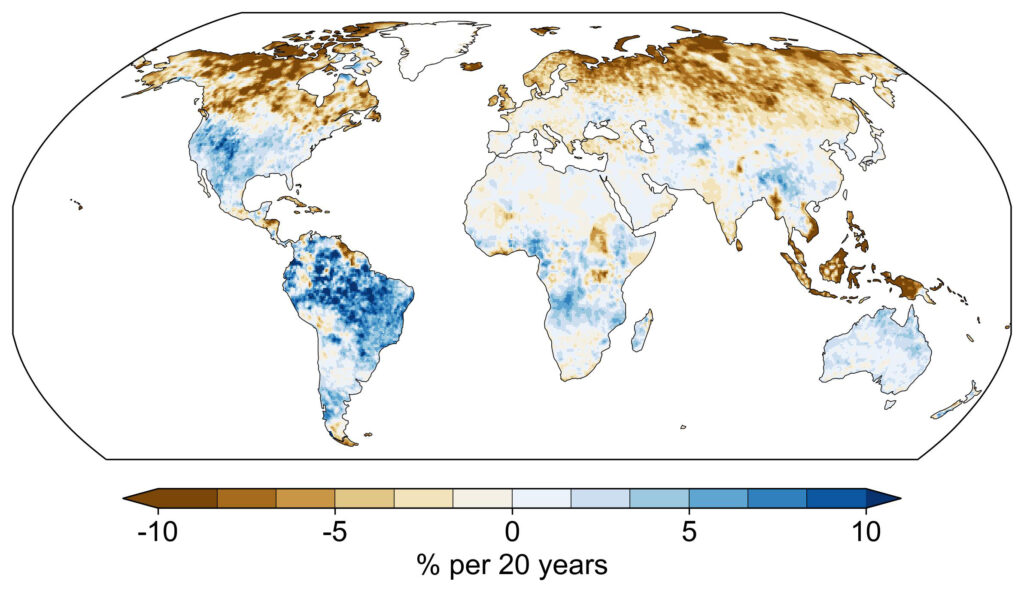
Using several precipitation datasets, Mankin and his co-author, Corey Lesk, a professor of Earth and atmospheric sciences at the Université du Québec à Montréal, determined where on Earth annual moisture was concentrating, and where yearly rain and snow totals were spreading out across the calendar.
“There’s really maybe two hotspots that have the strongest consolidation trends since 1980,” Lesk said. “One is the Amazon and adjacent regions, too, it’s a huge hotspot.”
“But the other hotspot is pretty much right over Wyoming [and] Colorado,” he added.
River basins across the American West have been drying out under a “megadrought” that has gripped the region for the better part of the 21st century, forcing Western states to cut back their water use and renegotiate—with considerable acrimony—the dwindling resource. Mankin and Lesk’s new paper adds to a growing body of science laying out the perils changing moisture cycles pose to river basins, where users are accustomed to receiving a set amount of water at a predictable time.
“The methods represent a strong combination of direct observations and tests of the relationships using computer simulations,” said Bryan Shuman, a paleoclimatology professor at the University of Wyoming who was not involved with the study. “These are not patterns that can be dismissed as untrustworthy computer predictions. They show that this pattern has been happening and can be observed.”
Shuman, who has previously studied precipitation concentration, said the dynamics outlined in Mankin and Lesk’s paper paint a sobering picture for the West’s climate.
“The challenges raised here highlight how the future could involve both dangerous flooding but that that can come along with much worse droughts than in the past,” he said. “Simply put, we could receive the same amount of rain and still experience drought.”
As the American West staggers out from its worst winter on record, there is a chance the coming El Niño cycle, where warmer water in the Pacific Ocean can increase temperatures and precipitation in the West, brings concentrated levels of precipitation, along with the potential drying Mankin and Lesk describe in their research.
While this is far from guaranteed, the relationship between precipitation delivery and drought risk is one Mankin hopes to explore in future research.
Since the early 20th century, the American West has blossomed on the vines of federal and state dams and canals meant to impound and transport water from where it flowed naturally to where it is useful for cities, farms and industries.
But this century-old infrastructure and the economies it enables could be “potentially maladapted to this rapidly changing climate,” Mankin said, in which the same amount of moisture packed into in a few heavy storms yields less water.
Moisture consolidation, which Mankin and Lesk believe is a logical result of a warming atmosphere, is “actually a new mode of volatility, a new way in which precipitation and the water cycle in a warmer climate is harder to predict and harder to manage,” Lesk added.
“It’s not just more of the same that the West has always dealt with.”
About This Story
Perhaps you noticed: This story, like all the news we publish, is free to read. That’s because Inside Climate News is a 501c3 nonprofit organization. We do not charge a subscription fee, lock our news behind a paywall, or clutter our website with ads. We make our news on climate and the environment freely available to you and anyone who wants it.
That’s not all. We also share our news for free with scores of other media organizations around the country. Many of them can’t afford to do environmental journalism of their own. We’ve built bureaus from coast to coast to report local stories, collaborate with local newsrooms and co-publish articles so that this vital work is shared as widely as possible.
Two of us launched ICN in 2007. Six years later we earned a Pulitzer Prize for National Reporting, and now we run the oldest and largest dedicated climate newsroom in the nation. We tell the story in all its complexity. We hold polluters accountable. We expose environmental injustice. We debunk misinformation. We scrutinize solutions and inspire action.
Donations from readers like you fund every aspect of what we do. If you don’t already, will you support our ongoing work, our reporting on the biggest crisis facing our planet, and help us reach even more readers in more places?
Please take a moment to make a tax-deductible donation. Every one of them makes a difference.
Thank you,

Reporter, Wyoming and the West
Jake Bolster reports on Wyoming and the West for Inside Climate News. Previously, he worked as a freelancer, covering climate change, energy, and the environment across the United States. He holds a Masters in Journalism from Columbia University.