

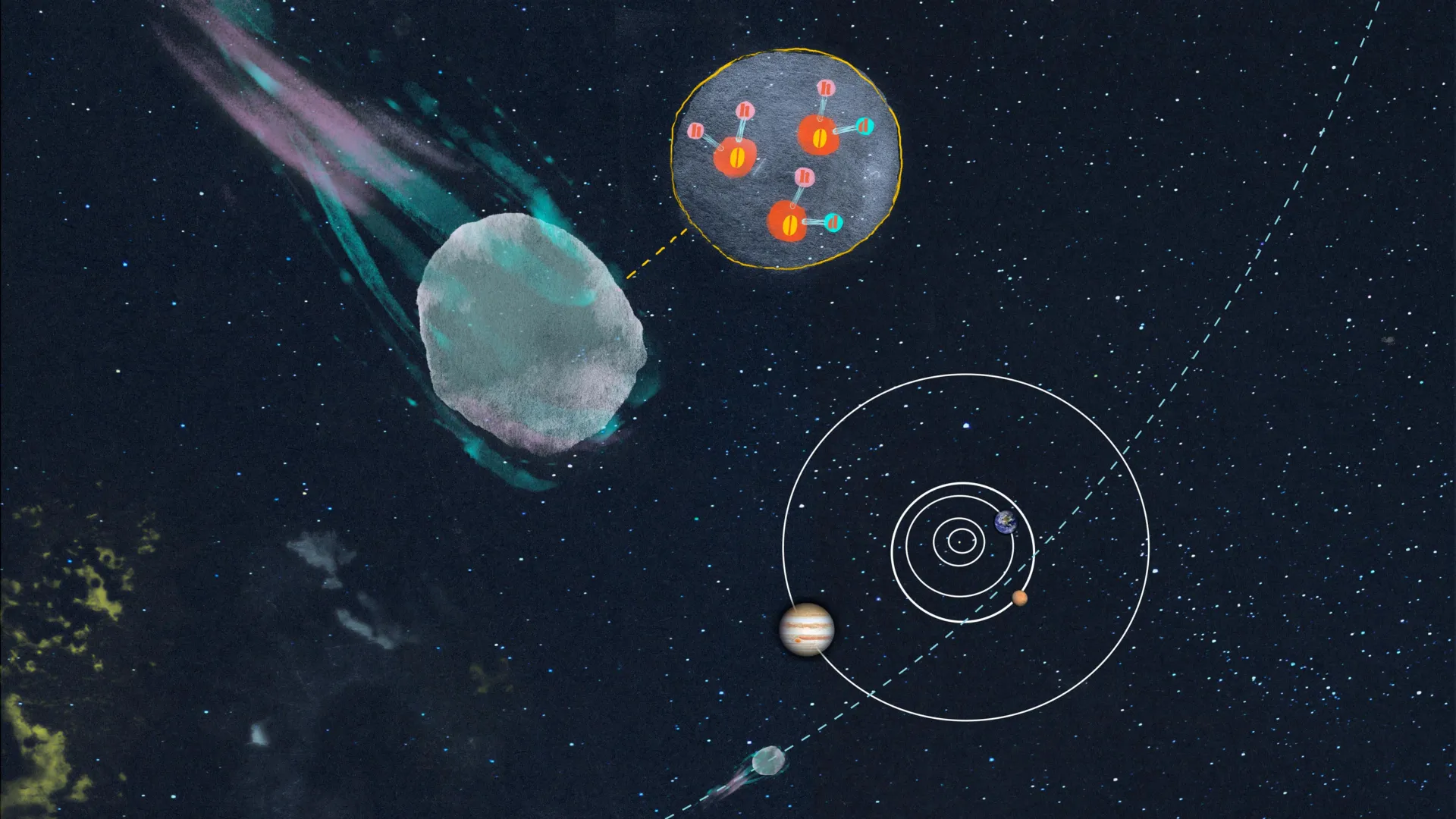
Less than a year ago, astronomers spotted a comet passing through our solar system that originated far beyond it. The object, known as 3I/ATLAS, is only the third confirmed interstellar visitor ever detected, and scientists are now uncovering clues about the alien environment where it formed.
A new study led by researchers at the University of Michigan suggests the comet was born in conditions far colder than those that shaped our own solar system. The findings come from an analysis of the comet’s unusual water composition, which revealed extraordinarily high levels of deuterium, a heavier form of hydrogen.
The research was published in the journal Nature Astronomy and received support from NASA, the U.S. National Science Foundation and Chile’s National Research and Development Agency.
“Our new observations show that the conditions that led to the formation of our solar system are much different from how planetary systems evolved in different parts of our galaxy,” said Luis Salazar Manzano, lead author of the study and a doctoral student in the U-M Department of Astronomy.
Alien Comet Contains Unusual “Heavy Water”
Water molecules are made up of two hydrogen atoms and one oxygen atom, giving water its familiar H2O formula. In ordinary water, hydrogen atoms contain only a proton. But some forms of water contain deuterium, an isotope of hydrogen that includes both a proton and a neutron.
Researchers discovered that 3I/ATLAS contains an exceptionally high amount of this deuterium-rich water. While small amounts of heavy water exist on Earth and in comets within our solar system, the levels found in 3I/ATLAS were dramatically higher.
“The amount of deuterium with respect to ordinary hydrogen in water is higher than anything we’ve seen before in other planetary systems and planetary comets,” Salazar Manzano said.
According to the researchers, the deuterium ratio in the comet was about 30 times higher than what has been measured in comets from our solar system and roughly 40 times higher than the ratio found in Earth’s oceans.
Clues About a Frozen Birthplace
Scientists use deuterium levels as a kind of chemical fingerprint that reveals the conditions present when celestial objects formed. By comparing these ratios with those found closer to home, researchers can infer what kind of environment produced the comet.
The team concluded that 3I/ATLAS likely formed in a much colder region with lower radiation levels than the environment that created the planets and comets in our solar system.
“This is proof that whatever the conditions were that led to the creation of our solar system are not ubiquitous throughout space,” said Teresa Paneque-Carreño, co-leader of the study and assistant professor of astronomy at U-M. “That may sound obvious, but it’s one of those things that you need to prove.”
How Scientists Studied 3I/ATLAS
The researchers said the study was only possible because astronomers detected 3I/ATLAS early enough for detailed follow-up observations.
After the discovery, Salazar Manzano and collaborators secured observing time at the MDM Observatory in Arizona, where they detected some of the first signs of gas emissions from the comet (MDM stands for Michigan, Dartmouth and the Massachusetts Institute of Technology, the observatory’s original partners).
Salazar Manzano then teamed up with Paneque-Carreño, who brought expertise using the Atacama Large Millimeter/submillimeter Array, or ALMA, in Chile. ALMA’s instruments are sensitive enough to distinguish deuterated water from ordinary water, allowing the team to precisely measure the ratio between the two.
The researchers say this marks the first time scientists have successfully performed this type of water analysis on an interstellar object.
“Being at the University of Michigan and having access to these facilities was the key to making this work possible,” Salazar Manzano said. “We were part of a team that was very talented and very experienced in multiple areas, all of us complemented each other and that’s what allowed us to analyze and interpret these data sets.”
More Interstellar Visitors Could Be Found
The study also demonstrates that astronomers may soon be able to chemically analyze additional interstellar objects to better understand how planetary systems form across the galaxy.
So far, scientists have identified only three known interstellar objects entering our solar system, but researchers expect that number to rise as more advanced observatories begin searching the skies.
Paneque-Carreño emphasized that preserving dark night skies will be essential for spotting these faint visitors.
“We need to be taking care of our night skies and keeping them clear and dark so we can detect these tiny and faint objects,” she said.
Additional support for the research came from the Michigan Society of Fellows and the Heising-Simons Foundation. ALMA is operated through a partnership involving the European Southern Observatory, the NSF and Japan’s National Institutes of Nature Sciences in cooperation with the Republic of Chile.