





The story so far:
Nine days after nearly 22 lakh medical aspirants wrote the National Eligibility cum Entrance Test (NEET), which paves the way for admission to medical colleges, they were in for a rude shock. On May 12, the National Testing Agency (NTA) stated that the exam had been ‘compromised,’ and that there would be a re-test.
The decision has created a furore among students across the country, with the Federation of All India Medical Association (FAIMA) moving the Supreme Court with a plea to either replace NTA or conduct major restructuring reforms.
What controversies has NEET faced over the years?
The decision to conduct re-examination for nearly 22 lakh students is unprecedented in NEET’s history, but concerns over paper leaks are not new. In 2024, the declaration of the NEET-UG results coincided with the announcement of national election results. For the first time, 67 out of the top 100 scorers received full marks. In comparison, only two students achieved full marks in 2023, while none did so in 2022. A high concentration of students achieving full marks led to massive rank inflation, with multiple aspirants who had scored high marks competing for a single seat in reputed medical colleges.
In 2024, 13 lakh students qualified and were competing for approximately 1.1 lakh MBBS seats across government and private medical colleges. Allegations of a paper leak later surfaced, with investigations revealing that 155 students had allegedly benefited from leaked question papers. Students had then demanded a re-examination, but their request fell on deaf ears.
Why has NTA’s ‘Zero Error’ promise fallen short?
With repeated cases of paper leaks surfacing year after year, the NTA appears not to have learnt from its chequered past. The overhaul of NTA merely remained lip service. After the 2024 debacle, IAS officer Subodh Kumar Singh, then Director General of the NTA, was removed from the post and transferred to the Ministry of Steel as Additional Secretary. He is currently serving as Principal Secretary to the Chief Minister of Chhattisgarh.
Following his transfer, the NTA remained without a full-time chief for over a year, with retired 1985-batch IAS officer Pradeep Singh Kharola holding ‘additional interim charge’. In March this year, former IndiaAI Mission CEO Abhishek Singh took charge of NTA and declared that there would be a ‘Zero Error, Zero Tolerance’ policy.
After the NEET-UG 2026 examination was conducted on May 3, the NTA underscored on social media the “smooth manner” in which the exam had been held across 5,432 centres, with 22.79 lakh candidates appearing. It stated that more than two lakh personnel were involved in conducting the examination.
The agency also claimed that there was end-to-end secure handling of confidential materials under sealed protocols, GPS-enabled vehicles with police escorts for the movement of examination material, CCTV surveillance at all examination centres (up to 1,50,000), with feeds linked to centralised control rooms, mandatory frisking through high-sensitivity metal detectors before entry, with strengthened manpower and equipment at every centre, Aadhaar-based biometric authentication to prevent impersonation and real-time monitoring through centralised control systems.
Mr. Abhishek Singh told The Hindu that the NTA had blocked 120 Telegram channels for circulating fake question papers and rumours, aimed at defrauding candidates.
Despite these measures, investigations by the Rajasthan Police revealed that a “guess paper” containing 120 out of 410 questions from the final examination had allegedly been circulating for nearly a month before the exam, a massive oversight by the NTA.
What did the Radhakrishnan panel recommend?
Following the NEET-UG 2024 controversy, the Ministry of Education formed a high-level committee headed by former ISRO chairman K. Radhakrishnan. However, the committee’s recommendations were not followed in letter and spirit by either the NTA or the Ministry.
The report, submitted in October 2024, highlighted the pen-and-paper testing (PPT) model as ‘a major security risk.’ It recommended a transition to Computer-Based Testing (CBT) format, similar to the Joint Entrance Examination (JEE) Main, which is also conducted by NTA. JEE Main sees participation of 13 to 15 lakh students annually and is conducted over four to five days.
The committee also recommended Computer-assisted Secure PPT, where encrypted papers are delivered digitally to exam centres and printed locally just before the test. This eliminates the vulnerable printing-and-transit leg. NTA has made no claim of implementing it. Instead, it relied on GPS vehicles and police escorts.
Mr. Abhishek Singh said that the NTA has the capacity to conduct CBT tests for only about 1.5 lakh students in a day. He added that shifting NEET to CBT mode is a ‘high-level ministry call’ involving both the Ministries of Health and Education.
In 2024, the NTA floated a tender to increase its capacity of computer labs, but the process could not be finalised. In 2026, the NTA has around 552 CBT centres, which are primarily used for JEE and CUET examinations. Since the Radhakrishnan Committee report came out in 2024, the NTA has not been able to augment its infrastructure to add more centres.
Multiple proposals to administer NEET-UG exams online were sent to the Ministry of Education, but in vain, officials at the NTA told The Hindu. “Talks for administering the NEET-UG in CBT mode, have been ongoing for at least five years now. The recent paper leak fiasco should serve as an eye-opener to change the format of the exams,” an official said.
The Ministry of Education has yet again handed over the probe to the Central Bureau of Investigation, as it had earlier in 2024 too. What came out of the earlier probe into the NEET 2024 leak case?
The Central Bureau of Investigation (CBI) filed chargesheets against 45 accused in the NEET-UG 2024 paper leak case between August and November 2024 before a special court for CBI cases in Patna. Candidates who allegedly benefited from the paper leak, along with impersonators, were shared with the Ministry of Education and NTA.
Initial reports stated that 36 arrests were made in connection with the case. However, there is no information on the status of the arrests and accused after the final chargesheet in November 2024.
With the CBI investigating the NEET-UG 2026 leak, the last official update in the 2024 case continues to state that “investigations are ongoing.”
What is the human cost of conducting a re-test on such a massive scale where the future of nearly 22.79 lakh aspirants is at stake?
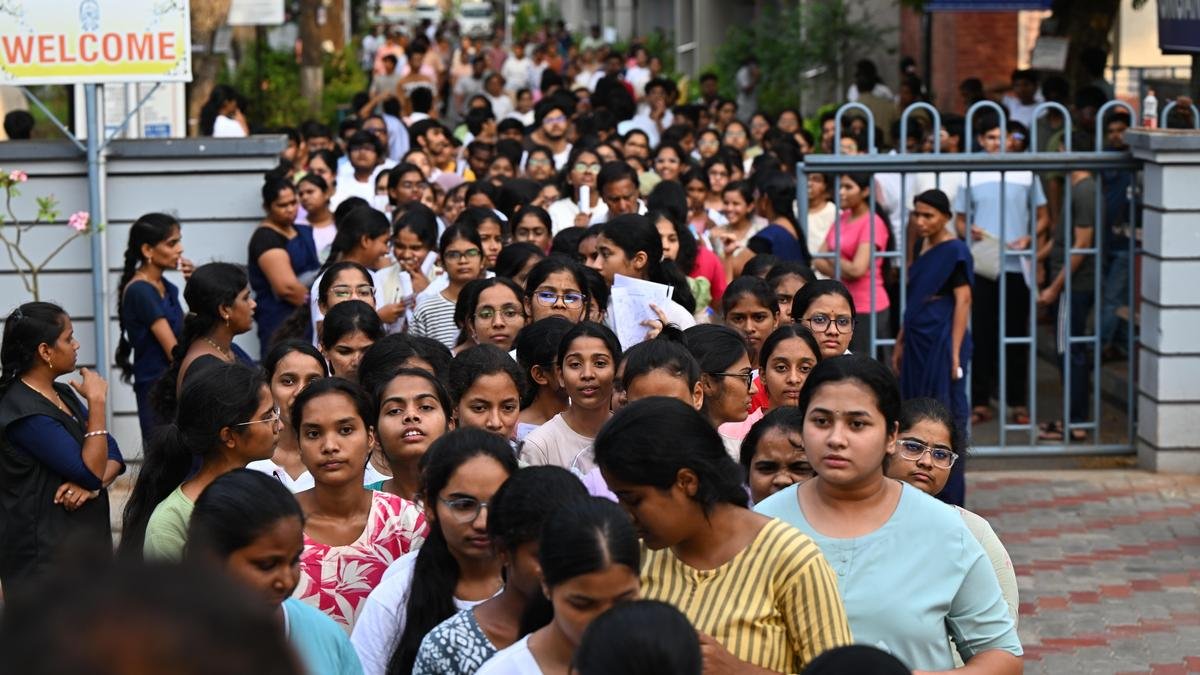
The cancellation of the NEET-UG examination and the uncertainty surrounding fresh exam dates have caused distress to aspirants across India. Many students point out that this is the second such instance in two years.
Several students who had performed well in the examination are disheartened by the new developments. Vamika, a student from Delhi, told agencies that although her projected score was good, she was uncertain about how she would perform in the re-test. “The constant studying and pressure eventually get to you,” she said.
Published – May 14, 2026 08:30 am IST


