







It’s only been a month since NASA’s Artemis 2 astronauts splashed down in the Pacific Ocean to wrap up their 10-mission around the moon, and the space agency is already readying the rocket for the next Artemis program test flight.
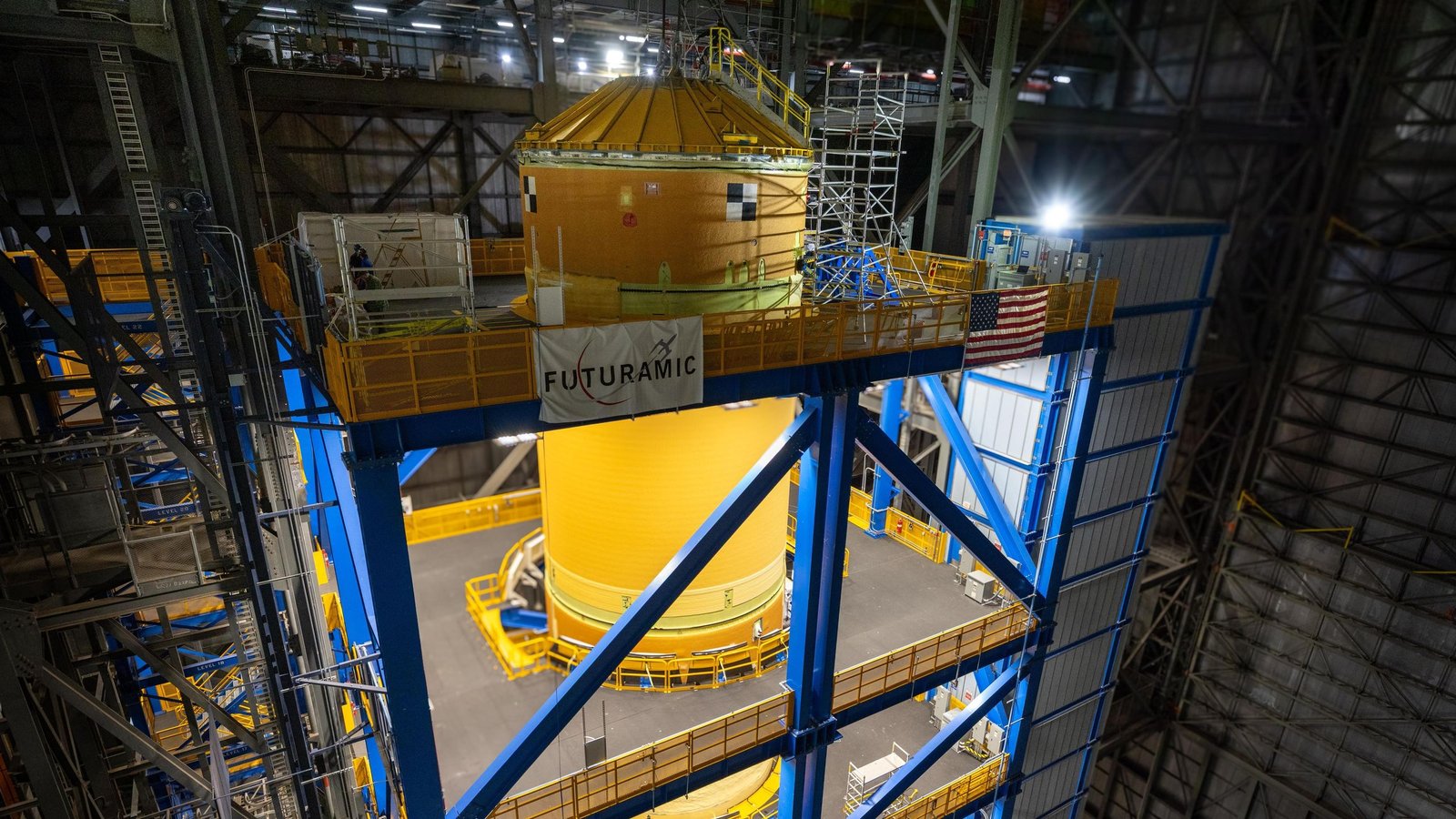
The first stage of the Artemis 3 Space Launch System (SLS) rocket is now vertical inside NASA’s cavernous Vehicle Assembly Building (VAB) at the Kennedy Space Center (KSC) in Florida, where it awaits integration with its engine section, NASA announced in an X post on Sunday (May 10).
“Technicians at @nasakennedy have completed operations of lifting the largest section of the core stage for NASA’s Artemis III SLS rocket into High Bay 2,” the post said. Once the launch vehicle’s four RS-25 engines are attached, the stage will be transferred to the VAB’s taller High Bay 3, where engineers will mate the remaining sections of SLS and the Orion spacecraft ahead of a launch date currently targeted for the latter half of next year.
The core stage of Artemis 3’s SLS rocket is 212 feet tall (65 meters) and houses the four main RS-25 engines used to launch it into space. When fully assembled with its upper stage, Orion spacecraft and twin solid rocket boosters, the SLS rocket will stand 322 feet tall (98 meters) and weigh 5.75 million pounds (2.6 million kilograms) when fully fueled.
NASA’s Artemis program aims to fly regular astronaut missions to the moon beginning in 2028, and eventually build a permanent base at the lunar south pole by the early 2030s.
Artemis 2 launched to the moon on April 1, and flew NASA astronauts Reid Wiseman, Victor Glover and Christina Koch, as well as Canadian Space Agency astronaut Jeremy Hansen on a lunar flyby. The mission also served as Orion’s first crewed spaceflight. Now that Orion has proven itself with astronauts onboard, its next mission — Artemis 3 — will stay in Earth’s orbit on a test flight for Orion and one or both of NASA’s Artemis moon landers..
There’s nothing better than seeing an SLS rocket stage vertical! 🏗️Technicians at @nasakennedy have completed operations of lifting the largest section of the core stage for NASA’s Artemis III SLS rocket into High Bay 2, where it will be connected to the engine section.Learn… pic.twitter.com/qCEtIS7lirMay 10, 2026
Artemis 3 was initially slated as the Artemis program’s first crewed lunar landing, but delays in the development timelines for the landers selected through NASA’s Human Landing System contracts, SpaceX‘s Starship vehicle and Blue Origin‘s Blue Moon lander, prompted NASA to rethink the Artemis mission architecture.
Now, to ensure the landers meet all the qualifications needed to safely deliver astronauts to the lunar surface, the next Artemis mission will forgo a flight to the moon altogether. Artemis 3 astronauts will launch aboard Orion to Earth orbit, where they will rendezvous with either or both Starship and Blue Moon to practice proximity and docking maneuvers. NASA has indicated that Artemis 3 will fly with whichever landers are ready when it comes time to launch the mission.
If they can do that successfully, and also demonstrate uncrewed lunar touchdowns, NASA plans to launch Artemis 4 in 2028 as the program’s first crewed moon landing. Starship is currently the lander contracted for that mission, but the readiness and performance of both landers during Artemis 3 could possibly change that arrangement if Blue Moon completes its qualification testing first.
It took about a year for components of the Artemis 2 SLS to arrive and undergo stacking inside the VAB before the rocket was fully assembled, though the same progress for Artemis 3 will be dependent on the production and testing status of the vehicle’s various stages. If all goes according to plan and at least one of the mission’s moon landers is ready, NASA hopes to launch Artemis 3 sometime in late 2027.


